Archive for the ‘Business’ Category
I Trust the BBC Much More than Any Other Media Outlet
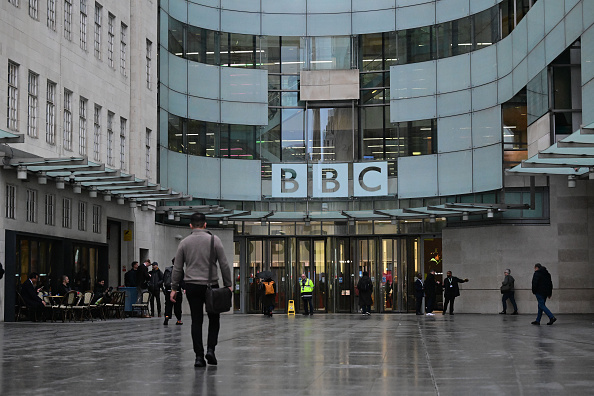
Look at who’s attacking it – the Telegraph along with the rest of the press, the Conservatives, Nigel Farage, Reform and Donald Trump. It’s not difficult to know who to trust!
It’s the Daily Telegraph that leads the assault on the BBC and there couldn’t be a sharper contrast between these two news providers. I was brought up seeing my father read the Telegraph every day and I followed him. For most of my adult life it was by far the best newspaper, both for the sheer quantity of news it published and the middle road it took between the Times, which could be very dry and the tabloids, which have always been a trivial form of entertainment rather than serious information. In the last few years, however, it has descended into the gutter and now ranks alongside the Daily Mail as not just trivial but mendacious.
To be fair, the Times has also deteriorated. Now much more readable, it has frittered away its reputation for accuracy and can no longer be considered reliable. It’s instructive that its current editor, Tony Gallagher, is a former editor of the Daily Mail, the Telegraph and the Sun. Another valuable insight can be gained by reading the comments on the Telegraph and Times websites. They show a readership that is predominantly further to the right even than the publications themselves. This is alarming.
I now read both the Times and the the Guardian but I trust and respect the BBC’s journalism far more. I don’t understand why the BBC pays so much attention to the press. It is a dying medium, moving ever further to the authoritarian right on a daily basis. I would like to see the BBC stop following the press, stop allowing it to set the news agenda, stop reviewing the newspapers. Newspapers have nothing to offer the BBC and are a negative influence on its work.
Of course, I have my own issues with the BBC, its pro-Israel stance and failure to report fairly or accurately the Palestinian point of view. The Centre for Media Monitoring report of June 2025 analysed 35,000+ pieces of BBC content showing that Palestinian deaths are treated as less newsworthy. There is systematic language bias favouring Israelis and an almost complete suppression of genocide allegations with interviewees cut off as soon as they mention the word. Palestinian voices are suppressed with hardly any representatives given an opportunity to speak.
The other issue on which the BBC is failing badly is drugs policy. It simply isn’t covered While there are many reports of the ‘War on Drugs’, law enforcement activity, drug deaths, violence and gang warfare, never ever does the BBC look at policy. On any other issue, when a major problem is identified, there would be interviews with experts, analyses of policy options, etc. There is a complete blackout in the BBC on drugs policy. Some of this can be explained by the terrible truth that politicians don’t want to talk about it,. In fact they will do anything to evade the subject, only ever telling us that they are ‘tough on drugs’. There is a ‘group think’ in British politics and media that believes prohibition is the only option. They are too cowardly to look at the alternatives.
But I back the BBC. I want to see it toughen up. I want to see it do better on Israel and on drugs policy but overall no other broadcaster comes close. The people now attacking it: the Telegraph, the rest of the press, the Conservatives, Nigel Farage and Reform – well that just confirms it, I know exactly which side I’m on!
Glass Pharms’ UK Cannabis Facility – Space, Technological Innovation and Quality.
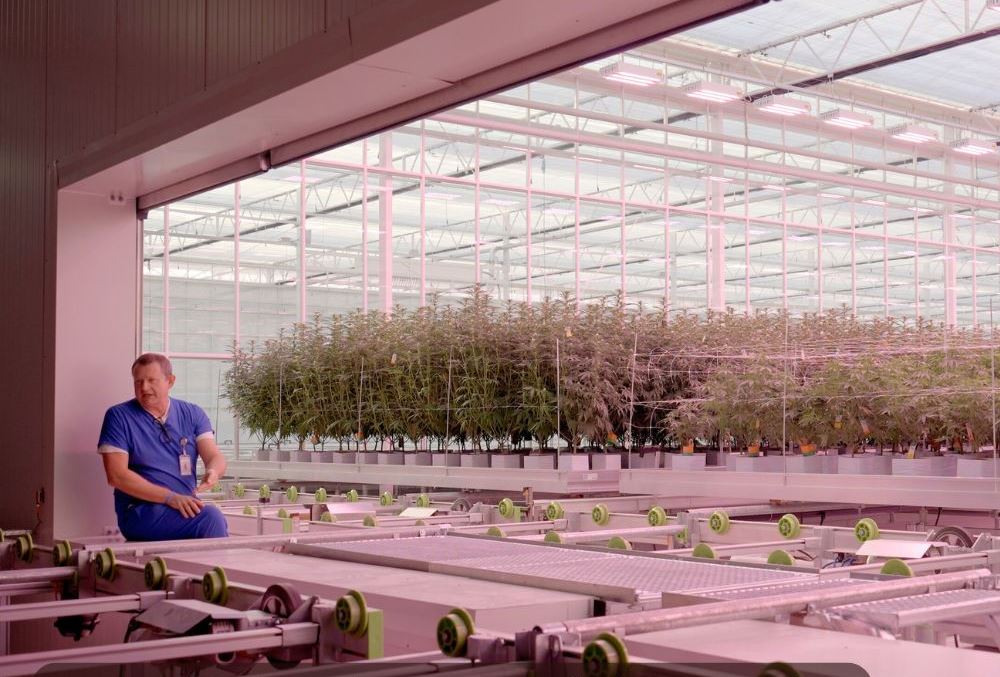
In mid-May 2025 this was my second visit to one of the very few licensed cannabis cultivation facilities in the UK. The first was a month earlier to Dalgety in Staffordshire. It is extraordinary to see two such totally different approaches to growing the same plant.
There is hardly a more beautiful location than where Glass Pharms is based, in deepest Wiltshire, in the middle of glorious English farmland with swooping and squabbling red kites as sentinels. First you pass the anaerobic food waste digestion plant which provides heat for power as well as carbon dioxide to boost plant growth. Then, almost surrounded by a massive solar panel installation, is an unmarked, anonymous but imposing building. From ground level you wouldn’t even know it was a glasshouse.
Security precautions are strict, just like Dalgety. Once through a succession of turnstiles and doors that familar, comforting smell becomes obvious. I was welcomed by managing director Richard Lewis who explained to me that his background and that of most of the staff onsite was in fresh produce. I learned that he regards cucumbers as the vegetable crop most similar to growing cannabis.
The main area of the facility is a large section, perhaps 70 or 80 metres square, where staff attend to plants in different stages of growth, groups of perhaps 30 plants on large trays, just over a metre wide and four metres long. This is where I learned one of the most important principles of this facility – the plants come to the people, the people never go to the plants. Using a robotic conveyor system, which can move in all directions, these trays take batches of plants to where they need to be, either for different lighting and nutrient regimes to simulate the seasons or for human intervention such as de-leafing or harvest.
I also met with James Duckenfield, chief executive and founder, who is a tremendously impressive character. A chemist by training, he very quickly lost me in an explanation of terpenes, other compounds and the reasons that they are currently growing 21 different cultivars to achieve a range of flower products to meet different medical needs. This is a depth of technical, scientific expertise, unlike any I have seen elsewhere, that supports skilled growers and horticulturalists. Glass Pharms did employ a head grower from the Canadian cannabis industry for a while but it didn’t work out. This is not the conventional approach to growing cannabis. It is continuous cultivation where every day new clones are planted and mature plants are harvested.
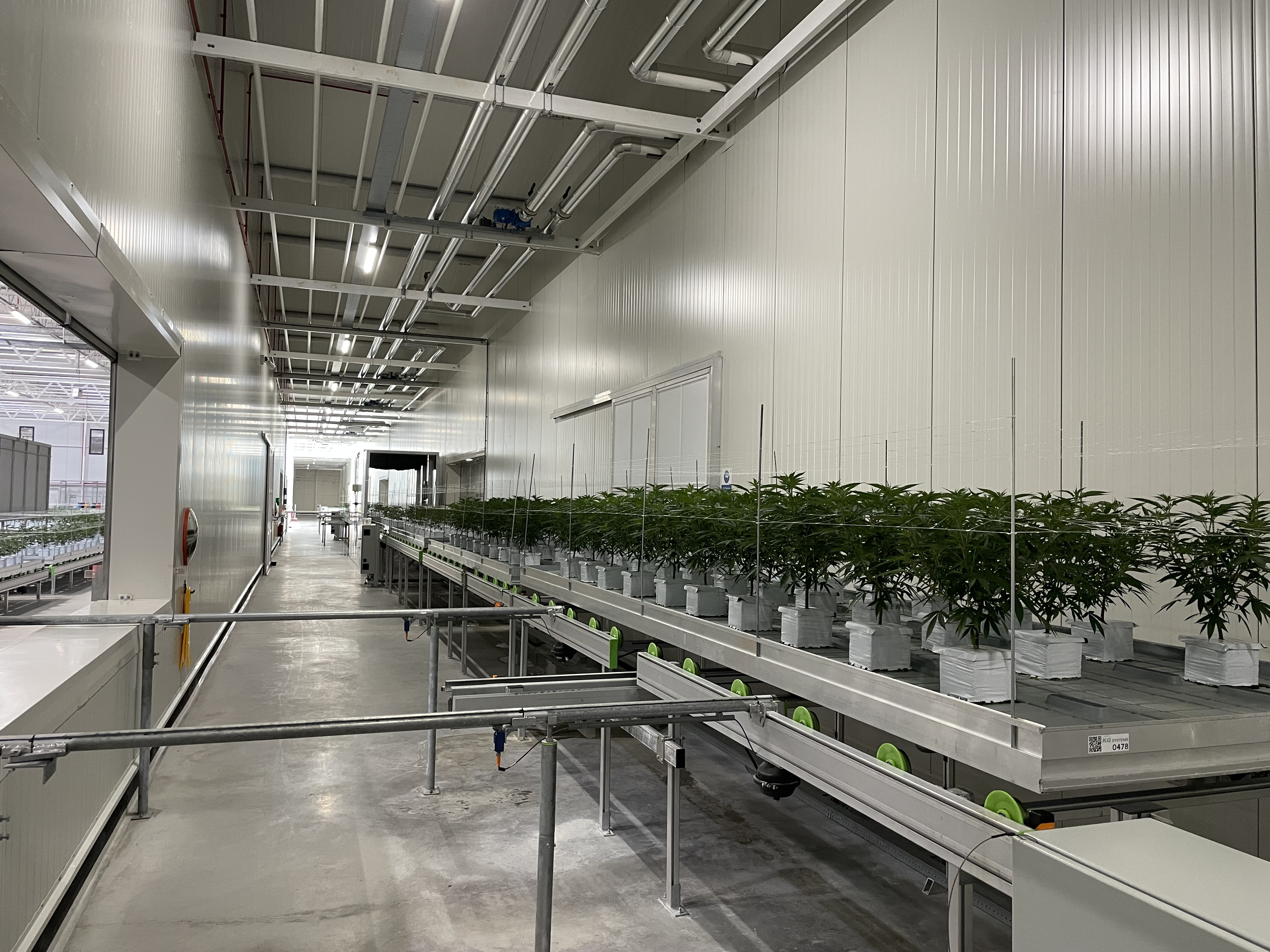
Alongside the main area is a long corridor that runs the entire width of the glasshouse. In fact this is the only place where you realise that you’re in a glasshouse as the roof is visible. There are surprisingly few lighting fixtures and they are of an entirely different type to those more commonly in use elsewhere. None seemed to be operating while I was there. It was a very bright, sunny day but this doesn’t explain why in different areas of the glasshouse there seemed to be different colours and temperatures of lighting, presumably seeking to replicate the different seasons.
Richard explained that 40% of the lighting requirement is provided by the sun. This is a huge saving on what is the most signifiant cost in cannabis cultivation. There are further huge savings on power as it all comes at greatly reduced cost from the anaerobic digestion plant next door. Finally, in what was the most surprising revelation of all, there is not a single HVAC unit in the whole facility. All heating and cooling is provided by an ingenious heat exchanger system working off the waste heat from next door.
Back in the main room, an area to the side is partitioned off. Harvested flowers are packed quite tightly into small trays and this is where they begin the drying and curing process. Again, this is not the conventional approach. I would be concerned straightaway by how tightly packed the buds are. How could they dry properly without going mouldy? Then I learn that this is the start of a secret drying and curing process which they aim to patent – and I was told no more.
As ever, the proof is in the final product and I was given the opportunity to examine four products presented in finished form in Glass Pharms’ unique sealed aluminium tins. These are an innovation in themselves, far better than plastic tubs or mylar bags. I was able to open each container, pick out the buds, feel them, break them apart, examine them in detail. A grinder was provided so I could see how the flower looked and smelled once broken down into vapable form. As I said to James, the only thing missing was a Volcano vaporiser at the end of the table for the ultimate test. I doubt that will ever be possible under UK medical regulations!
I cannot fault what I saw. The perfect consistency of the buds, evenly dried, even density throughout, trichomes visible in the heart of the buds as you break them apart. Just gorgeous. Mouthwatering even!
It’s very, very difficult and challenging to develop a cannabis cultivation facility in Britain. I know this only too well. We are three and a half years into the process in Belfast, where Growth Industries, who I have been advising from the beginning, are still probably two years away from first harvest. But what I have seen at Dalgety and Glass Pharms is tremendously impressive, even with two entirely different approaches. This bodes very well for the future of Britain’s cannabis industry. We can be world leaders in this. If only we had a government and regulators who were focused on helping the industry, rather than looking for ways to restrict it.
Dalgety’s UK Cannabis Facility – Excellence, Professionalism and Leadership.
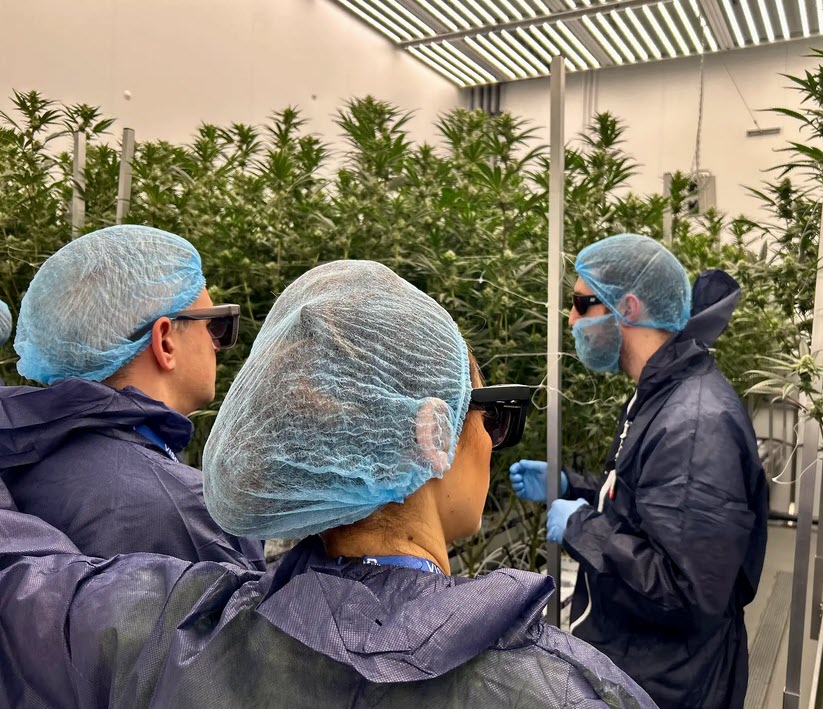
I could not have been more impressed by my recent visit to Dalgety’s cannabis facility, just north of Birmingham. It is the first UK business now permitted to cultivate and prepare a cannabis flower product in its finished form as a medicine that may be prescribed.
The team has shown great professionalism in meeting the conditions required for licensing by the the MHRA and the Home Office. There is also a huge amount of skill, knowledge, determination and financial investment.
It’s my considered opinion that Dalgety now demonstrates leadership in the UK prescription cannabis industry beyond any other business. They have brought into reality what is by far the most difficult objective to achieve. The hurdles put in place by the regulators are quite disproportionate for a plant-based medicine, which is why it has taken so long for any business to reach this stage.
Arriving at the main entrance, the security precautions are extraordinary. You enter through a series of gates, armoured turnstiles and fences. They are tall, strong, impregnable and that’s before you show ID, sign in and then continue through yet more gates. I cannot imagine that even military bases, intelligence services or nuclear installations could require anything more.
While I commend this, I cannot help thinking that 10 minutes down the road at the Dog & Duck, where eighths and quarters of weed are freely available, there are no security measures at all (despite the very dangerous drugs on sale at the bar). This is no criticism of Dalgety but it is condemnation of the absurd policy on cannabis of successive governments. There has been very little logic, rationale or common sense on drugs policy from any British government for at least 100 years – except for this small concession, nearly seven years ago, of allowing cannabis to be prescribed. .
The complex appears huge from the outside but once inside it is just like any other office where we are offered coffee and listen to a short presentation on the long and arduous process involved in development and licensing. Then we head for the grow rooms.
I am very fortunate to have already visited several licensed cannabis facilities both in Colorado and California. I’ve also seen many, shall we say, unlicensed facilities, ranging from one or two to perhaps 50 plants. I’ve never seen any of the huge illegal enterprises growing thousands of plants that supply the illicit UK market with its daily – yes, daily consumption of more than 3,000 kilos. To put that in context, at its present stage, Dalgety will produce 480 kilos per year although it will shortly expand to over 2,000 kilos per year.
The one common factor in all the facilities I have seen is attention to detail but at Dalgety this is taken to exceptional lengths. Each plant is given individual attention to ensure it reaches its maximum potential. All are propagated by cloning from mother plants but even so it is remarkable to see the consistency, almost identical growth heights, branch and flowering structure. This is common to all professional operations but Dalgety achieves a level beyond anything I have seen before.
I have also met many passionate growers. Indeed, I count one of them, Paul Shrive, amongst my closest colleagues and friends but it is impossible not to be very impressed by Brady Green, imported by Dalgety, with family and dogs, from Canada. He has the huge advantage of three years practical experience working to get the facility up and running but his knowledge and expertise is unparalleled. If ever there was a case for ‘key man insurance’, I expect Dalgtey are paying a big premium and keeping him very safe!
I am intimately acquainted with the demands of MHRA licensing, of GMP certification and a compliant pharmaceutical quality system, so I am not surprised by the cleanliness and precision of the grow rooms. They are another stage up from what I have seen in the USA. They are also much less crowded with far fewer plants and much more room around them. I was particularly impressed with the space given between branches hanging to dry. All this adds time and cost. There are no short cuts at all.
I am intrigued by Brady’s decision to dry trim and that all trimming is done by hand. This means that at harvest, fan leaves are removed and branches with flowers are detached from the main stem. These are then hung for a couple of weeks to dry with the smaller leaves still attached. This makes trimming much more difficult, particularly by hand which is completed with a team of about half a dozen people. While hand trimming can achieve a better result, it needs great skill and time. With the quantities involved I expect that eventually they will introduce machine trimming. It also has advantages of greater consistency and hygiene.
The trimming room was the closest we came to seeing the finished product. In California and Colorado such tours always end with a generous box of samples to take away, inspect and consume. No such luck under UK laws and regulations!
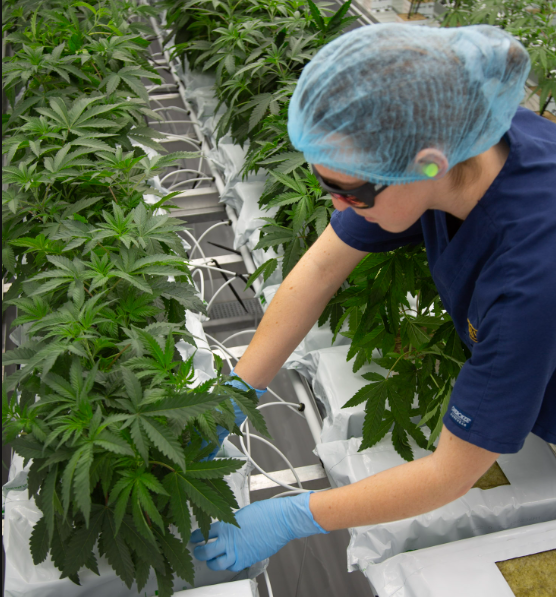
So I cannot judge the final product as I would wish to, at least not until I can get some Dalgety flower prescribed. Even without consuming any, I would have liked to be able to feel, squeeze, pull apart, smell and closely inspect some individual buds but the rules are far too strict for that.
I can say from what I saw in the trimming room that it looks excellent. The one big issue that I have with the regime that we have in the UK is that it places compliance over quality. The best quality flower I have ever seen in my life was in a California adult-use cultivation facility. It was far better than anything I have seen for the medical market in the UK. Without hands-on inspection, the Dalgety flower looked like may well be as good but is the the massive additional cost justified?
This is the fundamental question about growing cannabis legally in Britain. The first answer must be yes because the rules and regulations are in place and complying with them is the only way that we will develop our own cannabis industry. But the rules are manifesty absurd. Cannabis is treated as dangerous drug when in reality it is far safer even than over-the-counter painkillers. The security precautions enforced by the Home Office are about the same as for weapons grade nuclear material, despite the contrast with the free and easy availability of cannabis at the Dog & Duck and virtually any other pub even in the smallest, most remote village. Cannabis is ubiquitous, yet governments keep up this preposterous pretence that it is a ‘controlled drug’ – and in doing so they create, fuel and support organised crime. It is a ridiculous situation continued by ridiculous and weak politicians.
Is the massive cost of producing cannabis under MHRA regulations worth it in comparison to the superb quality available in the USA under much more relaxed conditions? It’s true that there is a very small proportion of potential patients with weak immune systems who may be vulnerable to contaminants but this is no real justification.
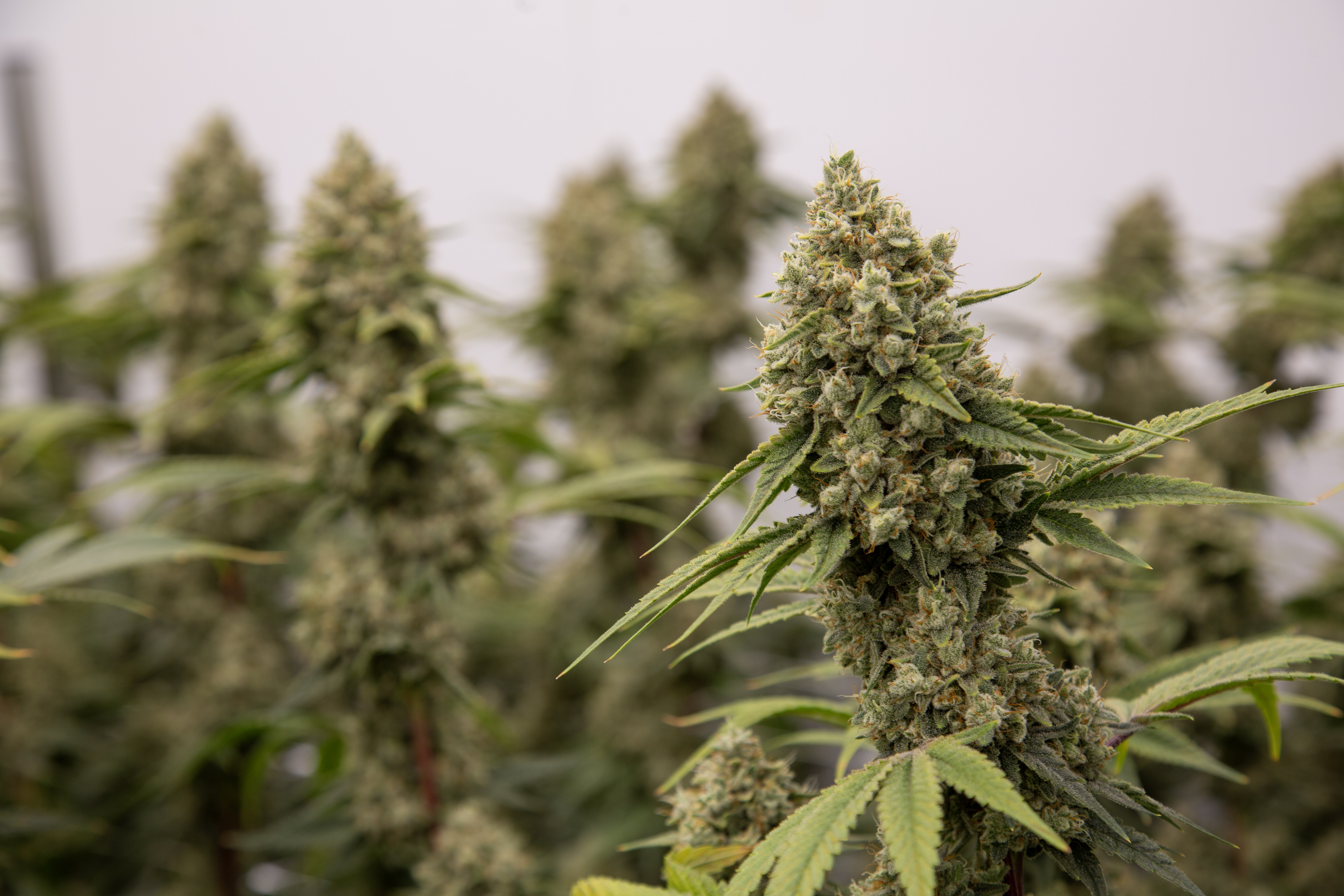
I do not resile from my admiration for what Dalgety has achieved. Indeed, I am pursuing the same path with my role in Growth Industries and this is the route that we must take. After decades of campaigning for law reform, after the change of law in 2018 I reached the conclusion that building the legal industry is the best way to achieve progress. In due course this is what will overcome the stigma, the fear and the nonsense we have been fed by governments and the media. I still hope for adult-use legalisation, perhaps in the next five to 10 years but it will probably be another 50 years, long after I am gone, before cannabis will be accurately and proportionately regarded for its immense benefits and minimal dangers.
Once I can get my hands on some Dalgety flower, I will report back with a final verdict. In the meantime, many congratulations for what the team has achieved. The issue is that UK regulators enforce a system in which compliance trumps quality. I choose that term deliberately because it accurately describes how silly it is!
Rapists and Rappers Are Not Suitable Brands for Prescription Cannabis
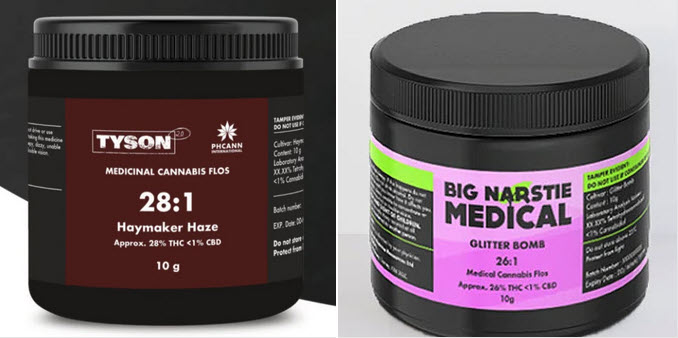
Last year, as chair of the Adult-Use sub group of the Cannabis Industry Council, I was literally screamed at to “shut up” when trying to raise the issue in the executive committee. I fully understood that importers of prescription cannabis felt their monopoly of legal cannabis supply was threatened but today I see those same people using the Tyson and ‘Big Narstie’ brands to promote their medical products.
It’s clear that avarice and greed are now driving the provision of prescription cannabis services in the UK. Apart from the crass misuse of inappropriate brands, I see more and more people who claim to be prescribed 60 or 90 grams per month and invited to ‘pick and choose’ from a range of different flower products. The number of patients in the UK who have a legitimate need for such quantity is very small. But don’t take my word for it. Take note of the ‘Good Practice Guide‘ issued by the Medical Cannabis Clinicians Society in July 2024. Predictably, perhaps, the response to this from importers of cannabis products and others was angry and vituperative.
I don’t need to explain the widespread concern at using the name of a convicted rapist for a medical product. As for ‘Big Narstie’, due respect to him as a patient in his own right but I hardly think that ‘grime comedy’ is appropriate for promoting medicine. When we finally get adult-use legalisation in the UK, I’d encourage him to get involved and he’ll probably do well.
I have some sympathy for anything that circumvents the ridiculous law that prohibits cannabis for adults. While some borderline prescribing was acceptable in my judgement, within reasonable limits, it now threatens the legitimacy of the entire prescription cannabis industry. If these greedy, short-sighted fools don’t get themselves in order, the regulators are going to intervene.
The lessons here are for the importers who dominate supply of prescription cannabis. Understandably, they take a much shorter term view than the few who are now introducing UK-based cultivation. I am certain that the domestic supply chain will be much more responsible as they have the future in mind. Clinics which are involved in excessive and ‘recreational-style’ prescribing also need to think about the long term.
I spent 40 years of my life campaigning for legal access to cannabis as medicine and, by accident rather than design, the 2018 regulations provide the most progressive and flexible system for prescribing cannabis anywhere in the world. It would be a terrible thing to lose this through abuse of the system for short term greed.
Medical use of cannabis is entirely legitimate, life-changing for many, life-saving for some. Adult-use of cannabis is also legitimate in principle, if not yet legal in law.
With common sense it’s easy enough to access cannabis for adult-use without putting oneself in great legal peril. The argument for legalisation is about liberty but most importantly about fighting the massive harms of the gangster-dominated criminal market.
Of course, between medical use and adult-use, there is some blurring at the margins but it’s prudent to separate the two and be disciplined about it.
The Idea of ‘Not for Profit’ Cannabis Reform is Bound to Fail
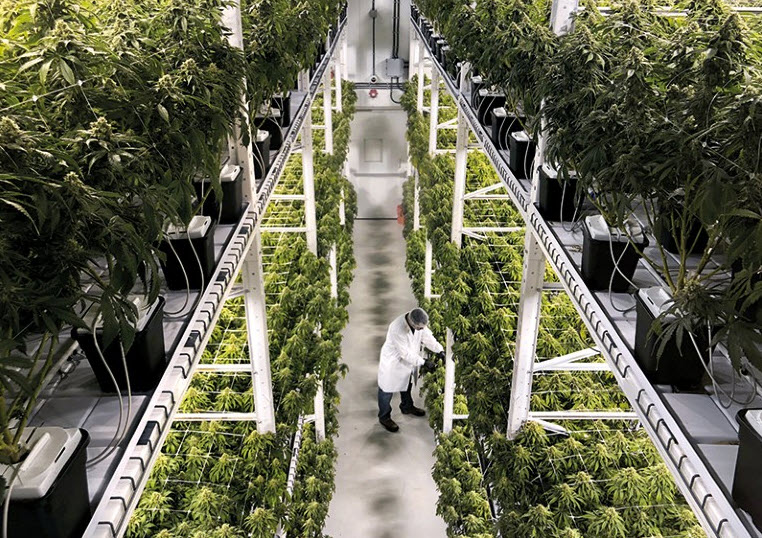
The whole premise of ‘not for profit’ cannabis reform is misguided. For decades, governments have gifted the huge profit opportunity in cannabis to organised crime. Now they want to deny legitimate business the opportunity.
We live in a market economy. Profit is not a dirty word in any other market. In fact profit creates jobs and puts food on families’ tables. The only people who object to profit are ideological socialists and naïve academics who don’t live in the real world.
But closet prohibitionists claim that a market in cannabis, regulated like any other consumer product, will result in aggressive marketing and greed-driven peddling of drugs to vulnerable people. Even some involved in cannabis reform share this fear. The jargon of ‘corporate capture’ and similar hyperbolic criticism supports an anti-business agenda which misses the key purpose of reform – that cannabis and its consumption must be reintegrated into society as ‘normal’. It is the demonisation of cannabis and its prohibition that has caused so much harm. Not just by the persecution of consumers but the consequential effects of creating a multi-billion-pound criminal market.
It is essential that reform enables cannabis to be produced and sold just like any other product, with appropriate regulations, just as we apply to tobacco, alcohol and OTC medicines. If we don’t let legitimate business trade in it, we invite organised crime and irresponsible actors to continue to dominate supply with all the harm that causes.
The EU is one of the main protagonists in trying to keep business out of cannabis. Just look at the problems Malta is experiencing. Already it has had three people in charge of its regulation authority, the first two with a history of opposing reform and they had so much difficulty appointing a replacement that the latest is the prime minister’s brother-in-law! Its preferred solution of cannabis social clubs is in chaos. After three years there are only 2,000 people registered as members and the bureaucracy is overwhelming, threatening the clubs’ viability.
Germany wanted to move forward with a legally regulated commercial supply chain but the EU knocked it back, insisting on the cannabis social club model. It too is experiencing great problems with administering this vastly complicated approach.
Malta, Luxembourg and Germany also provide for limited personal cultivation and this is a very good thing. Germany intends to move forward with pilot schemes for commercial supply but these are yet to get off the ground. The Czech Republic is next in line for reform and it is certainly trying to stand up to the EU but it may yet be knocked back into the social club model as well.
Cannabis social clubs were invented as a way of circumventing prohibition in jurisdictions where individuals growing plants for personal use was not banned. The idea was simply that group of individuals were clubbing together. I don’t have any objection if that is what people want to do but the idea that these clubs are the solution to organised crime production is nonsense. In fact, they are the perfect cover for organised crime.
While growing two or three cannabis plants is not difficult, once you move up to a dozen or more it becomes much more complex and demanding. Without the profit opportunity, weighed down with onerous regulation, the risk of losing a large harvest is too much. I cannot see that social clubs will ever be a solution. They can only be a minor component of a system of regulation that must include commercial supply.
The solution is easy to see on the other side of the Atlantic in Canada and in most of the legal, adult-use US states. California is an outlier where greedy politicians have made a terrible mess with levels of taxation that have continued to promote and support criminal production. Mind you, problematic as it is, no one in California is talking about going backwards!
Canada is a roaring, delightful success. Latest government data show that 82% of all purchases are now made through legal channels. After just six years this is a complete vindication of legalisation, of the sensible, logical approach that permits grow-your-own, prescription by doctors (it’s called ‘authorisation’ in Canada) and a legally regulated supply chain with licensed producers and retailers.
The pious, timid belief that cannabis must be provided on a not for profit basis is grounded in prohibition and that is where it should remain: repealed, abandoned, a relic of prejudice and historical failure.
There’s No Such Thing as ‘Medical Cannabis’
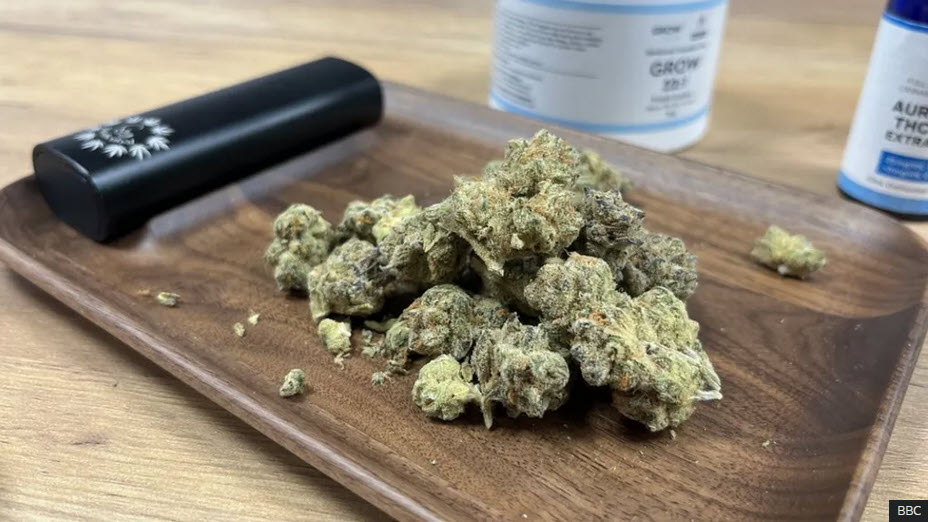
I am increasingly concerned about the ‘medical cannabis industry’ and its resistance to wider reform. These people, some of them at least, have forgotten very quickly who got them the business opportunity in the first place!
Of course, there is no such thing as ‘medical cannabis’. The more accurate language is ‘medicinal cannabis’ but the preferred term has to be ‘prescription cannabis’. It’s exactly the same product as is sold on ‘the streets’, grown in people’s lofts, in illicit ‘factories’ or in hugely expensive licensed facilities. Often, still, the ‘legal’ variety is of inferior quality.
There’s also no truth in the argument that prescription cannabis is safer or lower in THC. The vast majority of what is prescribed in the UK is what the media would call ‘skunk’. Unless you’re underage or smoking it with tobacco, it is safe, much safer than many other things in your kitchen cupboards.
These divisions in the cannabis sector, stoked by newcomers from the protectionist pharmaceutical industry will achieve nothing for anyone. We need a unified message on the benefits of cannabis. Whether it’s prescribed for chronic pain, anxiety, multiple sclerosis or whether it’s smoked in a spliff with the lights down and some psychedelic music on, it’s all about making you feel better.
This is the universal truth about cannabis.
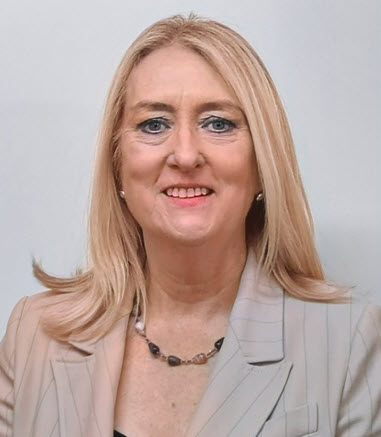
Staffordshire Company, Dalgety, Licenced to Cultivate Cannabis for Medical Use. On the Board of Directors, Jacqui Smith, Ex-Labour Home Secretary.
It’s excellent news that following on from Celadon Pharmaceuticals last month, the MHRA and Home Office have now issued a second set of licences to produce cannabis-based products for medical use (CBPM). Dalgety says it will be producing bulk dried flower, ground and pelletised flower, pure crystallised extracts, blended oils, solids and active pharmaceutical ingredients (API) as powders and extracts.
Reported on Staffordshire Live
But look who’s on the board. Former Staffordshire Chief Constable, Jane Sawyers, who was executive lead for drugs investigation and enforcement but most extraordinarily, Jacqui Smith the former Labour Home Secretary! It was she who was responsible for upgrading cannabis from a class C to a class B drug in 2007 and then famously in 2012 said it had been a mistake. After defying the ACMD’s advice she later reflected that “some people could use cannabis without harm and that education would have been a better option than criminalisation”. Source: Daily Telegraph
Some will cry hypocrisy and it is remarkable how many politicians completely reverse their position on drugs policy when they leave office. What this really shows is that the stupidity of current policy is well understood in government but our so-called leaders are too cowardly to face up to it.
But I welcome Ms Smith’s now wholehearted conversion to common sense. Perhaps it will influence others. I alss welcome this second set of licences. I firmly believe that domestic production is what will improve qualty and service for UK patients and eventually lead to more far reaching cannabis reform.
No, Taoiseach! There is no ‘Glamour’ in Continual Seizures, Chronic Pain, Multiple Sclerosis or in Children being sold Cannabis on the Street.
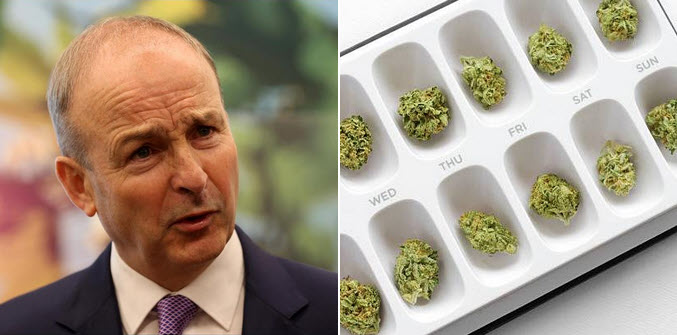
I was astonished to read the Taoiseach’s words as he “warns against cannabis being ‘glamorised’amid new legalising proposals”. There is nothing ‘glamorous’ about the suffering of Irish people who need access to medicinal cannabis, nor about sensible harm reduction policies designed to tackle the illegal market.
I have spent the past seven years trying to work with the Department of Health and the HPRA on medicinal cannabis and the truth is there is systematic, organised opposition to any progress at all levels. The Medical Cannabis Access Programme is a policy designed to fail and current policy on illegal use supports the gangsters’ business model and actually makes cannabis more easily available to children.
In everything related to cannabis, Irish policy is failing extremely badly and ministers, officials, the HSE, all medical institutions refuse to engage with the industry, patient representative groups or scientific experts. Irish doctors are regressive and badly informed on the subject. The term ‘luddite’ applies exactly because the luddites sabotaged progress in the textile industry in the 19th Century and this is exactly what the Irish medical establishment is doing today.
Ministers need to engage and get a grip of these policies because all they are doing at present is causing harm, both to patients who need access and to young people who are exploited by criminals.
Also, Ireland is missing out on very significant business and employment opportunities. In Europe, the market for medicinal cannabis and CBD will be worth over €20 billion within the next five years and Ireland is way behind every other country in the EU. I have represented several businesses ready and willing to invest millions of euros in Ireland and create hundreds of jobs in a strictly regulated system for producing our own medicinal cannabis but every offer is rejected without even any consideration.
There is a secretive cabal of senior Irish clinicians who lobby against cannabis. They use arguments about children smoking illicit, high-strength, street cannabis as a reason that very sick people shouldn’t be able to use it as medicine. In fact they say that cannabis isn’t a medicine when north of the border, across the sea in the Great Britain and throughout the EU, hundreds of thousands of people are prescribed cannabis by their doctors and gain great benefit from it.
It is the influence of this small group of doctors that has hobbled Ireland’s Medical Cannabis Access Programme (MCAP) which has fewer than a couple of dozen patients five years after it was announced. The power that these doctors wield is what has prevented the HSE from implementing any training or education on MCAP. It means that many of the country’s major healthcare institutions have banned clinicians from even discussing the subject – and remember, this is official government policy!
As seen in minutes disclosed under an FOI request, this cabal of clinicians has lobbied drugs minster Frank Feighan that anyone who lobbies him on cannabis must disclose it and yet they have failed to disclose their own activity. Even so, Minister Feighan refuses to meet anyone else who wants to put the other side of the argument.
Cannabis is not harmless. There is no medicine, nor any recreational drug that is. Most are far more harmful than cannabis. including common painkillers, alcohol and tobacco. While Irish psychiatrists can speak of nothing except the tiny risk of mental health problems (a non-existent risk in medical use), in the UK consultant psychiatrists are prescribing it for depression, anxiety, PTSD and other mental health disorders.
The misleading influence of these senior doctors is what makes cannabis a dirty word in the Department of Health, the HPRA and throughout government where ministers and officials just refuse to discuss the issue. The current review of MCAP is being conducted behind closed doors, in secret, without any opportunity for patients, representative groups, the industry or independent, scientific experts to contribute.
No, Taoiseach, there is nothing glamorous about anything to do with cannabis. Instead, in Ireland there is suffering, injustice, ignorance and evasion of an issue that affects thousands of people. Time to step up, firstly to support the very sensible, moderate bill to decriminalise small amounts of personal possession. Secondly, to put our health service to task to deal with medical access fairly, openly and based on the best evidence from around the world, not just the opinions of a small group of out-of-touch doctors who have nothing to say except ‘no’.
Don’t Believe a Word the FSA Says About CBD.
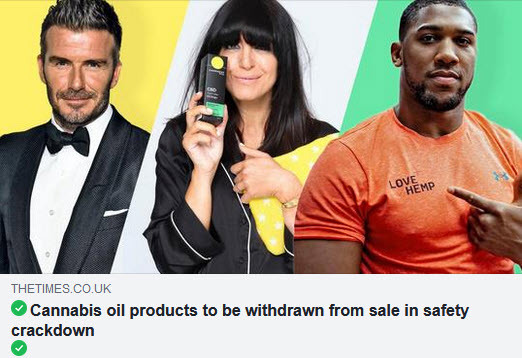
It’s reported in The Times and the Daily Mail today that many CBD products must be withdrawn from sale because of ‘safety concerns’. This follows a week of slavish repetition in the media of the FSA’s line that its publication of a list of 3,500 products that ‘might’ be authorised in the future is a “milestone” for the industry.
To be more accurate, it’s the line it’s devised in conjunction with the Association for the Cannabinoid Industry (ACI), the most recently formed trade association in the sector which, although repesenting only about 20 of the hundreds of CBD companies, now has privileged access and preferential treatment with the FSA. There is no doubt that the relationship between the two is improper and possibly corrupt. Dishonesty, deceit and underhand behaviour have been in play for at least the past year in order to give ACI and its members a commercial advantage and help the FSA create, on the basis of zero credible evidence, a massively expensive system that benefits no one else except its bureaucracy, least of all consumers.

This is nothing to do with safety. There are no reports from anywhere in the world at any time of anyone coming to any harm from CBD products.
The safety scare is entirely invented by the FSA in order to build its massive new, wholly unnecessary bureaucracy. They have been supported and encouraged by the ACI, most of its members dealing primarily in nasty, ineffective isolate products, not the ‘whole plant’ products which millions of people have found great benefit from.
CBD isolate needs to be taken at doses at least 10 times greater than whole plant products, doesn’t work anywhere near as well and because of the huge doses often causes stomach upsets.
This is a classic case of big business using financial muscle and influence to get the regulator to apply misguided, massively expensive over-regulation which squeezes out the smaller suppliers and bloats the bureaucracy.
It’s corrupt and the people who are harmed by it are consumers.
What was a fantastic British success story is being destroyed by vested interests squashing the small businesses that created the market.
The CBD market does need better regulation and the two longstanding trade associations, the Cannabis Trades Association (CTA) and CannaPro, had implemented very effective self-regulation of their members. What that needed to work was for the two regulators concerned, the FSA and the MHRA, to crack down on the unregulated end of the market but they both failed dismally to fulfil their responsibilities. The MHRA simply washed its hands of its duty to enforce the Human Medicines Regulations 2012, which meant widespread, unlawful claims of medical benefit from cowboy traders. The FSA spurned all the work that CTA and CannaPro had done with it over the previous five years and formed its unlawful relationship with the multimillionaire backers of ACI.
There are just two issues which need addressing in regulating CBD products: what the products contain and how they are marketed. This is the effective and inexpensive approach that CTA and CannaPro were taking and is explained in detail in this article published a year ago: The FSA’s Intervention in the CBD Market is a Farce. Here’s the Clear and Simple Solution.
The effect of the FSA’s action has already been to destroy many small businesses and hundreds of jobs. What lies ahead is a two-tier market: the FSA/ACI ‘authorised products’ which will be ineffective, isolate-based and available in high street chains; and ‘real’ whole plant CBD products, which are what work and what consumers want, operating in a black market, either online or through independent retailers.
Don’t buy CBD isolate products. You will be wasting your money.
Update on the Food Standards Agency’s CBD Fiasco
At midday today the FSA will publish a ‘public list’ of 3500 CBD products on its website.
What does it mean? What are the products? Does this mean they are legally allowed to be on sale?
These and many other questions come to mind, as a result of which I arranged an online meeting this morning with Paul Tossell, Team Leader on Novel Foods with the FSA.
I only became aware of today’s announcement because I heard from a journalist friend that there was an advance media briefing yesterday. You may well ask and I certainly did, why were the media being briefed before the industry? My roles in CLEAR, CannaPro, the Cannabis Industry Council (CIC) and my past role in the Cannabis Trades Association (CTA) mean that I am well established, along with others, as a stakeholder. Yet, neither I nor anyone else in any of the trade bodies have been contacted by the FSA – except that is, of course, the Association for the Cannabinoid Industry (ACI) and its sister organisation, the Centre for Medicinal Cannabis (CMC). That is no surprise at all to anyone who knows the history of the FSA’s blunder into the CBD market. It has an improper relationship with ACI/CMC and the three of them have conspired together to create an absurd bureaucracy of vastly expensive but wholly unnecessary regulations which no doubt give preferential status to the few, large companies, mostly in the CBD isolate business, which are associated with ACI/CMC.
My meeting with Paul Tossell followed exactly the same format as all the other meetings I have had with him and his colleagues over the past years. It was a monologue. I couldn’t get a word in edgeways and all Tossell was interested in was very long, very turgid, pointless explanations of the FSA’s process. He wouldn’t answer any of my questions properly.
This is what I have learned.
None of the 3500 products on the list are ‘legal’ in the FSA’s terms and Trading Standards may remove and confiscate any of them at any time. All 3500 are the result of just five novel foods applications which have been ‘validated’ and 65 applications which have not yet been ‘validated’ but look like they are ‘work in progress’ towards providing the information necessary for validation.
Apparently the purpose of the list is to help Trading Standards set its priorities for enforcement. So if a product isn’t on the list it stands no chance of ever being officially ‘legal’. In fact, as has been obvious all along and as I now have from a source right at the top of Trading Standards, it doesn’t have the resources or the intention of going after CBD products. It has far more important things to do, such as going after products which genuinely are dangerous.
As anyone who knows me will confirm, I am no shy and retiring type but I had to be extremely forceful and insistent to try and get a couple of key questions to Tossell, neither of which were answered.
Firstly, what is the basis for this intervention, what evidence do you have that these products can be harmful? This was dismissed as “You’ve got it the wrong way round.” He’d already said that “Consumers need to know the product is safe, that’s the whole point of this.” I couldn’t get any answer and of course the truth is there is no evidence of any danger, or of anyone ever coming to any harm. All Tossell can do is repeatedly refer back to his bureaucratic process which is entirely for its own sake and has no substantive purpose.
My second question was that the scope of novel foods was originally defined by the FSA as being about products that are selective extracts from cannabis. As I’ve been asking for years, what about genuine whole plant extracts which are non-selective extracts? Back came the same old non-answer, side-stepping the question and referring to cold pressed products. When I pressed him that other methods of extraction could be non-selective, he simply denied this and refused to discuss it any further, saying it had been “settled” two years ago.
Novel food applications which have been ‘validated’ will still need to go through further processes. Risk assessment where an independent scientific body will give an opinion. Then risk management where any necessary actions will be determined and finally, extraordinarily, every single product which is to be determined as ‘legal’ will have to be named in a Statutory Instrument which will have to be passed into law by Parliament.
The absurdity and pointlessness of all this is beyond doubt but it is more serious than that. The only evidence on which the FSA’s concern for any harm is based is experiments on rats by GW Pharmaceuticals with its CBD isolate medicine, Epidiolex, administered at doses hundreds or thousands of times the equivalent in humans. And the conflict of interest is obvious. I am no enemy of GW, on the contrary I admire the company and its work but it has the only licensed CBD medicine and its interest would be to restrict access to non-licensed products.
Also, it is my honest opinion that the relationship between the FSA and ACI/CMC is corrupt. Dishonesty, deceit and obfusaction are being used for the purposes of gain, both in a commercial sense and for the sake of bureaucratic power.
All that the FSA’s intervention in the CBD market will achieve, aside from the enormous damage to businesses and jobs, is to promote the black market. For consumers the situation is only going to get worse. They will have the choice of ‘legal’ but useless, ineffective, isolate-based products or the wild west of totally unregulated products, some of which are the ‘real thing’ but many of which are produced and marketed by cowboys.
I set out a year ago the two very simple steps which, taken together, will completely solve the regulatory requirements for the CBD market.
The FSA’s actions are without any real purpose. The novel foods regulations are solely for their own sake and establish a pointless bureaucratic process at huge expense which will only make things worse for consumers.

 Peter Reynolds