Posts Tagged ‘cannabis social club’
The Idea of ‘Not for Profit’ Cannabis Reform is Bound to Fail
The whole premise of ‘not for profit’ cannabis reform is misguided. For decades, governments have gifted the huge profit opportunity in cannabis to organised crime. Now they want to deny legitimate business the opportunity.
We live in a market economy. Profit is not a dirty word in any other market. In fact profit creates jobs and puts food on families’ tables. The only people who object to profit are ideological socialists and naïve academics who don’t live in the real world.
But closet prohibitionists claim that a market in cannabis, regulated like any other consumer product, will result in aggressive marketing and greed-driven peddling of drugs to vulnerable people. Even some involved in cannabis reform share this fear. The jargon of ‘corporate capture’ and similar hyperbolic criticism supports an anti-business agenda which misses the key purpose of reform – that cannabis and its consumption must be reintegrated into society as ‘normal’. It is the demonisation of cannabis and its prohibition that has caused so much harm. Not just by the persecution of consumers but the consequential effects of creating a multi-billion-pound criminal market.
It is essential that reform enables cannabis to be produced and sold just like any other product, with appropriate regulations, just as we apply to tobacco, alcohol and OTC medicines. If we don’t let legitimate business trade in it, we invite organised crime and irresponsible actors to continue to dominate supply with all the harm that causes.
The EU is one of the main protagonists in trying to keep business out of cannabis. Just look at the problems Malta is experiencing. Already it has had three people in charge of its regulation authority, the first two with a history of opposing reform and they had so much difficulty appointing a replacement that the latest is the prime minister’s brother-in-law! Its preferred solution of cannabis social clubs is in chaos. After three years there are only 2,000 people registered as members and the bureaucracy is overwhelming, threatening the clubs’ viability.
Germany wanted to move forward with a legally regulated commercial supply chain but the EU knocked it back, insisting on the cannabis social club model. It too is experiencing great problems with administering this vastly complicated approach.
Malta, Luxembourg and Germany also provide for limited personal cultivation and this is a very good thing. Germany intends to move forward with pilot schemes for commercial supply but these are yet to get off the ground. The Czech Republic is next in line for reform and it is certainly trying to stand up to the EU but it may yet be knocked back into the social club model as well.
Cannabis social clubs were invented as a way of circumventing prohibition in jurisdictions where individuals growing plants for personal use was not banned. The idea was simply that group of individuals were clubbing together. I don’t have any objection if that is what people want to do but the idea that these clubs are the solution to organised crime production is nonsense. In fact, they are the perfect cover for organised crime.
While growing two or three cannabis plants is not difficult, once you move up to a dozen or more it becomes much more complex and demanding. Without the profit opportunity, weighed down with onerous regulation, the risk of losing a large harvest is too much. I cannot see that social clubs will ever be a solution. They can only be a minor component of a system of regulation that must include commercial supply.
The solution is easy to see on the other side of the Atlantic in Canada and in most of the legal, adult-use US states. California is an outlier where greedy politicians have made a terrible mess with levels of taxation that have continued to promote and support criminal production. Mind you, problematic as it is, no one in California is talking about going backwards!
Canada is a roaring, delightful success. Latest government data show that 82% of all purchases are now made through legal channels. After just six years this is a complete vindication of legalisation, of the sensible, logical approach that permits grow-your-own, prescription by doctors (it’s called ‘authorisation’ in Canada) and a legally regulated supply chain with licensed producers and retailers.
The pious, timid belief that cannabis must be provided on a not for profit basis is grounded in prohibition and that is where it should remain: repealed, abandoned, a relic of prejudice and historical failure.
A CLEAR Response To the Liberal Democrats’ Proposals For Cannabis Regulation.
CLEAR welcomes the Liberal Democrats’ proposals which can be seen here. We set out below a few comments which we intend to be constructive.
We represent more than 600,000 people who support cannabis law reform. Our own publication, ‘How to Regulate Cannabis in Britain’ is now in its second edition.
It is based on independent, expert research which we commissioned from the Independent Drug Monitoring Unit, published as ‘Taxing the UK Cannabis Market’.
Comments on ‘A framework for a regulated market for cannabis in the UK’
1. We support a cautious approach and agree that it is better to start with stricter regulation that could, based on experience, be relaxed at a later date if appropriate.
Spectrum of Cannabis Policy
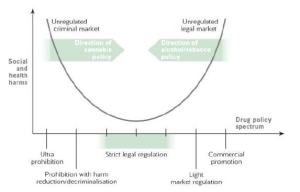
We reject the diagram ‘Exploring a spectrum of options for regulating cannabis’ which paints an inaccurate picture of the effects of a legal market. Evidence from all jurisdictions that have implemented reform does not support the equivalence of ‘social and health harms’ with ‘ultra prohibition’ and ‘commercial production’. It is absolutely clear that legally regulated commercial production is far less harmful than prohibition.
Essentially, instead of a ‘U’ shaped curve, we consider an ‘L’ shaped curve is more accurate.
2. The diagram indicates a fundamental objection to the commercial model implemented in Colorado, Washington and Oregon and the report explicitly rejects the Colorado model in favour of the Uruguay model.
We disagree with this. The Colorado model is a proven success with virtually no downsides. The Uruguay model is still a theory which is yet to be proven in practice. This conclusion in the report is therefore not evidence-based. This suggests that wider political or philosophical considerations have been allowed to trump existing evidence.
3. We are concerned about the undue weight given to restricting commercial enterprise. The UK is not a socialist economy and there is a danger of a ‘nanny-state’ attitude which we cannot support. We repeat the point that it seems wider political or philosophical considerations have been allowed to prevail over actual evidence. There needs to be a balance between a ‘cautious approach’ as in 1. above and over-regulation which will only result in a continuing criminal market. The UK is a market economy and if the legal market is too strict and rigid, the illegal market will flourish.
4. We have very grave concerns about the cannabis social club (CSC) model which provides significant opportunity for the corruption of those involved into major criminal enterprises with exploitation of both workers and customers. The establishment of such ‘clubs’ is entirely unnecessary given the other more controllable methods of supply and will only lead to diversion and perhaps active marketing of excessive production through criminal networks. In other words, CSCs are a golden opportunity for the emergence of ‘drug pushers’ and they undermine the whole purpose of cautious regulation.
5. We regard the recommendation not to permit the production and marketing of ‘edibles’ as an error. If the other recommendations making raw herbal cannabis legally available are implemented then this will inevitably lead to the production and marketing of unregulated ‘edibles’, undermining the whole purpose of regulation. Far better to learn from the mistakes already made in excessively potent ‘edible’ products and introduce appropriate regulations with reduced dosages.
If anything, ‘edibles’ need regulation far more urgently than the raw product because of the potential for very unpleasant overdosing. To abrogate responsibility for this is an extremely unwise proposal and inconsistent with the whole basis for a regulated market.
6. We would encourage a more positive and supportive approach to enable producer countries such as Morocco, the Lebanon, Pakistan and Afghanistan to supply varieties of cannabis resin and hashish. Encouraging such trade under strict regulation will further undermine criminal activity and offers great potential for better relations and positive ‘soft power’ influence on these countries. We recognise the difficulties involved in this with regard to the UN conventions but consider it is a prize worth working towards.
7. For the same reasons set out above we consider that a refusal to regulate concentrates and vapouriser products undermines the whole purpose of a regulated market. Vapouriser products are almost certainly going to be an important component of the medical cannabis market. These nettles must be grasped. To avoid them is irresponsible.
8. We would argue for far more emphasis on harm reduction information, particularly about smoking and avoiding mixing cannabis with tobacco. As in 7. above, we would actively promote the choice of vapouriser products.
9. In principle we agree with the proposal for three levels of THC content and for minimum CBD content. However, there is no evidence to support the necessity for CBD content as high as 4%. The evidence suggests that levels of 1% or 2% adequately meet the desirable ‘entourage’ effects of CBD. Furthermore, at these levels, existing strains are available. Little consideration has been given to the practicalities of developing three new strains to meet the THC:CBD ratios proposed. To develop such strains and ensure they are stable and consistent is the work of several years, requiring significant investment and so undermines the ability to implement these proposals in timely fashion.
10. We consider that the ‘plain packaging’ proposal is unnecessarily restrictive in the UK’s market economy. We agree with child proof containers but would recommend that far more emphasis is given to content and harm reduction labelling. There is nothing to be gained from restricting the marketing and commercial enterprise of companies wishing to develop brands and packaging styles within strict regulations.
11. For reasons already set out we consider that the restrictions on exterior and interior retailer environments are oppressive and will be self-defeating. The UK is not accustomed to such overbearing and anti-business regulation. Existing pharmacies do not operate under such heavy restrictions and they make significant use of point-of-sale and merchandising techniques.
Overall, we welcome this document and the proposals it contains. One final point that is of significance is that clearly there was no ‘consumer’ representation on the panel and this is obvious in some of the tone and detail of the report. We recommend that account should be taken of consumer opinion in any future development of the proposals.

 Peter Reynolds