Posts Tagged ‘Glass Pharms’
Glass Pharms’ UK Cannabis Facility – Space, Technological Innovation and Quality.
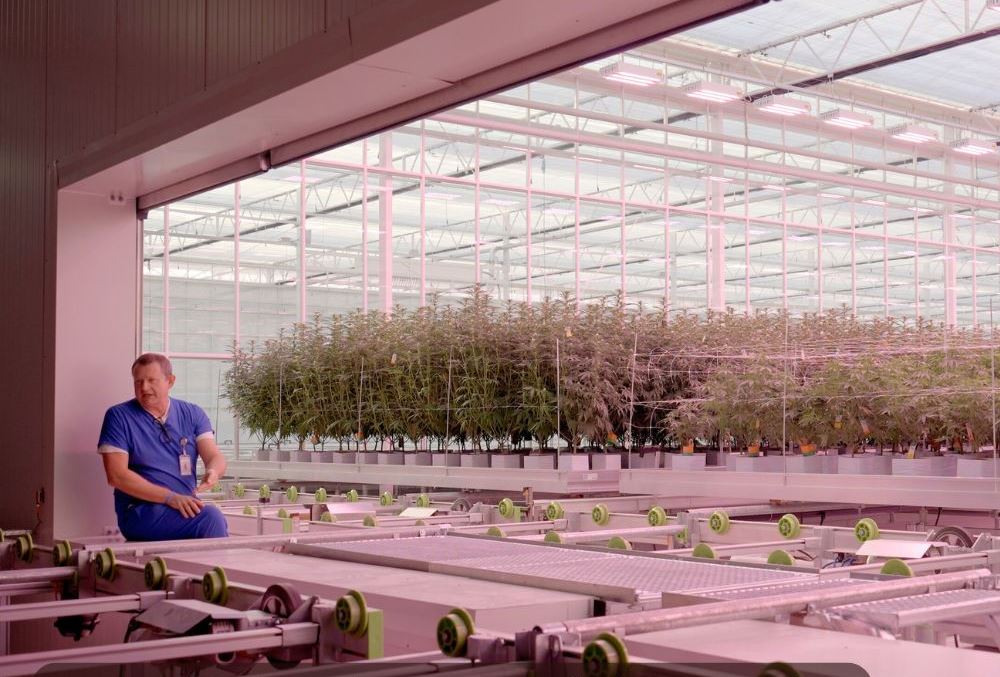
In mid-May 2025 this was my second visit to one of the very few licensed cannabis cultivation facilities in the UK. The first was a month earlier to Dalgety in Staffordshire. It is extraordinary to see two such totally different approaches to growing the same plant.
There is hardly a more beautiful location than where Glass Pharms is based, in deepest Wiltshire, in the middle of glorious English farmland with swooping and squabbling red kites as sentinels. First you pass the anaerobic food waste digestion plant which provides heat for power as well as carbon dioxide to boost plant growth. Then, almost surrounded by a massive solar panel installation, is an unmarked, anonymous but imposing building. From ground level you wouldn’t even know it was a glasshouse.
Security precautions are strict, just like Dalgety. Once through a succession of turnstiles and doors that familar, comforting smell becomes obvious. I was welcomed by managing director Richard Lewis who explained to me that his background and that of most of the staff onsite was in fresh produce. I learned that he regards cucumbers as the vegetable crop most similar to growing cannabis.
The main area of the facility is a large section, perhaps 70 or 80 metres square, where staff attend to plants in different stages of growth, groups of perhaps 30 plants on large trays, just over a metre wide and four metres long. This is where I learned one of the most important principles of this facility – the plants come to the people, the people never go to the plants. Using a robotic conveyor system, which can move in all directions, these trays take batches of plants to where they need to be, either for different lighting and nutrient regimes to simulate the seasons or for human intervention such as de-leafing or harvest.
I also met with James Duckenfield, chief executive and founder, who is a tremendously impressive character. A chemist by training, he very quickly lost me in an explanation of terpenes, other compounds and the reasons that they are currently growing 21 different cultivars to achieve a range of flower products to meet different medical needs. This is a depth of technical, scientific expertise, unlike any I have seen elsewhere, that supports skilled growers and horticulturalists. Glass Pharms did employ a head grower from the Canadian cannabis industry for a while but it didn’t work out. This is not the conventional approach to growing cannabis. It is continuous cultivation where every day new clones are planted and mature plants are harvested.
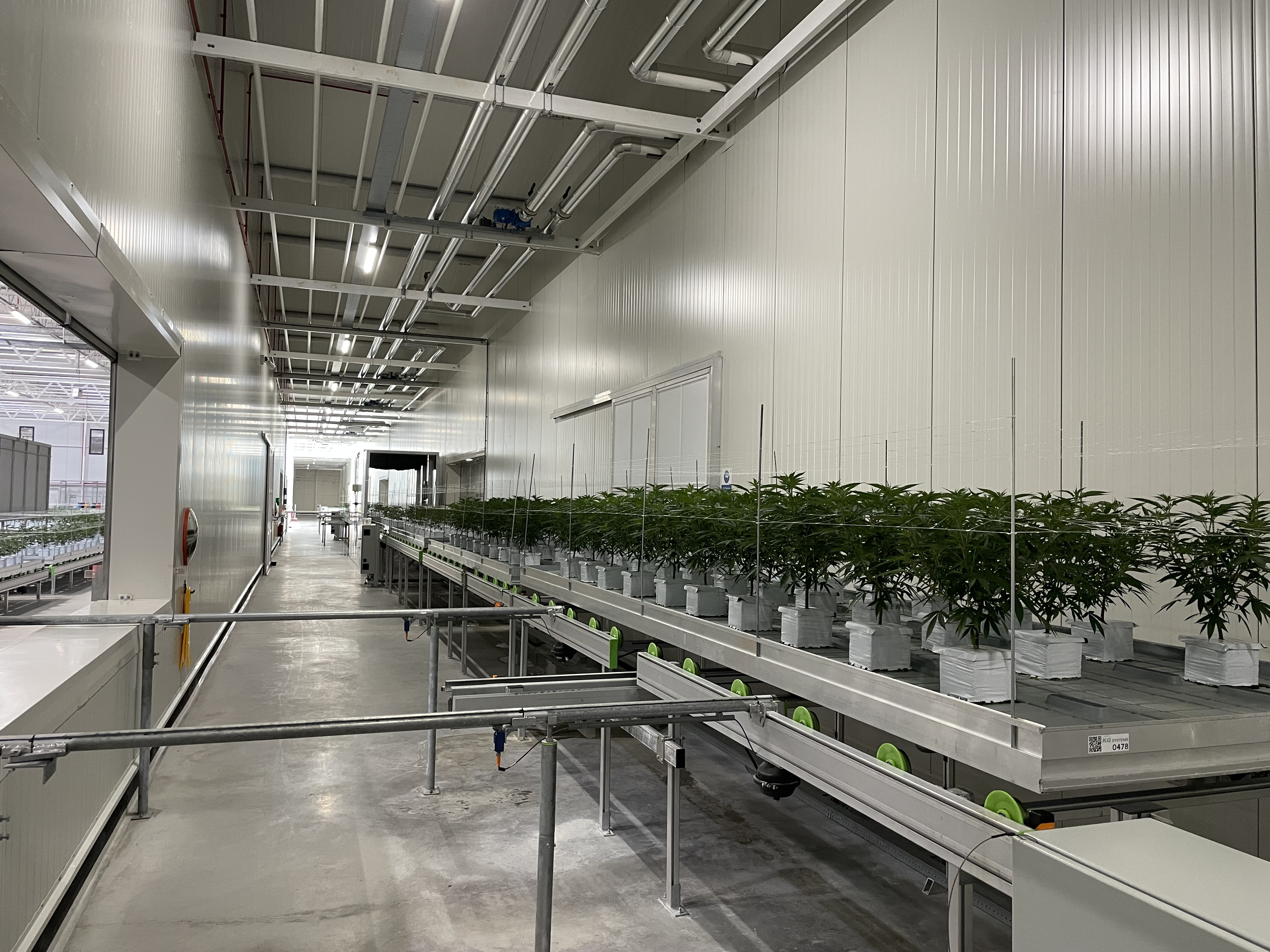
Alongside the main area is a long corridor that runs the entire width of the glasshouse. In fact this is the only place where you realise that you’re in a glasshouse as the roof is visible. There are surprisingly few lighting fixtures and they are of an entirely different type to those more commonly in use elsewhere. None seemed to be operating while I was there. It was a very bright, sunny day but this doesn’t explain why in different areas of the glasshouse there seemed to be different colours and temperatures of lighting, presumably seeking to replicate the different seasons.
Richard explained that 40% of the lighting requirement is provided by the sun. This is a huge saving on what is the most signifiant cost in cannabis cultivation. There are further huge savings on power as it all comes at greatly reduced cost from the anaerobic digestion plant next door. Finally, in what was the most surprising revelation of all, there is not a single HVAC unit in the whole facility. All heating and cooling is provided by an ingenious heat exchanger system working off the waste heat from next door.
Back in the main room, an area to the side is partitioned off. Harvested flowers are packed quite tightly into small trays and this is where they begin the drying and curing process. Again, this is not the conventional approach. I would be concerned straightaway by how tightly packed the buds are. How could they dry properly without going mouldy? Then I learn that this is the start of a secret drying and curing process which they aim to patent – and I was told no more.
As ever, the proof is in the final product and I was given the opportunity to examine four products presented in finished form in Glass Pharms’ unique sealed aluminium tins. These are an innovation in themselves, far better than plastic tubs or mylar bags. I was able to open each container, pick out the buds, feel them, break them apart, examine them in detail. A grinder was provided so I could see how the flower looked and smelled once broken down into vapable form. As I said to James, the only thing missing was a Volcano vaporiser at the end of the table for the ultimate test. I doubt that will ever be possible under UK medical regulations!
I cannot fault what I saw. The perfect consistency of the buds, evenly dried, even density throughout, trichomes visible in the heart of the buds as you break them apart. Just gorgeous. Mouthwatering even!
It’s very, very difficult and challenging to develop a cannabis cultivation facility in Britain. I know this only too well. We are three and a half years into the process in Belfast, where Growth Industries, who I have been advising from the beginning, are still probably two years away from first harvest. But what I have seen at Dalgety and Glass Pharms is tremendously impressive, even with two entirely different approaches. This bodes very well for the future of Britain’s cannabis industry. We can be world leaders in this. If only we had a government and regulators who were focused on helping the industry, rather than looking for ways to restrict it.

 Peter Reynolds