Posts Tagged ‘drugs policy’
I Trust the BBC Much More than Any Other Media Outlet
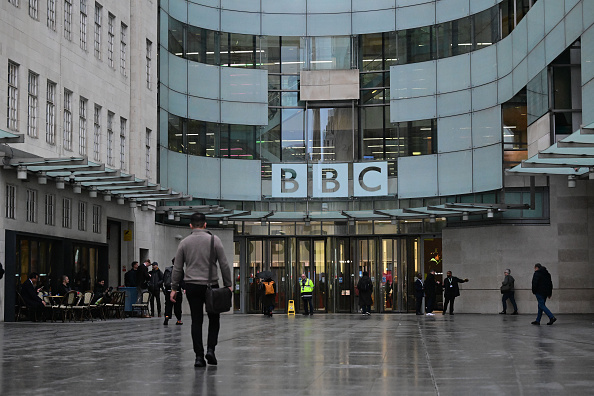
Look at who’s attacking it – the Telegraph along with the rest of the press, the Conservatives, Nigel Farage, Reform and Donald Trump. It’s not difficult to know who to trust!
It’s the Daily Telegraph that leads the assault on the BBC and there couldn’t be a sharper contrast between these two news providers. I was brought up seeing my father read the Telegraph every day and I followed him. For most of my adult life it was by far the best newspaper, both for the sheer quantity of news it published and the middle road it took between the Times, which could be very dry and the tabloids, which have always been a trivial form of entertainment rather than serious information. In the last few years, however, it has descended into the gutter and now ranks alongside the Daily Mail as not just trivial but mendacious.
To be fair, the Times has also deteriorated. Now much more readable, it has frittered away its reputation for accuracy and can no longer be considered reliable. It’s instructive that its current editor, Tony Gallagher, is a former editor of the Daily Mail, the Telegraph and the Sun. Another valuable insight can be gained by reading the comments on the Telegraph and Times websites. They show a readership that is predominantly further to the right even than the publications themselves. This is alarming.
I now read both the Times and the the Guardian but I trust and respect the BBC’s journalism far more. I don’t understand why the BBC pays so much attention to the press. It is a dying medium, moving ever further to the authoritarian right on a daily basis. I would like to see the BBC stop following the press, stop allowing it to set the news agenda, stop reviewing the newspapers. Newspapers have nothing to offer the BBC and are a negative influence on its work.
Of course, I have my own issues with the BBC, its pro-Israel stance and failure to report fairly or accurately the Palestinian point of view. The Centre for Media Monitoring report of June 2025 analysed 35,000+ pieces of BBC content showing that Palestinian deaths are treated as less newsworthy. There is systematic language bias favouring Israelis and an almost complete suppression of genocide allegations with interviewees cut off as soon as they mention the word. Palestinian voices are suppressed with hardly any representatives given an opportunity to speak.
The other issue on which the BBC is failing badly is drugs policy. It simply isn’t covered While there are many reports of the ‘War on Drugs’, law enforcement activity, drug deaths, violence and gang warfare, never ever does the BBC look at policy. On any other issue, when a major problem is identified, there would be interviews with experts, analyses of policy options, etc. There is a complete blackout in the BBC on drugs policy. Some of this can be explained by the terrible truth that politicians don’t want to talk about it,. In fact they will do anything to evade the subject, only ever telling us that they are ‘tough on drugs’. There is a ‘group think’ in British politics and media that believes prohibition is the only option. They are too cowardly to look at the alternatives.
But I back the BBC. I want to see it toughen up. I want to see it do better on Israel and on drugs policy but overall no other broadcaster comes close. The people now attacking it: the Telegraph, the rest of the press, the Conservatives, Nigel Farage and Reform – well that just confirms it, I know exactly which side I’m on!
Will a Worthy Opponent Please Step Forward to Debate me on Cannabis Law Reform?

This week I debated Peter Hitchens on cannabis again. It was at Cannabis Europa in the Barbican. The text of my opening speech is below.
After about 14 years of doing this repeatedly. I’ve grown quite fond of the old blowhard but he has nothing new to offer. Just the same evidence-opposed assertions and less than a handful of anecdotes that shed no light on the subject at all.
So please, will someone step forward? I can definitely get such a debate hosted at a university or other respected institution. I can guarantee publishing it on YouTube, possibly even we might get it broadcast on TV.
Is there a politician with the guts to do it? I doubt it. They all runaway like frightened rabbits from any serious discussion about drugs policy. They’re terrified of what the Daily Telegraph and Daily Mail will say, even though most of them know that what we’ve done for 50 years has caused more harm than good.
This is an open invitation. Contact me on Facebook, Twitter/X, LinkedIn or by email at peter@peter-reynolds.co.uk
My Speech at Cannabis Europa, 25th June 2024
Thank you chair, Mr Ellson, and thank you Mr Hitchens for coming to this debate. My respects to you for entering what must seem like the lion’s den.
I am here to explain why the current law against cannabis causes far more harm than it ever has or ever could. We have suffered under bad drugs policy in Britain since the Dangerous Drugs Act of 1928. The prohibition of drugs, including cannabis, has created criminal markets which have caused extraordinary harm to our society. I suggest that it is the worst failure of social policy since the war. Nothing else has impacted communities, divided the people from the police, like prohibition. This may be elevating drugs policy to higher importance than you have heard before but I consider that bad drugs policy, prohibition, is driving the breakdown of our society like nothing else. The problem is not cannabis, nor any drug. It is prohibition.
Now, I offered Mr Hitchens the opportunity to phrase the motion for this debate. I was ready to speak either for or against, however he wished it to be set.
So, ‘This house calls for the repeal of the laws against marijuana’ and I speak for the motion. It is the last time that you will hear me speak the ‘M’ word. I prefer the correct scientific and botanical term, cannabis.
But the ‘M’ word, or rather the use of it, is a very good place to start. It’s an Hispanic nickname for cannabis which was deliberately selected and promoted by the architects of cannabis prohibition in the USA, William Randolph Hearst, the newspaper magnate and Harry Anslinger, head of the Federal Bureau of Narcotics, later to become the DEA.
They chose the ‘M’ word in order to associate cannabis with Mexicans and the perceived threat across America’s borders. How little has changed! They went so far as to even enshrine the word in US legislation. Transforming racially charged slang into statute. An extraordinary exercise in state propaganda..
So it was a racist meme from the beginning. Hearst’s newspapers published stories about Mexicans going insane, committing horrendous violence, sexually ravaging white American women and all of it was put down to cannabis. Again, it’s remarkable how little has changed. In Britain, the Mail newspapers continue this campaign of disinformation today.
I understand, of course, that language changes, develops but the choices we make are important and this history illustrates how the laws that currently exist are based on prejudice, misinformation and have nothing to do with science, health records or evidence of any sort. When that was tested by rigorous scientific method by David Nutt and his team, the Labour government had him sacked for it. That’s how deep this falsehood runs
So, as the motion states, I would repeal the laws against cannabis and I would replace them with laws that seek to control and regulate it.
Some argue that cannabis should be treated like carrots or cabbages. If we could go back to beginning of the 20th Century, I would agree. There are many plants in our gardens far more harmful than cannabis but 100 years of bad drugs policy, of prohibition, have created and supported a gangster-driven criminal market which we cannot walk away from. For the safety of our society, the cannabis market has to be regulated – not to protect us from cannabis but from the violent criminal trade in it.
I do not suggest that cannabis is harmless. No one with any sense claims that it is. But it has many benefits. Not just as medicine but as something that can bring great pleasure, insight and joy. It can enhance life experiences such as music, food, all forms of culture, spirituality and relationships. It is unique in this regard. I like to think of it as a condiment for life. It enhances and develops all the flavours of life and although those of us who consume it understand this, these benefits are largely obscured by the hysteria and falsehood around it.
Clearly, excessive or irresponsible use can cause health harms, as with any substance. The most vulnerable are children and that’s why the principle role of the law must be to protect them. As for adults, they should in my view be able to consume anything they wish without restriction under law – unless of course they cause harm to someone else. And we already have all the laws we need to protect others without banning personal possession or use of any drug.
The main harms to children are around brain health but in mature adults, science shows exactly the opposite, that cannabis is neuroprotective, promotes neurogenesis and is a prophylactic for brain injury either through trauma, stroke or neurodegenerative disease. Professor Gary Wenk of Ohio State University says that regular, moderate use of cannabis in middle age will delay the onset of dementia so effectively that most people will never experience it
So it is with protecting children that the law should be concerned. Yet what we have seen, beyond doubt, is that the effect of the law has been exactly the opposite. The laws against cannabis are the principle cause of its harm to children. Because it is prohibited, it is easier for children to get hold of it than the drugs that we regulate, alcohol and tobacco.
The criminal market in cannabis drives street dealing, sales to children, the exploitation of children as runners and it inveigles them into gang culture and county lines. I suggest that cannabis prohibition is the root cause of most knife crime. It and the prohibition of other more dangerous drugs is the cause of most crime and violence in Britain. There is no dispute about this. Over 70% of people in prison are there for drug-related crime. Police spend most of their time on drug-related matters. We have created this huge edifice of drug crime which now overwhelms everything else. Globally we have created the biggest ever criminal market worth, 10 years ago, in 2014, $652 billion. We have done this deliberately. It is stupidity beyond belief.
It is because of this huge, overwhelming weight of drug-related crime that our police have no time for real wrongdoing, for burglary, rape or fraud. And this is a choice we have made. There is no inherent wrong in cannabis. It’s just a plant. We have obsessed over ‘malum prohibitum’, that is a wrong that we have invented, at the expense of ‘malum per se’, that is something that is inherently wrong, in itself, such as theft or assault.
The demand for cannabis is huge. According to the largest ever study on the subject, we consume more than 2800 kilos of it every single day in Britain. It’s utterly naïve and absurd to think this demand can be turned off or suppressed – and indeed, why should it be for consenting adults? It’s the futile attempt to suppress it that causes so much harm.
And let’s be clear, even though the cannabis laws are barely enforced at a personal level now – thank heavens the police recognise what a waste of their resources it is – prohibition still supports and promotes the criminal market and all the harm it causes and the other crime it finances. As I set out in my book, ‘100 year of Bad Drugs Policy’, to be published next year, the cannabis market is the most reliable source of regular cashflow for criminal gangs. It incorporates human trafficking, modern slavery, child exploitation and
funds the smaller but much more profitable trade in heroin and crack. It provides the working capital for every other type of crime you can imagine. And all because politicians, enjoying their taxpayer-subsidised drug consumption rooms in Parliament, have decided, on the basis of no evidence at all, that you should be stopped from enjoying a joint or a brownie or easing your aches and pains without the bother or expense of a prescription.
So how do we regulate cannabis? I have already published a great deal on this, so has Transform, so have Conservative think tanks, so have Labour think tanks, the Liberal Democrats, the Green Party and others. And now we have the real-world experience of dozens of US states, Canada, the Netherlands, Malta, Luxembourg and Germany. We have a huge quantity of evidence.
Of course, there have been mistakes. California’s greedy politicians tried to impose taxation at a ludicrous rate which only supported the illicit market. They’re now fixing ii but as in all of this it’s unrealistic to expect immediate results. Undoing the harm of 100 years of prohibition takes time. But in Colorado, 12 years since legalisation, teenage use is now down 30%. 30%! In Canada, after just six years, 82% of all purchases are now made through legal channels. These are amazing achievements, which fully vindicate legalisation – and we, in Britain, have the opportunity to do even better!
So we have to repeal these laws against cannabis. They cause so much harm and our fears of dire consequences are illusory and now proven to be so by actual experience.
All we are currently doing is wasting time, our own time, police time, the time of the courts, the probation service and the time of all the people who are being hurt by the consequences of prohibition. And the money we are wasting, the lives we are wrecking, the terrible waste that this ludicrous policy causes every day is a tragedy.
These are my arguments for why we should repeal the laws against cannabis. I have more to add but now it is time for us to hear from Mr Hitchens.
Germany Legalises Cannabis. The Most Important News in Drugs Policy in Our Lifetimes – So Far!

I’ve been waiting for this moment for 53 years. Since I first experienced the joy, insight and delight of cannabis as a 13-year old back in 1971, there has been no more important development. A nation state of 83 million people has at last made the move that will roll back prohibition, undermine organised crime, reduce harm and restore some degree of precious liberty to its people.
Since 1983, when I first gave evidence to the UK Parliament on cannabis, I have fought, campaigned and struggled to enlighten British politicians about the enormous harm cannabis prohibition causes and the immense opportunities that it prevents. Ironically, Germany’s very welcome move comes as politics in Britain reaches its very nadir. Only this week, the House of Commons embarrassed the whole nation by its disgusting, self-serving bickering on a debate about the catastrophe unfolding in Gaza. Of the many politicians I have met over the past 40 years, only a handful have earned my respect. The majority are concerned only with their own and their party’s short-term interest. My work on drugs policy has brought this home to me and the shameful approach of our politicians to the rabid slaughter of innocents confirms this.
My interest in cannabis reform was entirely selfish to begin with. I was outraged at an interference with my personal liberty that had no basis in science, nor in common sense policy. Quickly though I was consumed with the pressing need of so many who could benefit from cannabis as medicine. It was this that lit a fire within me and has driven my work.
There have been important milestones. California legalised medical access in 1996. The US states of Colorado and Washington legalised adult-use in 2012 and the following year Uruguay become the first nation state to see the light. Canada, with a population of 35 million, became the largest nation to legalise in 2018 and out-of-the-blue, in November of that year, the UK legalised medical access. Not through any rational or evidence-based policymaking but solely because the government suffered severe media embarrassment over the plight of two very young, epileptic children, Billy Caldwell and Alfie Dingley. Although very welcome, since then the UK has only gone backward on drugs policy. Currently we have a nasty, vindictive approach to people who use illicit drugs, yet the police operate de facto decriminalisation of personal possession. Meanwhile, powerful drugs gangs have taken over our streets and our negligent approach to drugs policy drives most crime, violence, exploitation of the vulnerable and societal breakdown.
In Germany, from April, it will legal for adults to possess up to 50 grams at home, up to 25 grams in public and each household may cultivate three plants. Cannabis social clubs of up to 500 members will be able to grow cannabis collectively and distribute it amongst their members. There’s a great deal of room for improvement in these arrangements. The clubs are a misguided response to fear of establishing a commercial market but in fact they are an ideal opportunity for cover of criminal gangs. I have no doubt that eventually a sensible, legally regulated, commercial market will be introduced but today is not the day to complain. Today is a cause for great celebration!
It is certain that Germany’s move will influence the rest of the world, particularly Europe, the EU and my adopted homeland, Ireland. I am hopeful for at least decriminalisation in the near future. But in Britain, I am not optimistic. The crass stupidity of both Conservative and Labour politicians knows no bounds. With very few exceptions, their desire to posture as ‘tough on drugs’ trumps any evidence, science or common sense. Reform will come eventually in the UK, probably, just like medical access, it will arrive suddenly and not through any rational process but because of grubby politicking. Such is the reality of living under the small minds and self-interests of British MPs.
Reasons to be Hopeful on Drugs Policy
You can be forgiven for a sense of despair if you live under the rule of the Conservative and Labour Party in Britain or the Fine Gael/Fianna Fail/Green Party coalition in Ireland. Our politicians are obsessed with pushing a ‘tough on drugs’ narrative. It’s an easy, cheap, go-to headline-grabber rather than addressing the real issues on drugs policy.
There are a few hopeful signs. But not in Britain. The dullard consensus between Conservative and Labour is depressing and another manifestation of the sickness that pervades all our political discourse. In Ireland, politicians are paying lip service to reform but the recent Citizens’ Assembly on Drugs Use has forced the issue along, despite best efforts to rig the outcome.
The hope comes from the west, that re-scheduling of cannabis in the USA is about to be confirmed and from the east, that Germany seems to have finally resolved its cannabis reform bill and decriminalisation should take effect within a few months.
So Britain and Ireland are getting squeezed. Both countries face elections later this year. Drugs policy will not be an election issue in either country but crime, violence and anti-social behaviour will be. There’s a complete failure, a refusal, to see the link between bad drugs policy and these problems. In fact, it’s one of the principal causes of societal breakdown but not something that politicians will face up to.
Neither rational argument, nor evidence-based campaigning have any immediate effect on drugs policy. Over many years they do have some impact as understanding across society is improved and eventually wiser politicians come into office. While we’re stuck with those brought up with the ‘War on Drugs’; logic, evidence and common sense make no difference. They continue to ‘Just Say No’.
Nothing seems to move politicians except media embarrassment. It was only the tabloid coverage of Alfie Dingley and Billy Caldwell that shamed Theresa May into legalising prescription cannabis. More recently, the UK Post Office scandal has shown that government and civil service are perfectly capable of acting quickly when it suits them but they prefer a life of indolence and procrastination. There’s an almost endless list of scandals that the Conservatives have preferred to ignore: contaminated blood, sodium valproate birth defects, Grenfell, Windrush, etc, etc. Labour will do exactly the same when they get into power.
In Ireland, despite the recommendations on cannabis by the Oireachtas Justice Committee and the Citizens’ Assembly, unbelievably the government has decided they need another committee but they’re going to put it off for nine months by which time the election will be imminent. It really is farcical. ‘Yes Minister’ and the Office of Circumlocution from ‘Little Dorrit’ aren’t fiction, they are factual narratives.
So while we must keep on with our efforts in campaigning and education for the long-term, politicians aren’t really interested in us or in reasoned argument. We’re wasting our time expecting it. We have to find the lever that will cause them embarrassment, show them an immediate personal gain or rely on broader international pressures before they will do the right thing.
Ireland’s Best Chance Ever for Effective Drugs Policy Reform
As the Citizens’ Assembly on Drugs Use meets for the fourth time (2nd, 3rd September), it is at a crucial point which will determine its usefulness. Either it will move on to examine the broad range of drugs use and wider policy or it will continue to ignore and exclude 90% of its subject from consideration, focusing only on problematic use and treatment services.
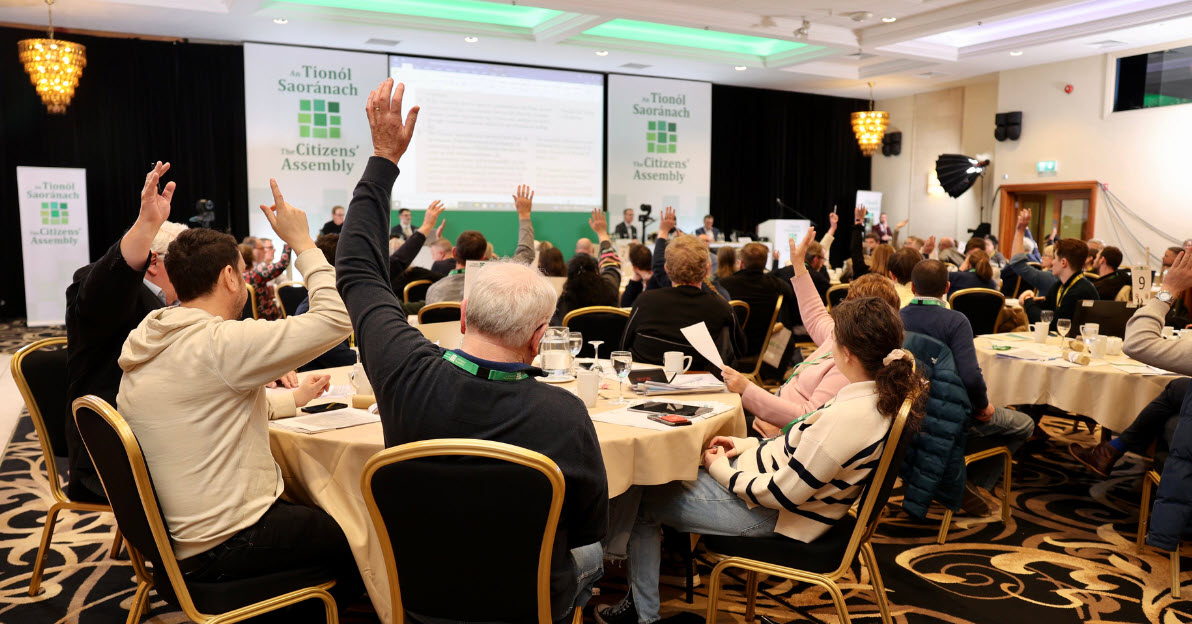
Whatever recommendations the the Citizens’ Assembly on Drugs Use makes, it is up to the government to decide on them. Same-sex marriage and abortion rights achieved legislative reform through this route but response to the recent Citizens’ Assembly on Biodiversity Loss has been very different. The government and our political leaders have failed to implement any its 150 recommendations to protect nature. It was almost certainly a mistake to make so many recommendations and this has given politicians the excuse they need to turn away and fail to act. It could well be the same on the difficult and controversial issue of drugs.
Yet nothing demands more immediate and urgent action. All the violence, disorder and anti social behaviour about which there is so much concern is driven by criminal drugs markets. Demand for drugs comes from within our communities. It is our families, our sons, daughters, brothers, sisters, mothers and fathers that are the customers of these criminal gangs. While in 90% of cases their drug use causes no harm to themselves or others, they enrich and empower the gangsters and government has done nothing to regulate these markets to reduce all the harm they cause.
While politicians refuses to acknowledge and provide sensible and safe legal access for drugs, particularly cannabis, all they do is turn the forces of law enforcement against the communities they are supposed to protect and add to the power and wealth of the drugs gangs.
It is the criminal markets that cause so much harm and only a small proportion of drugs users that suffer health harms. Street dealing, violence, child exploitation, debt intimidation, human trafficking, modern slavery, all these evils stem from the criminal markets which bad drugs policy has allowed to proliferate. And the health harms of drugs are maximised when criminals control their production and distribution, when there is no regulation, quality control, age limits or harm reduction infomation and education provided.
This is Ireland’s best chance ever for effective drugs policy reform and huge responsibility now rests on the shoulders of Paul Reid, chair of the Citizens’ Assembly. In the remaining three meetings, will he encompass the broad agenda which the issue demands or will we continue only to hear about one, narrow aspect?
Clearly, problematic drug use has a terrible impact on those involved and their families but we already know that the answer is properly funded treatment services. Also, problematic drug use drives violent and acquisitive crime as users have no option but to access drugs from criminals at high cost. The answer here is also properly funded treatment services but also regulation of markets, so that legal access is possible but in controlled and safe circumstances.
We need properly funded treatment services, safe consumption rooms, decriminalisation of the user, legally regulated access for adults at least to cannabis, MDMA and possibly cocaine, drug testing services, education and harm reduction services.
Such intelligent, evidence-based and progressive drugs policy will drive the gangsters off our streets. It will stop the violence, the mugging, the anti social behaviour of feral youth, It will reduce health harms, overdoses deaths and all sorts of crime. But it requires courage. It needs politicians to take decisions that will attract the fury of the older, reactionary, authoritarian wing of society but unless we takes these steps then Ireland’s drugs problem is only going to get worse. The demand isn’t going away and unless we find a sensible way of meeting it in safe, regulated fashion then the violent gangsters and everything that flows from their activity will continue.
The Houses of Parliament, the London Drugs Commission and Cannabis

Last week I was invited to give evidence to the London Drugs Commission on the effectiveness of the UK’s drugs laws, focusing on cannabis.
Later that same day I attended the Cannabis Industry Council’s event at the Houses of Parliament where we launched our ‘Protect our Patients’ campaign to enable cannabis prescribing by GPs.
All in all, a good day in London, a city I appreciate much more from afar than when I used to live there!
Dear Lord Falconer,
It was a pleasure to meet you and your colleagues on the London Drugs Commission last week. Thank you for the opportunity to give evidence.
I am writing to summarise the key points that I made.
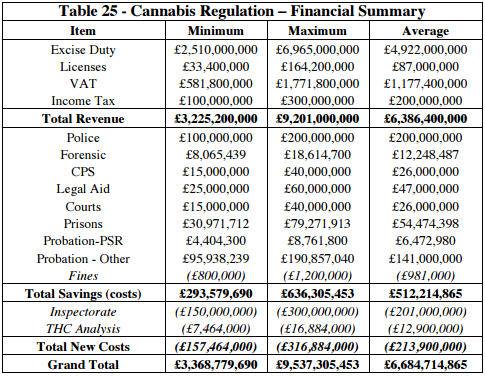
- There have been a number of studies and papers published on the costs/benefits of cannabis legalisation and regulation, including the paper by Chris Snowdon of the IEA who was also in our meeting. The IEA, the Taxpayers’ Alliance, Health Poverty Action, the Adam Smith Institute, the Beckley Foundation with the University of Essex and the LSE have all published well-researched analyses. I endorse them all but none is as comprehensive or uses the variety of sources (many no longer available) as the study that CLEAR Cannabis Law Reform commissioned in 2011 from the Independent Drug Monitoring Unit. Although now 12 years old, it remains as relevant as ever. The price of cannabis has, if anything, reduced while all other costs have increased.
‘Taxing the UK Cannabis Market’, 2011, Atha et al, projects a net annual gain to the UK economy of between £3.4 billion to £9.5 billion based on a £1 per gram cannabis sales tax in addition to VAT. See the attached table which neatly summarises this. I have also attached a full copy of the study.
- Cannabis is not harmless and you won’t find anyone serious who makes this claim. However its health harms are systematically and consistently exaggerated. Peanuts and shellfish cause more health harms. Finished admission episodes to hospital for ‘mental and behavioural problems’ related to cannabinoids are at one-fifth the rate of such admissions for alcohol. What appears to be a massive increase in community-based treatment for young people is confounded because 89% of such treatment is coercive. That is, such ‘treatment’ is imposed by authorities such as educational institutions or the courts as an alternative to suspension/expulsion or harsher sentences. (Sources NHS, DHSC)
The University of York estimates the risk of a diagnosis of psychosis associated with cannabis use for regular users is 1 in 20,000. Comparatively, the National Geographic Society estimates the lifetime risk of being struck by lightning at 1 in 3,000.
However, the more harmful you think cannabis is, the more irrational and irresponsible it is to leave the market unregulated and controlled by criminals.
- Cannabis prohibition creates deep and far reaching fractures in our society which affect everyone. With the value of the market at least three times that of Class A drugs such as heroin and cocaine, it is the principal provider of regular cashflow to organised crime. It drives gangsterism, street dealing, underage use, violence, knife crime, intimidation, exploitation, county lines, human trafficking, contaminated products, societal breakdown and authoritarian policing of people’s private lives.
When government finally takes responsibility for the cannabis market and regulates it, the benefits will transform society, making our streets safer and reducing crime of all sorts. Prohibition of this largely benign and very popular substance has turned the forces of law enforcement against the communities they are supposed to protect. This policy was always destined to fail and persisting with it has caused immense, incalculable harm.
If I can be of further assistance please let me know.
Kind regards,
Peter Reynolds
18 Truths on Drugs Policy
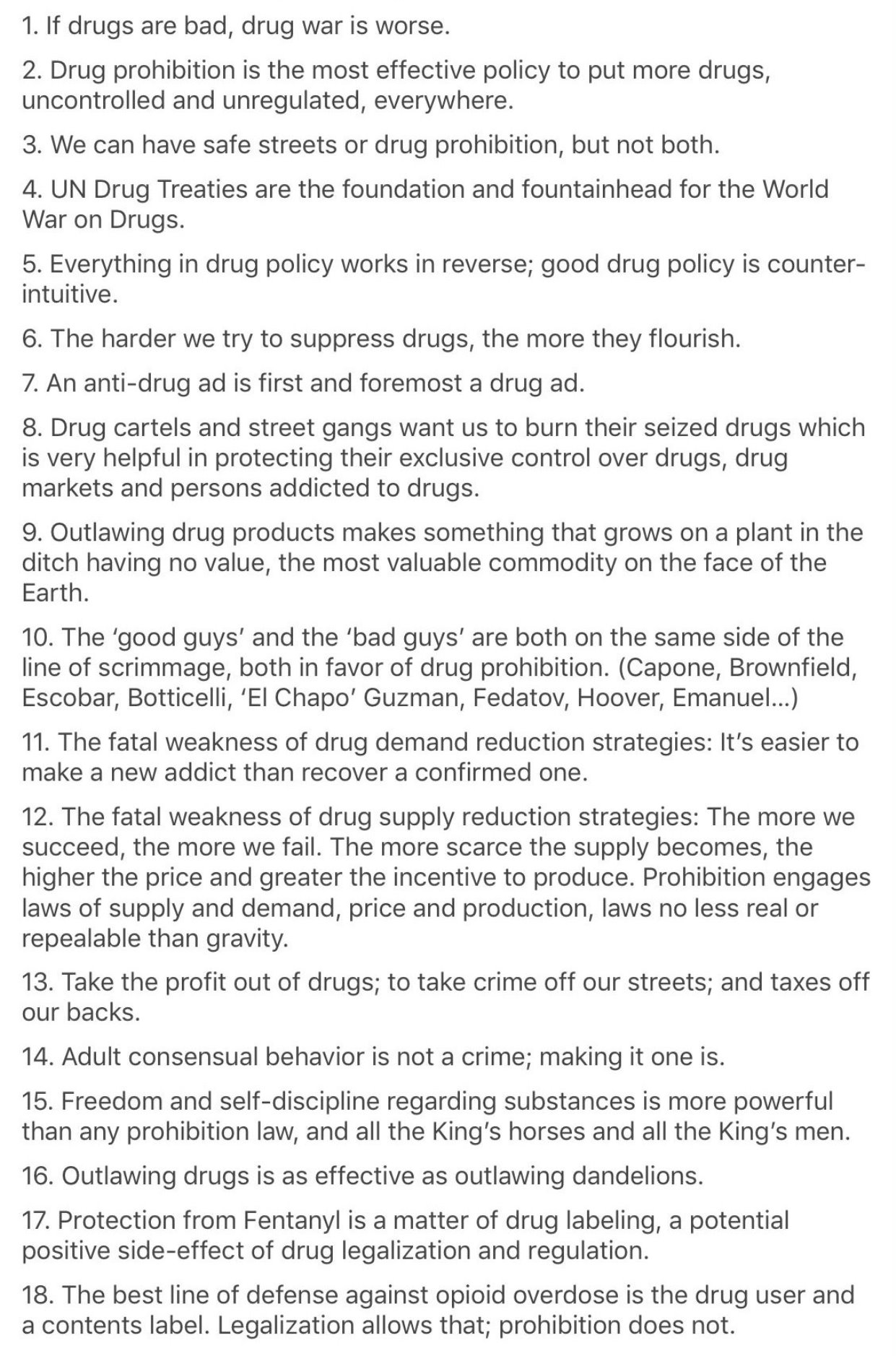
Source: @JamesGierach Retired Chicago-area attorney, former Cook County prosecutor, drug policy reformer, author, Gierach Blogs at http://jamesgierach.tumblr.com
Blundering decision on Nitrous Oxide will Increase Danger, Harm and Anti-Social Behaviour
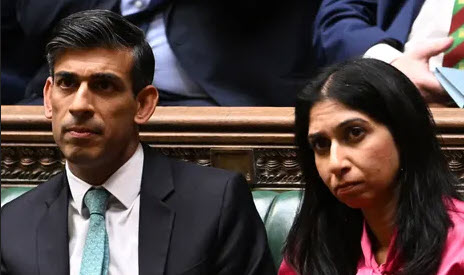
The ban on safe, legitimate supply of nitrous oxide will directly endanger young people, create a criminal market and introduce many to an underworld of drug supply, violence and exploitation
It was inevitable, like seeing an express train barrelling down towards you, our politicians’ decision to criminalise and endanger millions of young people by this prohibition. It was unstoppable in a world where politicians’ main concern is how they are portrayed in the increasingly hard-right British press. .
And it is not just the Conservative government but the Labour Party who support this foolish and inane move, even in opposition.
Nitrous oxide is much, much safer than alcohol which presently has a monopoly on legal, recreational drugs. It causes far less anti- social behaviour, far less littering and has no role in promoting the violence that is often inevitable with alcohol. There is no rational, scientific or moral reason for banning it.
Prohibition will drive this product underground. It means that criminals will immediately start selling legitimate products diverted from their intended use. Alongside it, heroin, crack and toxic new synthetic drugs will be on offer. Quickly it will cause criminal gangs to start illicit manufacture of the gas. This is a dangerous, potentially explosive process and can produce gas contaminated with colourless, odourless but highly toxic nitric oxide.
It is difficult to imagine a more stupid or reckless decision but this is exactly what our politicians have always done on drugs policy. It’s even more difficult too imagine what will ever cause them to change. As Britain becomes more authoritarian, dissent is crushed and politicians, increasingly distant from the public, seem to converge into an autocratic union where both major parties are the same.
IRELAND. Minister for Justice, Simon Harris TD, Sets Out to Sabotage the Citizens’ Assembly on Drugs Before it’s Even Started
Only the day after the government formally annouces the Citizens’ Assembly on Drugs, Simon Harris TD, the Minister for Justice, pulls that old prohibitionist trope again and blames drugs consumers for the harms caused by prohibition drugs policy.
He’s says he’s “concerned about the growing social acceptance of drug taking in this country…the increasing prevalance and often visibility of drug taking as part of a night out in Ireland.”
He says “there is a direct link between snorting a line, taking a pill and murder, assault, criminality and misery.”
Exactly as there would be if the market in Guinness and Jameson wasn’t properly regulated.
Consumers are not responsible for the harms caused by government’s failure to regulate drugs markets. In every other market, including the drugs market for alcohol, government acts to minimise harm and tackle rogue operators. In other drugs markets, unbelievably if you think about it, government policy maximises all harms and supports the gangsters’ business model.
It is government which has created the gangsterism around drugs. In Ireland the government and the Kinahans are on the same side. They both want drugs to remain banned and the harder government drives the gardai to ‘crack down’ on drugs, the higher the prices rise and the more profit the Kinahans and other gangsters make.
Harris isn’t the first politician to blunder into this trap and he won’t be the last,. It’s a way of diverting attention from the horrendous damage to our society which their dreadful drugs policy has caused. Harris and politicians throughout the world have their hands dripping in blood from the wars, murder, torture, death and degradation their laws have caused.
Vancouver’s Experiment with Decriminalisation of all Drugs
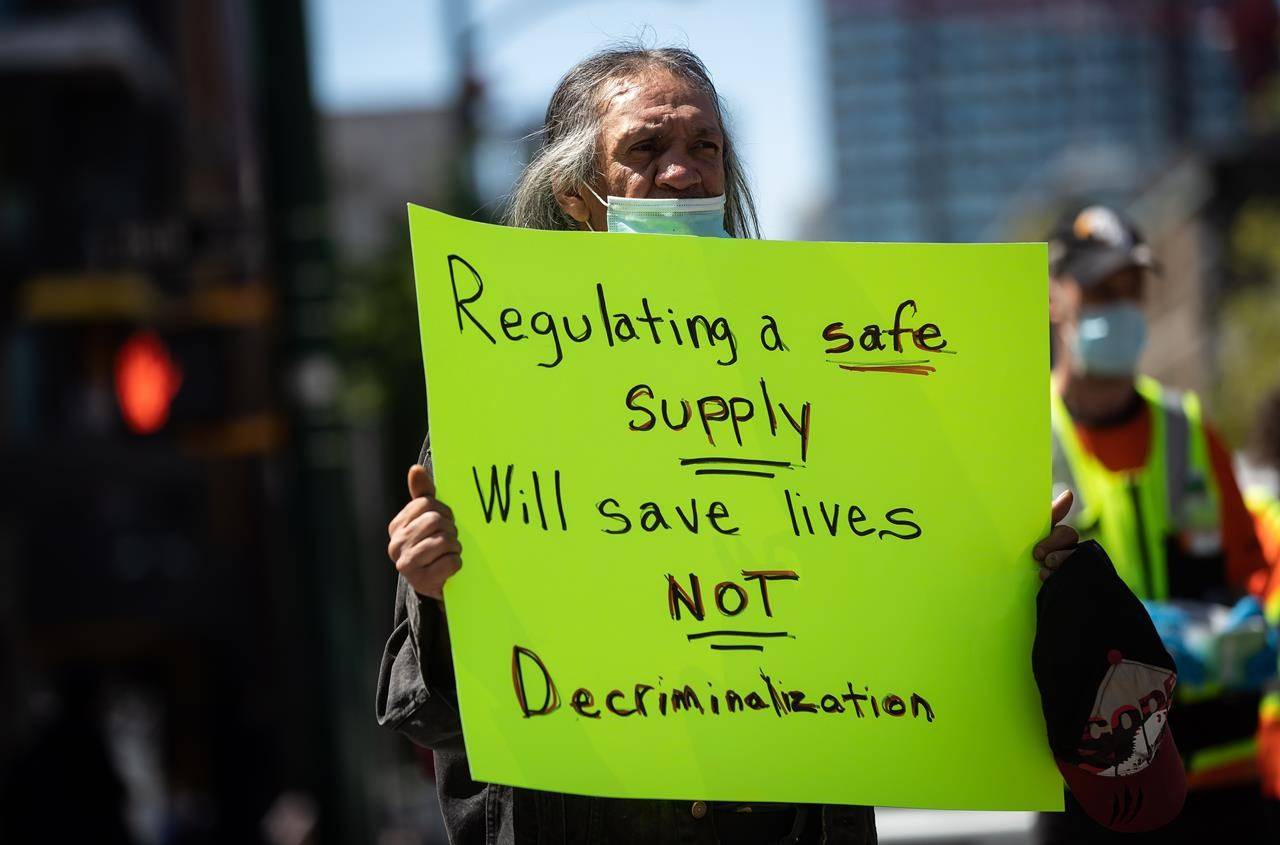
Decriminalisation is an extremely dangerous halfway measure that frees up the market while leaving it under control of gangsters. All the dangers of contaminated product, unknown strength, violence and exploitation continue and will probably get worse.
The only effective drugs policy is legal regulation of all substances where access to clean, known-strength product from regulated sources is available but restricted in accordance with their potential for harm. This would mean that alcohol would be more tightly restricted than cannabis. Heroin or meth would only be available under medical supervision.
This won’t eliminate all harm but it will minimise it, instead of prohibition which maximises all harm.
Prohibition never works because demand comes from the communities that law enforcement is duty-bound to protect. So if the authorities try to try to ‘crack down’, as idiotic British governments have for over 50 years, it makes everything worse
Far more intelligent drugs policy is required and while decriminalisation is part of that because criminalising people for drug use achieves nothing and only causes harm, it is not the solution. Governments need to take responsibility rather than abandoning it to gangsters. That means legal regulation.

 Peter Reynolds