Posts Tagged ‘CLEAR’
The CLEAR Executive Committee
Following recent changes, the CLEAR executive committee is now comprised of the following people.
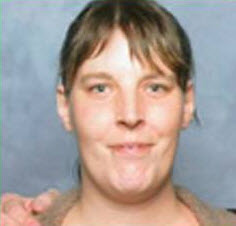 Andrea Clarke
Membership Manager
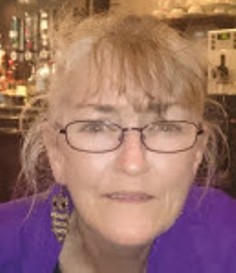 Vicky Hodgson
Medicinal Users Panel
Vicky was awarded a fellowship of CLEAR in August 2014
 Peter Reynolds
President
 Graham Smith
Graham was awarded a fellowship of CLEAR in July 2015
 Derek Williams
Derek was awarded a fellowship of CLEAR in February 2014.
He is presently on compassionate leave caring for his mother who is gravely ill.
The CLEAR Cannabis Law Reform Campaign.
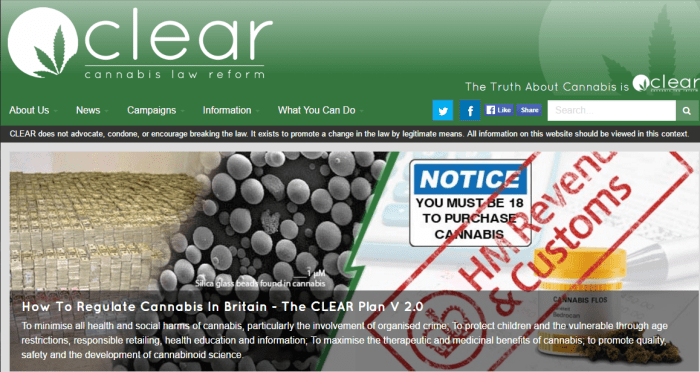
In five years, CLEAR has transformed the UK cannabis campaign from a ragtag group of protestors into a coherent, science and evidence-based strategy. New groups pursuing similar, responsible advocacy have emerged such as the United Patients Alliance (UPA) and most recently End Our Pain (#EndOurPain). In the last three years, in government and Parliament, there has been more liaison between the campaign, ministers and senior politicians than in the last 50 years. The Liberal Democrats have formally adopted policies which are almost identical to those enshrined in CLEAR’s aims and objectives.
Fundamental to CLEAR’s work has been the publication of evidence and the development of plans based on consultation with consumers, patients, doctors, scientists, academics and other experts.
These three publications form the basis for all our work. Please download them, read them, share them and use them as widely as you can. Together they defeat all the arguments for the continuing ban on cannabis.
The most authoritative, independent, expert research on the UK cannabis market by the Independent Drug Monitoring Unit, commissioned by CLEAR in 2011.
 How To Regulate Cannabis In Britain
This is the second version of a plan for the regulation of the cannabis supply chain in Britain. This version was published on 18th October 2013
 Medicinal Cannabis: The Evidence
The most up-to-date, comprehensive analysis of the evidence on the safety and efficacy of cannabis as medicine. Focuses on Alzheimer’s disease, cancer, chronic pain, Crohn’s disease and multiple sclerosis. Published April 2015.
CLEAR Withdraws Its Endorsement of UK CBD.
 CLEAR can no longer endorse or recommend UK CBD as a supplier of CBD products.
This decision is made with regret but is unavoidable due to a number of problems which, despite our best efforts, have proved impossible to resolve. Our endorsement was based on UK CBD’s ethical and quality standards but the position has changed and the directors of UK CBD have been unable satisfactorily to address our concerns.
Our main concern is that certain products marketed by UK CBD contain such high levels of the controlled drugs THC and CBN that we consider them to be unlawful.
One particular product, UK CBD 710 Cannabinoid Crystals, is being promoted as containing “over 4mg of THC”. Anyone importing, supplying or in possession of this product risks criminal prosecution.
Potentially this product could destroy the whole CBD market. If a prosecution was brought under the Psychoactive Substances Act 2016, it could result in all CBD products being regarded as psychoactive.
CLEAR strongly supports the developing CBD market as a legal alternative to high-THC products. However, it is vital for the security of consumers that products comply with the law.
A CLEAR Response To the Liberal Democrats’ Proposals For Cannabis Regulation.
CLEAR welcomes the Liberal Democrats’ proposals which can be seen here. We set out below a few comments which we intend to be constructive.
We represent more than 600,000 people who support cannabis law reform. Our own publication, ‘How to Regulate Cannabis in Britain’ is now in its second edition.
It is based on independent, expert research which we commissioned from the Independent Drug Monitoring Unit, published as ‘Taxing the UK Cannabis Market’.
Comments on ‘A framework for a regulated market for cannabis in the UK’
1. We support a cautious approach and agree that it is better to start with stricter regulation that could, based on experience, be relaxed at a later date if appropriate.
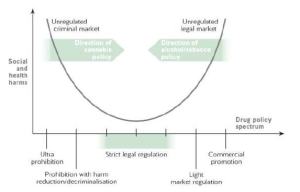
Spectrum of Cannabis Policy
We reject the diagram ‘Exploring a spectrum of options for regulating cannabis’ which paints an inaccurate picture of the effects of a legal market. Evidence from all jurisdictions that have implemented reform does not support the equivalence of ‘social and health harms’ with ‘ultra prohibition’ and ‘commercial production’. It is absolutely clear that legally regulated commercial production is far less harmful than prohibition.
Essentially, instead of a ‘U’ shaped curve, we consider an ‘L’ shaped curve is more accurate.
2. The diagram indicates a fundamental objection to the commercial model implemented in Colorado, Washington and Oregon and the report explicitly rejects the Colorado model in favour of the Uruguay model.
We disagree with this. The Colorado model is a proven success with virtually no downsides. The Uruguay model is still a theory which is yet to be proven in practice. This conclusion in the report is therefore not evidence-based. This suggests that wider political or philosophical considerations have been allowed to trump existing evidence.
3. We are concerned about the undue weight given to restricting commercial enterprise. The UK is not a socialist economy and there is a danger of a ‘nanny-state’ attitude which we cannot support. We repeat the point that it seems wider political or philosophical considerations have been allowed to prevail over actual evidence. There needs to be a balance between a ‘cautious approach’ as in 1. above and over-regulation which will only result in a continuing criminal market. The UK is a market economy and if the legal market is too strict and rigid, the illegal market will flourish.
4. We have very grave concerns about the cannabis social club (CSC) model which provides significant opportunity for the corruption of those involved into major criminal enterprises with exploitation of both workers and customers. The establishment of such ‘clubs’ is entirely unnecessary given the other more controllable methods of supply and will only lead to diversion and perhaps active marketing of excessive production through criminal networks. In other words, CSCs are a golden opportunity for the emergence of ‘drug pushers’ and they undermine the whole purpose of cautious regulation.
5. We regard the recommendation not to permit the production and marketing of ‘edibles’ as an error. If the other recommendations making raw herbal cannabis legally available are implemented then this will inevitably lead to the production and marketing of unregulated ‘edibles’, undermining the whole purpose of regulation. Far better to learn from the mistakes already made in excessively potent ‘edible’ products and introduce appropriate regulations with reduced dosages.
If anything, ‘edibles’ need regulation far more urgently than the raw product because of the potential for very unpleasant overdosing. To abrogate responsibility for this is an extremely unwise proposal and inconsistent with the whole basis for a regulated market.
6. We would encourage a more positive and supportive approach to enable producer countries such as Morocco, the Lebanon, Pakistan and Afghanistan to supply varieties of cannabis resin and hashish. Encouraging such trade under strict regulation will further undermine criminal activity and offers great potential for better relations and positive ‘soft power’ influence on these countries. We recognise the difficulties involved in this with regard to the UN conventions but consider it is a prize worth working towards.
7. For the same reasons set out above we consider that a refusal to regulate concentrates and vapouriser products undermines the whole purpose of a regulated market. Vapouriser products are almost certainly going to be an important component of the medical cannabis market. These nettles must be grasped. To avoid them is irresponsible.
8. We would argue for far more emphasis on harm reduction information, particularly about smoking and avoiding mixing cannabis with tobacco. As in 7. above, we would actively promote the choice of vapouriser products.
9. In principle we agree with the proposal for three levels of THC content and for minimum CBD content. However, there is no evidence to support the necessity for CBD content as high as 4%. The evidence suggests that levels of 1% or 2% adequately meet the desirable ‘entourage’ effects of CBD. Furthermore, at these levels, existing strains are available. Little consideration has been given to the practicalities of developing three new strains to meet the THC:CBD ratios proposed. To develop such strains and ensure they are stable and consistent is the work of several years, requiring significant investment and so undermines the ability to implement these proposals in timely fashion.
10. We consider that the ‘plain packaging’ proposal is unnecessarily restrictive in the UK’s market economy. We agree with child proof containers but would recommend that far more emphasis is given to content and harm reduction labelling. There is nothing to be gained from restricting the marketing and commercial enterprise of companies wishing to develop brands and packaging styles within strict regulations.
11. For reasons already set out we consider that the restrictions on exterior and interior retailer environments are oppressive and will be self-defeating. The UK is not accustomed to such overbearing and anti-business regulation. Existing pharmacies do not operate under such heavy restrictions and they make significant use of point-of-sale and merchandising techniques.
Overall, we welcome this document and the proposals it contains. One final point that is of significance is that clearly there was no ‘consumer’ representation on the panel and this is obvious in some of the tone and detail of the report. We recommend that account should be taken of consumer opinion in any future development of the proposals.
Talking Cannabis In Parliament.
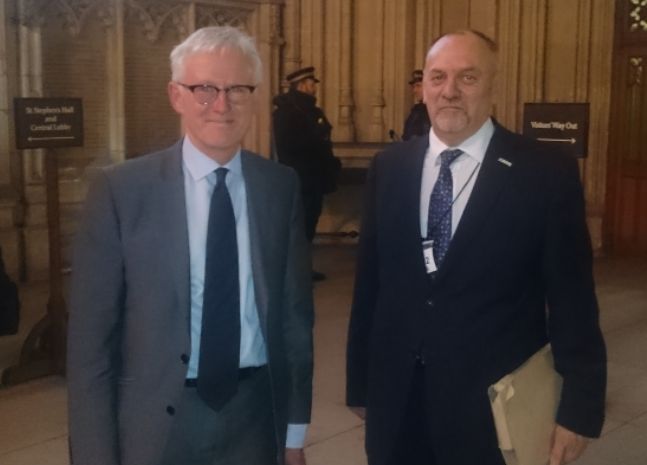
Norman Lamb MP, Peter Reynolds
Today, 8th February 2016, Peter Reynolds, president of CLEAR, met with Norman Lamb MP, Liberal Democrat spokesperson for health, for an update on the cannabis campaign.
Independent Panel of Experts on Cannabis Regulation.
The Liberal Democrats have set up an independent panel of experts to establish how a legalised market for cannabis could work in the United Kingdom. Norman Lamb wants the panel to look at evidence from Colorado, Washington State and Uruguay, where cannabis has been legalised and to make recommendations for the party to consider in the spring.
As a contribution to the panel’s work, CLEAR has provided the independent study it commissioned in 2011, ‘Taxing the UK Cannabis Market’ which establishes the most comprehensive database on the reality of cannabis in the UK. In addition, The CLEAR Plan, ‘How To Regulate Cannabis in Britain’, builds on this data to propose detailed regulations for exactly how the market could work and contribute a £6.7 billion net gain to the UK exchequer.
Imminent Launch of New Medicinal Cannabis Campaign.
Within the next few days, CLEAR, along with other cannabis law reform groups, will co-operate in the launch of probably the largest campaign for access to medicinal cannabis ever seen in the UK. The time has come when people who are suffering must be given the opportunity to stop their pain with a safe, non-toxic, proven alternative to expensive and debilitating pharmaceutical products. The intransigence of successive UK governments must be overcome and this time a strategy is in place which will work.
The CLEAR publication ‘Medicinal Cannabis:The Evidence’ has received international acclaim and is the most comprehensive and up to date review of the scientific evidence supporting the use of cannabis.
Further Development of Liberal Democrat Drugs Policy.
In 1971, when the Misuse of Drugs Act came into force there were approximately 3,000 problematic drug users in the UK. Today, 45 years on, that figure has risen to around 350,000. Norman Lamb describes this as “one of the greatest public policy disasters of all time”. Today, in a speech about the prison service, David Cameron talked of the need to tackle the most difficult social problems facing Britain. Drug crime and drug addiction is probably the single biggest factor in our prison problems and the consequences of 45 years of failed drugs policy pervades our society. As the Liberal Democrats consider this difficult issue, tackling reform of cannabis policy is the first step.
CLEAR, The British Medicinal Cannabis Campaign and UK CBD Combine To Offer Media Briefings.
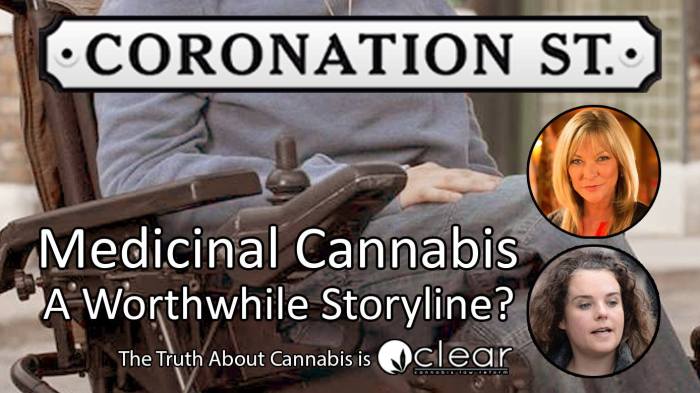
The subject of cannabis as medicine is certain to rise to the top of the UK news agenda in forthcoming weeks as a new Coronation Street storyline unfolds.
The character Izzy Armstrong (Cherylee Houston) who has Ehlers-Danlos Syndrome, will be seen suffering when her prescription medicine fails to alleviate her pain. Erica Holroyd (Claire King) will then suggest that she starts using cannabis as an alternative and ends up supplying Izzy with the drug. The programme will look at all aspects of the debate on medicinal cannabis and examine the legal implications and the far reaching consequences of Izzy’s actions for her family.
Now, three of the UK’s most important organisations in the field are joining forces to provide the media with facts, evidence and personal testimonies about medicinal cannabis.
CLEAR is the largest drugs policy reform group in the UK with nearly 600,000 followers. The British Medicinal Cannabis Campaign (BMCC) is an independent group consisting of 4,500 members, all of whom are UK-based medicinal cannabis users. UK CBD is the leading distributor of legal, cannabinoid nutraceuticals including the world famous Charlotte’s Web and Mary’s brands.
Roland Gyallay-Pap, managing director of CLEAR, commented:
“Not for the first time, but at a crucial time in the worldwide debate, the issue of medicinal cannabis will be addressed in a British soap. We have high hopes that this will stimulate the debate and bring the absurdity of the UK government’s position into sharp focus.”
Throughout Europe, the USA, Canada, Australia, Israel and South America, interest in and the use of medicinal cannabis is growing fast. The UK is now virtually isolated amongst first world countries with the stubborn refusal of government even to consider the evidence. However there is a growing clamour from politicians, scientists and doctors that it must address what is a deeply cruel and evidence-free policy. Hundreds of thousands already use medicinal cannabis and risk a criminal record just for trying to improve their health. In addition they have to deal with a criminal underworld and risk violence, contaminated and low quality product all because government refuses to take responsibility.
There is now an overwhelming body of peer-reviewed, scientific evidence on the safety and efficacy of cannabis as medicine. CLEAR published ‘Medicinal Cannabis: The Evidence’ in April 2015 which has received international acclaim and is now also available in a Spanish language edition. Download here in English or Spanish.
Individual briefings will be available on request to journalists, reporters, media organisations and other interested parties. Briefings will be led by Peter Reynolds, one of the nation’s leading experts on the science, medicine and politics of cannabis, Mark Scott, a representative of BMCC and Nicolas Ellis, founder and managing director of UK CBD.
Please contact CLEAR to arrange a briefing at your premises by appointment. Alternatively, a central London venue can be arranged on request.
The Weak And Ineffectual Response Of Most MPs To The Cannabis Debate.
CLEAR has been mobilising its members as never before to lobby their MPs in advance of the cannabis debate on 12th October.
There are honourable exceptions but most responses have been unhelpful, dismissive and have completely failed to deal with the arguments put forward. Most MPs are indoctrinated with the false reporting churned out by the press, scared stiff of the subject and not prepared to look any deeper.
It is a terrible indictment of these people, each of whom costs us about £250,000 per year in salary and expenses. Most simply do not do their job properly, certainly not in the interests of or representing their constituents, mainly they just pursue their own political ambitions and interests. They cannot be bothered to deal with the cannabis issue.
Usually, from both Tory and Labour MPs, the responses parrot the official Home Office line. Most are too lazy to inform themselves about cannabis and the facts and evidence around current policy which costs the UK around £10 billion per annum. This vast sum comprises a futile waste of law enforcement resources and the loss of a huge amount of tax revenue. It provides funding to organised crime, including human trafficking, and does nothing to prevent any health or social harms around cannabis. In fact, if anything it maximises these harms, endangering health, communities and the whole of our society by enforcing a policy which is based not on evidence but on prejudice. Source: http://clear-uk.org/media/uploads/2011/09/TaxUKCan.pdf

Paul Flynn MP
As Paul Flynn MP, said in the House on 14th September:
“There is [a debate] in a fortnight’s time, on a subject that terrifies MPs. We hide our heads under the pillow to avoid talking about it, but the public are very happy to talk about it in great numbers. That subject is the idea of legalising cannabis so that people here can enjoy the benefits enjoyed in many other countries that do not have a neurotic policy that is self-defeating and actually increases cannabis harm.”
Source: http://www.theyworkforyou.com/whall/?id=2015-09-14a.185.0#g194.0
Below I reproduce a reply from one MP. This is the standard MP line on cannabis. The words may vary slightly but essentially this is the response that the Home Office enforces and, irrespective of party, these are the disingenuous statements that MPs hide behind.
“I believe cannabis is a harmful substance and use can lead to a wide range of physical and psychological conditions. I therefore do not support the decriminalisation or legalisation of cannabis at this time.
I welcome that there has been a significant fall in the numbers of young people using cannabis, and the number of drug-related deaths among under-30s has halved in a decade and I would not want to see this progress undermined.”
Stating cannabis is harmful is meaningless and and an evasion of the question. Anything can be harmful. Such an assertion only has any meaning when in comparison to other substances. In fact, cannabis is relatively benign, even when compared to many foods. It is much less harmful than energy drinks, junk food, all over-the-counter and prescription medicines and, of course, tobacco and alcohol. Compared to these two most popular legal drugs, cannabis is hundreds of times less harmful. Source: http://www.ncbi.nlm.nih.gov/pmc/articles/PMC4311234/

If cannabis can lead to a wide range of physical and psychological conditions, what are they and how likely is cannabis to bring them on compared to other substances? In fact, the Royal College of Psychiatrists, whose publications are often presented as evidence of cannabis harms, states unequivocally
“There is no evidence that cannabis causes specific health hazards.”
Source: http://www.rcpsych.ac.uk/healthadvice/problemsdisorders/cannabis.aspx
There is a reported fall in cannabis use from the British Crime Survey. However, the Association of Chief Police Officers reports ever increasing incidents of cannabis cultivation and there has been a massive surge in the use of ‘legal highs’ or novel psychoactive substances. Without exception, these are far more harmful than cannabis and their very existence is the product of government policy. In places such as Holland and the US states that have legalised, there is no problem at all with such substances.
As for “drug-related deaths”, this is classic disinformation. What does it have to do with cannabis? Are our MPs so badly informed that they cannot distinguish between different drugs? Sadly, in many cases the answer is yes. Even so, this is a false claim. The latest figures show an increase in the number of drug poisoning deaths to the highest level since records began in 1993. So much for the claimed “progress”. Source: http://www.ons.gov.uk/ons/dcp171778_414574.pdf
Just recently MPs have started to address the question of medicinal use, almost certainly because of the rising clamour from people in pain, suffering and disability. Also because the UK is now a very long way out of step with the rest of Europe, the USA, Canada, Israel, Australia and most ‘first world’ countries. Source: http://clear-uk.org/static/media/PDFs/medicinal_cannabis_the_evidence2.pdf
“I am aware that one of the issues raised is around enabling the use of cannabis for medicinal purposes. I know that cannabis does not have marketing authorisation for medical use in the UK, and I understand that the Medicines and Healthcare products Regulatory Agency can grant marketing authorisation to drug compositions recognised as having medicinal properties, such as in the case of Sativex.”
A marketing authorisation from the Medicines and Healthcare products Regulatory Agency (MHRA) is a deliberate diversion from the issue. Medicines do not have to have an MHRA marketing authorisation. Doctors can prescribe any medicine, licensed or unlicensed, as they wish. However, since 1971, medical practitioners have been specifically prohibited from prescribing cannabis on the basis of no evidence at all except minsters’ personal opinions. Source: http://www.legislation.gov.uk/uksi/2001/3997/made.
Applying for an MHRA marketing authorisation costs over £100,000 as an initial fee and clinical trials have to be conducted at a cost of at least the same again. Instead, minsters could simply move cannabis from schedule 1 of the Misuse of Drugs Regulations to schedule 2 alongside heroin and or, more logically, to schedule 4, alongside the cannabis oil medicine Sativex. This would place the whole question of the use of cannabis as medicine in the hands of doctors and not in the politically motivated hands of Westminster. Isn’t that where it should be?
 This is the most important short term objective of the cannabis campaign – move cannabis out of schedule 1. Not only would this enable doctors to prescribe Bedrocan medicnal cannabis as regulated by the Dutch government but it would mean research could start in earnest. The restrictions presently in place on cannabis, because it is schedule 1, make research very expensive, complicated and are a real deterrent.
If you haven’t lobbied your MP on the cannabis debate yet, you still have time to. If you can, get along and see them in a constituency surgery. Full guidance is provided here but you must act now: http://clear-uk.org/guidance-on-how-to-lobby-your-mp-for-the-cannabis-debate/
Most MPs run surgeries on Fridays so that means you have just this coming Friday, 2nd October and the following 9th October.
Please at least ensure you write to your MP. This is our moment and we are having an impact. Make sure you do your bit.
It’s Time To Be CLEAR.
The prohibition of cannabis has caused massive harm to our society. It has created a criminal market which has attacked our children, our communities, our health and our liberty. The time to end this failed experiment is now.
Cannabis in West Sussex, England, UK. With acknowledgement and thanks to Joni Mitchell and Eddie Mitchell of Aerial News. (No relation, as far as we know)
I came upon a child of God
He was walking along the road
And I asked him where are you going
And this he told me
I’m going on down to Yasgur’s farm *
I’m going to join in a rock ‘n’ roll band
I’m going to camp out on the land
I’m going to try an’ get my soul freeWe are stardust
We are golden
And we’ve got to get ourselves
Back to the gardenThen can I walk beside you
I have come here to lose the smog
And I feel to be a cog in something turning
Well maybe it is just the time of year
Or maybe it’s the time of man
I don’t know who I am
But you know life is for learningWe are stardust
We are golden
And we’ve got to get ourselves
Back to the gardenBy the time we got to Woodstock
We were half a million strong
And everywhere there was song and celebration
And I dreamed I saw the bombers
Riding shotgun in the sky
And they were turning into butterflies
Above our nationWe are stardust
Billion year old carbon
We are golden
Caught in the devil’s bargain
And we’ve got to get ourselves
back to the garden
© Siquomb Publishing Company
“The British People Have Been Systematically Misled, Misinformed And Deceived About Cannabis.”
Peter Reynolds, president of CLEAR, interviewed on Sky News, Sunday, 9th August 2015
Peter Reynolds Steps Down, Roland Gyallay-Pap Appointed Acting Leader of CLEAR.
At a meeting of the CLEAR Executive Committee held over the weekend of 18th/19th July 2015, Peter Reynolds tendered his resignation as leader. He was first elected as leader in February 2011, won a confidence vote in April 2012 and was re-elected unopposed in February 2014.

Roland Gyallay-Pap
Roland-Gyallay-Pap has been appointed acting leader and preparations will now begin for a leadership election.
Roland Gyallay-Pap said:
“I would like to extend a big thank you to Peter for the tireless work he has put in over the past four years. It is through his professionalism and tenacity that CLEAR is where it is now.
“I will seek to capitalise on our achievements so far, extending membership, and further building on the success of our Medicinal Users Panel. Never have we been so close to achieving our goals and I look forward to working with those who share our views on how change can be brought about in the most effective manner.”
Peter Reynolds’ letter of resignation reads:
Dear Colleagues,
This is my resignation from the office of leader of CLEAR, effective immediately.
I will remain a member of the leadership team as president of the executive committee. However, it is time for a new leader to take charge and drive our campaign forward.
I want to thank all members of CLEAR for the opportunity to serve as leader since February 2011. I am immensely proud of what we have achieved. We have built a follower base that exceeds all other UK drugs policy groups combined. We have developed a set of policies and tactics that are more effectively challenging cannabis prohibition than ever before. We have made more progress with government in the last two years than the whole campaign has in the last 50.
I will now concentrate on managing the Medicinal Users Panel. This is at the core of our strategy for practical, achievable law reform. It is, I believe, how I can now make the most effective contribution. CLEAR needs a new face to take the next steps in our campaign and I shall give my full support to our new leader.

 Peter Reynolds