Archive for the ‘Health’ Category
The CLEAR Cannabis Law Reform Campaign.
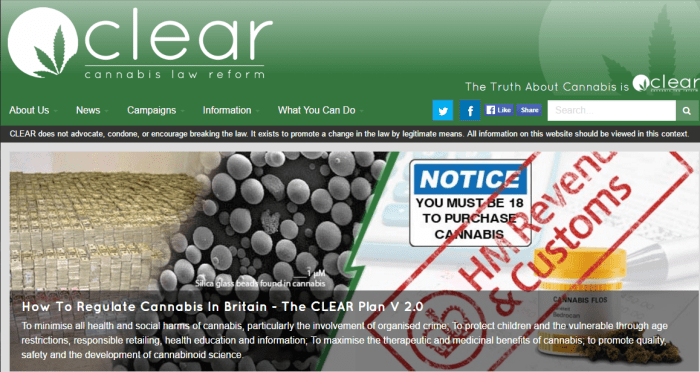
In five years, CLEAR has transformed the UK cannabis campaign from a ragtag group of protestors into a coherent, science and evidence-based strategy. New groups pursuing similar, responsible advocacy have emerged such as the United Patients Alliance (UPA) and most recently End Our Pain (#EndOurPain). In the last three years, in government and Parliament, there has been more liaison between the campaign, ministers and senior politicians than in the last 50 years. The Liberal Democrats have formally adopted policies which are almost identical to those enshrined in CLEAR’s aims and objectives.
Fundamental to CLEAR’s work has been the publication of evidence and the development of plans based on consultation with consumers, patients, doctors, scientists, academics and other experts.
These three publications form the basis for all our work. Please download them, read them, share them and use them as widely as you can. Together they defeat all the arguments for the continuing ban on cannabis.
The most authoritative, independent, expert research on the UK cannabis market by the Independent Drug Monitoring Unit, commissioned by CLEAR in 2011.
 How To Regulate Cannabis In Britain
This is the second version of a plan for the regulation of the cannabis supply chain in Britain. This version was published on 18th October 2013
 Medicinal Cannabis: The Evidence
The most up-to-date, comprehensive analysis of the evidence on the safety and efficacy of cannabis as medicine. Focuses on Alzheimer’s disease, cancer, chronic pain, Crohn’s disease and multiple sclerosis. Published April 2015.
LibDems: Correct On Cannabis Policy, Wrong On Scaremongering.
The Liberal Democrats are doing great work on advancing the cause of cannabis law reform. Their policy proposals are sensible and their arguments for change are irrefutable but they are wrong to buy into and sustain the myths and scaremongering that have dominated the cannabis debate for so long.
Cannabis does not cause psychosis. Stronger strains do not present serious health risks. Memory loss is not a significant issue and no issue at all in comparison to the health harms of alcohol or tobacco. Cannabis cannot be described as dangerous unless you also apply that word to hay fever remedies, over-the-counter painkillers and energy drinks. There is not and never has been any scientific evidence to support these myths.
Of course, we must be sensitive to people’s fears and concerns. For more than 50 years the British people have been fed a stream of lies and exaggeration by the tabloid media. The Home Office, right up to today, is engaged in a systematic and deliberate policy to mislead and misinform on cannabis. Shocking though that fact is, this policy transcends successive governments and continues irrespective of ministers’ views. It clearly emanates from dishonest and corrupt officials who are determined to pursue their own agenda, irrespective of truth or concern for the massive harms and cost of cannabis prohibition.
 Norman Lamb, the Liberal Democrat MP and health spokesperson, who is leading the party’s campaign, is a brave, sincere and conscientious politician. One of the few in Westminster that matches up to the high standards of probity and wisdom that we should be able to expect from all MPs. Similarly, Nick Clegg, former leader, and Tim Farron, current leader, have spoken out strongly on the need to reform the law. Now is the time for them also to start telling the truth about cannabis, about how its dangers have been vastly exaggerated, how for adults, in moderation, it can actually be very beneficial and far preferable as a choice of relaxant to alcohol. Indeed, if people substituted cannabis for some of their alcohol consumption, it would be a public health revolution. It would save the NHS billions and transform the health of our society.
The cannabis campaign will not succeed unless we tell the truth. We cannot compromise facts and evidence for the illusory belief that buying into the scare stories will somehow advance the cause. We need to push back at the scaremongering, acknowledge there are risks but that they are extremely small. They really only apply to use by children or to behaviour that is analogous to a ‘white cider drinker’. Consume anything to excess, regularly, without a break, without regard to other aspects of life and it will cause harm but even then, cannabis will cause less harm than any other substance.
As for children, one of the main aims of reform must be to minimise underage use. Even then, the scare story that cannabis is causing significant mental health problems amongst young people is untrue. The Department of Health’s own data shows that in the last five years, there has been an average of just 28 episodes per year of care for ‘cannabis psychosis’ in young people. 28 individual tragedies but an insignificant problem in public health terms.
The misuse of the term ‘skunk’ is also unhelpful. The Channel 4 ‘Drugs Live’ debacle last year was based on reckless, irresponsible overdosing of inexperienced users by a scientist who should know better. All the time calling the cannabis was called ‘skunk’ when it is a matter of fact that it was silver haze as grown by Bedrocan, the Netherlands’ government producer of medicinal cannabis. Skunk is actually the name of one particular cannabis strain and not an especially strong one. Cannabis is available in Britain that is twice, sometimes three times as potent as skunk but the word has been selected and promoted by the tabloid press because of its obvious, sensationalist, negative connotations.
Thank you to the Liberal Democrats for the fantastic work they are doing. All we need now is a little adjustment and focus on truth rather than scare stories.
‘Poppers Are Not Psychoactive’. The Arrogant Madness Of UK Drugs Policy.
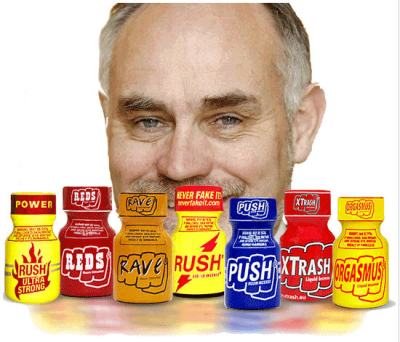
Crispin Blunt MP
If you want something slightly less psychoactive than poppers, I suggest you try a crack pipe.
Seriously, poppers produce an instantaneous high as powerful and intense as anything I have ever known. Cannabis, alcohol, even cocaine are mild and gentle compared to the rush that you get from inhaling the vapour from a bottle of poppers. Maybe crack or crystal meth are stronger. I don’t claim knowledge at that extreme end of drugs experiences.
It’s well established fact that successive UK governments are dishonest and corrupt on drugs policy. You cannot trust anything the Home Office says about drugs. The reality of the policies of both Labour and Tory governments is that they maximise harm and cause enormous damage to our society as well as individuals.
The announcement today that poppers are to be excluded from the Psychoactive Substances Act because they are ‘not psychoactive’ is as ludicrous a statement as ever made by any government anywhere. See minister Karen Bradley’s announcement here.
The Psychoactive Substances Act is universally recognised as the most ridiculous and scientifically-illiterate legislation ever passed by Parliament – universal that is with the exception of the slippery fools that sit in the House of Commons. Most of them have no idea at all of what they are doing on drugs policy and their only concern is to appease the Daily Mail, the Daily Telegraph and the hysteria drummed up by the prohibition lobby. However, when one of their own, Crispin Blunt, MP for Reigate, complains about his drug of choice being banned, in record time the Home Office has obtained fake scientific advice and reversed its decision to ban poppers. Meanwhile, benign, largely beneficial, mild and virtually harmless cannabis remains banned, even for those in desperate need to relieve their pain, suffering and disability.
Don’t misunderstand me, I don’t think poppers should be banned. They are known as a sex aid amongst gay men as they relax the anal sphincter, enabling easier ‘backdoor’ sex. There’s a good argument that this helps to prevent injury and therefore infection but they are also an intense sexual stimulant. I can confirm they are great fun for straight sex too.
I’m very pleased that Crispin Blunt will continue to have access to his drug of choice and I have no argument with him at all. He is an MP who is on the record as supporting cannabis law reform, particularly for medicinal use. It’s the sickening, dishonest and corrupt conduct of Home Office ministers that must be condemned.
I’d like to see the craven fools at the Home Office take a big whack off a bottle of poppers and then say they aren’t psychoactive. Black is white and pigs fly over Marsham Street when it comes to drugs.
CLEAR Withdraws Its Endorsement of UK CBD.
 CLEAR can no longer endorse or recommend UK CBD as a supplier of CBD products.
This decision is made with regret but is unavoidable due to a number of problems which, despite our best efforts, have proved impossible to resolve. Our endorsement was based on UK CBD’s ethical and quality standards but the position has changed and the directors of UK CBD have been unable satisfactorily to address our concerns.
Our main concern is that certain products marketed by UK CBD contain such high levels of the controlled drugs THC and CBN that we consider them to be unlawful.
One particular product, UK CBD 710 Cannabinoid Crystals, is being promoted as containing “over 4mg of THC”. Anyone importing, supplying or in possession of this product risks criminal prosecution.
Potentially this product could destroy the whole CBD market. If a prosecution was brought under the Psychoactive Substances Act 2016, it could result in all CBD products being regarded as psychoactive.
CLEAR strongly supports the developing CBD market as a legal alternative to high-THC products. However, it is vital for the security of consumers that products comply with the law.
A CLEAR Response To the Liberal Democrats’ Proposals For Cannabis Regulation.
CLEAR welcomes the Liberal Democrats’ proposals which can be seen here. We set out below a few comments which we intend to be constructive.
We represent more than 600,000 people who support cannabis law reform. Our own publication, ‘How to Regulate Cannabis in Britain’ is now in its second edition.
It is based on independent, expert research which we commissioned from the Independent Drug Monitoring Unit, published as ‘Taxing the UK Cannabis Market’.
Comments on ‘A framework for a regulated market for cannabis in the UK’
1. We support a cautious approach and agree that it is better to start with stricter regulation that could, based on experience, be relaxed at a later date if appropriate.
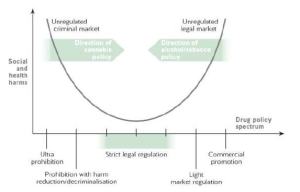
Spectrum of Cannabis Policy
We reject the diagram ‘Exploring a spectrum of options for regulating cannabis’ which paints an inaccurate picture of the effects of a legal market. Evidence from all jurisdictions that have implemented reform does not support the equivalence of ‘social and health harms’ with ‘ultra prohibition’ and ‘commercial production’. It is absolutely clear that legally regulated commercial production is far less harmful than prohibition.
Essentially, instead of a ‘U’ shaped curve, we consider an ‘L’ shaped curve is more accurate.
2. The diagram indicates a fundamental objection to the commercial model implemented in Colorado, Washington and Oregon and the report explicitly rejects the Colorado model in favour of the Uruguay model.
We disagree with this. The Colorado model is a proven success with virtually no downsides. The Uruguay model is still a theory which is yet to be proven in practice. This conclusion in the report is therefore not evidence-based. This suggests that wider political or philosophical considerations have been allowed to trump existing evidence.
3. We are concerned about the undue weight given to restricting commercial enterprise. The UK is not a socialist economy and there is a danger of a ‘nanny-state’ attitude which we cannot support. We repeat the point that it seems wider political or philosophical considerations have been allowed to prevail over actual evidence. There needs to be a balance between a ‘cautious approach’ as in 1. above and over-regulation which will only result in a continuing criminal market. The UK is a market economy and if the legal market is too strict and rigid, the illegal market will flourish.
4. We have very grave concerns about the cannabis social club (CSC) model which provides significant opportunity for the corruption of those involved into major criminal enterprises with exploitation of both workers and customers. The establishment of such ‘clubs’ is entirely unnecessary given the other more controllable methods of supply and will only lead to diversion and perhaps active marketing of excessive production through criminal networks. In other words, CSCs are a golden opportunity for the emergence of ‘drug pushers’ and they undermine the whole purpose of cautious regulation.
5. We regard the recommendation not to permit the production and marketing of ‘edibles’ as an error. If the other recommendations making raw herbal cannabis legally available are implemented then this will inevitably lead to the production and marketing of unregulated ‘edibles’, undermining the whole purpose of regulation. Far better to learn from the mistakes already made in excessively potent ‘edible’ products and introduce appropriate regulations with reduced dosages.
If anything, ‘edibles’ need regulation far more urgently than the raw product because of the potential for very unpleasant overdosing. To abrogate responsibility for this is an extremely unwise proposal and inconsistent with the whole basis for a regulated market.
6. We would encourage a more positive and supportive approach to enable producer countries such as Morocco, the Lebanon, Pakistan and Afghanistan to supply varieties of cannabis resin and hashish. Encouraging such trade under strict regulation will further undermine criminal activity and offers great potential for better relations and positive ‘soft power’ influence on these countries. We recognise the difficulties involved in this with regard to the UN conventions but consider it is a prize worth working towards.
7. For the same reasons set out above we consider that a refusal to regulate concentrates and vapouriser products undermines the whole purpose of a regulated market. Vapouriser products are almost certainly going to be an important component of the medical cannabis market. These nettles must be grasped. To avoid them is irresponsible.
8. We would argue for far more emphasis on harm reduction information, particularly about smoking and avoiding mixing cannabis with tobacco. As in 7. above, we would actively promote the choice of vapouriser products.
9. In principle we agree with the proposal for three levels of THC content and for minimum CBD content. However, there is no evidence to support the necessity for CBD content as high as 4%. The evidence suggests that levels of 1% or 2% adequately meet the desirable ‘entourage’ effects of CBD. Furthermore, at these levels, existing strains are available. Little consideration has been given to the practicalities of developing three new strains to meet the THC:CBD ratios proposed. To develop such strains and ensure they are stable and consistent is the work of several years, requiring significant investment and so undermines the ability to implement these proposals in timely fashion.
10. We consider that the ‘plain packaging’ proposal is unnecessarily restrictive in the UK’s market economy. We agree with child proof containers but would recommend that far more emphasis is given to content and harm reduction labelling. There is nothing to be gained from restricting the marketing and commercial enterprise of companies wishing to develop brands and packaging styles within strict regulations.
11. For reasons already set out we consider that the restrictions on exterior and interior retailer environments are oppressive and will be self-defeating. The UK is not accustomed to such overbearing and anti-business regulation. Existing pharmacies do not operate under such heavy restrictions and they make significant use of point-of-sale and merchandising techniques.
Overall, we welcome this document and the proposals it contains. One final point that is of significance is that clearly there was no ‘consumer’ representation on the panel and this is obvious in some of the tone and detail of the report. We recommend that account should be taken of consumer opinion in any future development of the proposals.
Tim Farron. Another Politician Displays Total Ignorance About Cannabis.
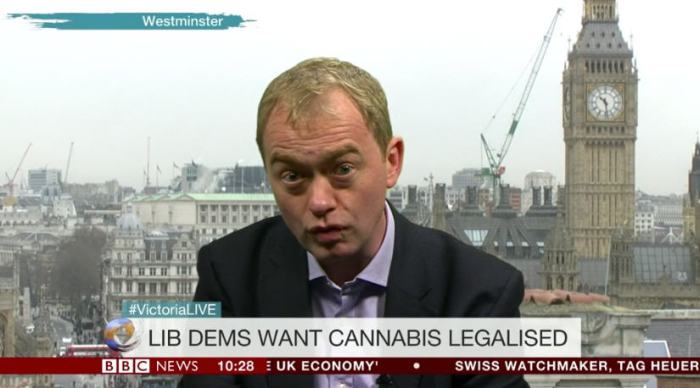
Tim Farron on BBC’s Victoria Derbyshire show
It is truly pathetic to see. Farron clearly understands the huge harm caused by cannabis prohibition but doesn’t have the knowledge, the courage or the integrity to speak the truth. Instead he panders to to the scaremongers and says:
“Cannabis causes psychosis”
“Cannabis is dangerous”
“People who use cannabis have a health problem”
“Cannabis is a bad thing”
The Liberal Democrat’s report ‘A framework for a regulated market for cannabis in the UK: Recommendations from an expert panel’ is a re-hash of Transform’s ‘Blueprint’ and its work on a socialist model of cannabis regulation in Uruguay. It denigrates the highly successful commercial model introduced in Colorado and follows Transform’s evidence-free exaggeration of the harms of cannabis and its determination to impose anti-business controls on a legal cannabis market.
There is no evidence that cannabis causes psychosis. The most that can be said is that in a very small number of genetically-vulnerable people, it may be one of many ‘component causes’.
There is no evidence that cannabis is dangerous. The most that can be said is that it does have the potential for harm if used by children, to excess, irresponsibly or by a tiny group of people who may have an allergic reaction. If you describe cannabis as dangerous then you have to describe peanuts, aspirin and hay fever remedies as more dangerous. That’s without even considering comparison with the two most dangerous drugs of all: tobacco and alcohol.
Some people who use cannabis have a health problem and they use cannabis for its remarkable properties to relieve pain and other symptoms. For most people, in moderation, cannabis is actually beneficial, helping to protect against autoimmune conditions, cancer, dementia and other diseases of aging.
For at least 95% of people who use cannabis they do so safely, without any negative consequences and it is a very good thing for their health and wellbeing.
CLEAR Evidence For the APPG Medicinal Cannabis Inquiry.
Roland Gyallay-Pap, Peter Reynolds
Yesterday, 2nd March 2016, Roland Gyallay-Pap and Peter Reynolds were called to give evidence at the All Party Parliamentary Group for Drug Policy Reform Inquiry into Regulation of Cannabis for Medicinal Use.
We have already submitted a 15 page written response. Yesterday’s oral hearing was to enable the inquiry to question us in more detail. We cannot publish our written response or go into great detail about yesterday’s hearing until the inquiry has published its own report which is some weeks away yet.
As we arrived at the hearing, Tom Lloyd, ex-chief constable of Cambridgeshire, was waiting to go in so we sat at the back of the committee room and listened to his contribution. Later, after our session, we adjourned to the Westminster Arms for some legal recreational drug use and to swop notes. Tom is a great asset to the campaign and we were able to update each other on the work we are involved in.
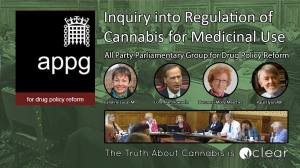
The inquiry panel consisted of three MPs and five members of the House of Lords. Roland opened our session with an account of how cannabis oil had helped in the last months of his mother’s life before she died from pancreatic cancer. The whole panel was visibly moved. Baroness Meacher explained that this was not the only such testimony they had heard. Everyone was extremely receptive. A lot of detailed questions were asked about CLEAR’s work and our knowledge of the science, law and best practice involved in medicinal cannabis.
The inquiry’s report will undoubtedly support some reform of the law around medicinal cannabis. Let us hope it will provoke real action from government.
Top Jersey Doctor Misinforms and Misleads On Medicinal Cannabis.

Dr Nigel Minihane
Dr Nigel Minihane is the head of Jersey Primary Care Trust which represents all GPs on the island. Recently he contributed supposedly ‘expert opinion’ to an article in the Jersey Evening Post about someone who had been juicing raw cannabis for therapeutic reasons. His comments demonstrate an ignorance and lack of knowledge which is unacceptable in a doctor in such a senior position. In conjunction with CLEAR members in Jersey, we have submitted a formal complaint.

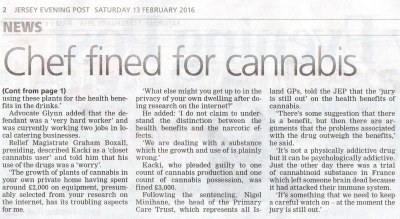
Jersey Evening Post, 13th February 2016
Dear Sirs,
On behalf of our members in Jersey, we wish to bring a complaint of misconduct against Dr. Nigel Minihane concerning comments attributed to him and published in the Jersey Evening Post on 13th February 2016.
The article in question is attached to this email. The passage we are concerned about is at the very end of the article where Dr Minihane gives false information about a recent drug trial in France which resulted in one death and several people suffered brain damage.
The trial to which Dr Minhane refers was not “of a cannabinoid substance”, it was of an FAAH inhibitor, known as BIA 10-2474. This drug is designed to inhibit the natural degradation of endocannabinoids, leading, it was hoped, to pain relief through modulation of the CB receptor network. It was therefore neither a cannabinoid substance nor cannabis. See: http://www.nature.com/news/scientists-in-the-dark-after-french-clinical-trial-proves-fatal-1.19189
Dr Minihane’s words were therefore inaccurate and misleading and contribute to the prejudice and misunderstanding around the use of cannabis and cannabinoids as medicine. Dr Minihane is, of course, entitled to his opinion but based on his other comments in the article he is clearly very poorly informed on the subject. There is a vast amount of peer reviewed, published evidence which supports the safety and efficacy of cannabis and cannabinoids as medicine. See attached paper ‘Medicinal Cannabis: The Evidence’. Furthermore, it is well established in the evidence that cannabis is physically addictive, with about 9% of regular users developing dependence which is characterised by physical withdrawal symptoms including insomnia, lack of appetite and headache.
We understand that Dr Minihane is head of the Jersey Primary Care Trust and the Jersey Evening Post will have asked him to provide an expert opinion. The information he provided was inaccurate, misleading and reckless. In our view it falls well below the professional standard that one is entitled to expect from any doctor. It is woefully inadequate in the case of a doctor in such a senior position who holds himself out as an expert yet communicates false information to the public through the media.
We would be grateful if you would consider this complaint at your earliest opportunity. We are able to provide oral evidence in support and to suggest witnesses resident in Jersey who endure unnecessary pain and suffering due to medicinal conditions that coud be treated by cannabis if the PCT was properly assessing and considering the evidence.
Yours faithfully
Peter Reynolds
President
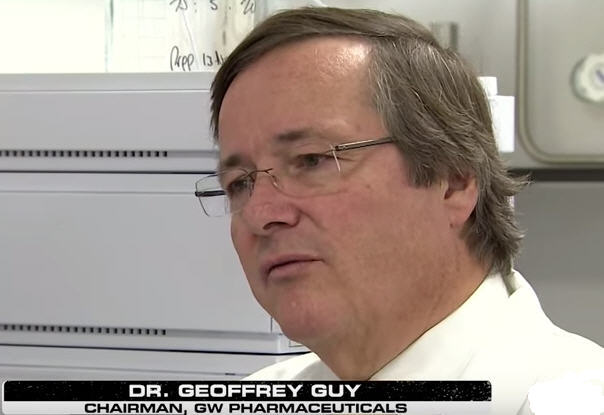
GW Founder And Chairman, Geoffrey Guy, Explains Sativex.
“Most people in our industry said it was impossible to turn cannabis into a prescription medicine. We had to rewrite the rule book. We have the first approval of a plant extract drug in modern history. It has 420 molecules, whereas every other drug has just one.”
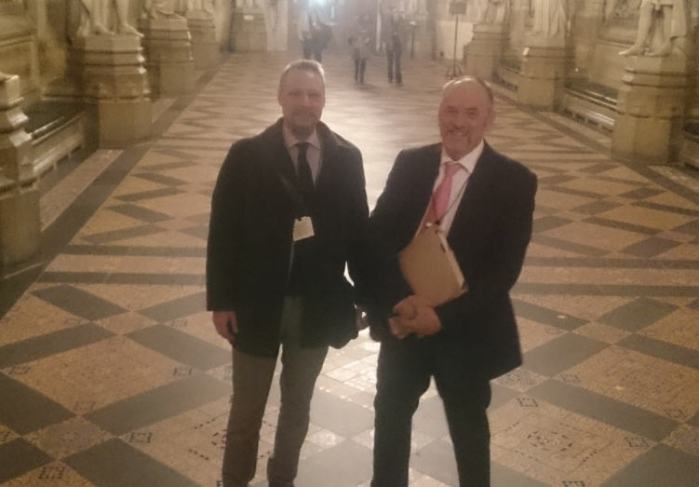
Talking Cannabis In Parliament.
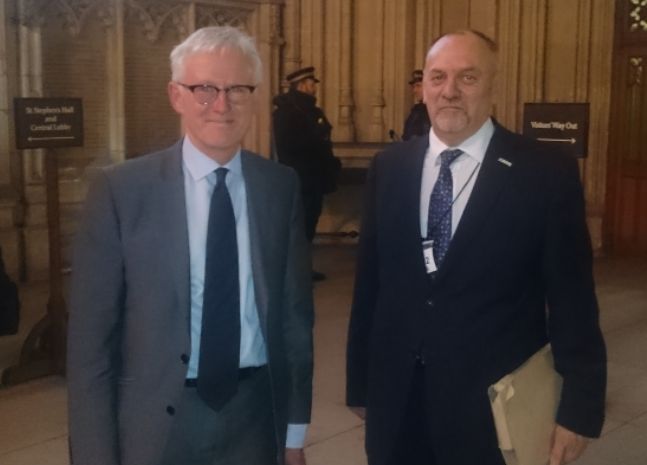
Norman Lamb MP, Peter Reynolds
Today, 8th February 2016, Peter Reynolds, president of CLEAR, met with Norman Lamb MP, Liberal Democrat spokesperson for health, for an update on the cannabis campaign.
Independent Panel of Experts on Cannabis Regulation.
The Liberal Democrats have set up an independent panel of experts to establish how a legalised market for cannabis could work in the United Kingdom. Norman Lamb wants the panel to look at evidence from Colorado, Washington State and Uruguay, where cannabis has been legalised and to make recommendations for the party to consider in the spring.
As a contribution to the panel’s work, CLEAR has provided the independent study it commissioned in 2011, ‘Taxing the UK Cannabis Market’ which establishes the most comprehensive database on the reality of cannabis in the UK. In addition, The CLEAR Plan, ‘How To Regulate Cannabis in Britain’, builds on this data to propose detailed regulations for exactly how the market could work and contribute a £6.7 billion net gain to the UK exchequer.
Imminent Launch of New Medicinal Cannabis Campaign.
Within the next few days, CLEAR, along with other cannabis law reform groups, will co-operate in the launch of probably the largest campaign for access to medicinal cannabis ever seen in the UK. The time has come when people who are suffering must be given the opportunity to stop their pain with a safe, non-toxic, proven alternative to expensive and debilitating pharmaceutical products. The intransigence of successive UK governments must be overcome and this time a strategy is in place which will work.
The CLEAR publication ‘Medicinal Cannabis:The Evidence’ has received international acclaim and is the most comprehensive and up to date review of the scientific evidence supporting the use of cannabis.
Further Development of Liberal Democrat Drugs Policy.
In 1971, when the Misuse of Drugs Act came into force there were approximately 3,000 problematic drug users in the UK. Today, 45 years on, that figure has risen to around 350,000. Norman Lamb describes this as “one of the greatest public policy disasters of all time”. Today, in a speech about the prison service, David Cameron talked of the need to tackle the most difficult social problems facing Britain. Drug crime and drug addiction is probably the single biggest factor in our prison problems and the consequences of 45 years of failed drugs policy pervades our society. As the Liberal Democrats consider this difficult issue, tackling reform of cannabis policy is the first step.

 Peter Reynolds