CLEAR and GroGlo Establish First UK Clinical Trials on Cannabis for Chronic Pain.

CLEAR has formed a partnership with the research arm of GroGlo, a UK-based manufacturer of high power, LED, horticultural grow lighting.
The plan is to grow cannabis under a Home Office licence for the production of cannabis oil, both as a dietary supplement and for the development of medical products. To begin with, a low-THC crop of industrial hemp will be planted. We will be using the finola strain, originally developed in Finland and known for its short stature and early flowering. Unlike hemp grown for fibre, finola is usually grown for seed and only reaches a height of 160 – 180 cm but we will be removing male plants before they produce pollen and cultivating the female plants to produce the maximum yield of oil from their flowering tops.

Finola Industrial Hemp
The low-THC oil will be marketed as a dietary supplement, commonly known as CBD oil. There is already a burgeoning market in the UK for CBD products, all of which is currently imported from Europe or the USA. In the USA, the CBD products market was said to be worth $85 million in 2015 so there is huge potential here at home. Aside from the benefit of being UK grown and processed, we anticipate achieving a CBD concentration of about 40%, which is higher than most products already on the market.
Cultivation will be in glasshouses supplemented with LED lighting. GroGlo already has an established glasshouse facility in the east of England. Initial trials will experiment with adjusting the LED technology to provide a changing blend of light wavelengths at different stages of plant growth. This is GroGlo’s area of expertise -combining LED lighting and plant sciences, including existing relationships with some of Europe’s top universities. Professor Mick Fuller, GroGlo’s director of plant science, will lead this research and development process.

Professor Mick Fuller
During the R&D phase, CO2 extraction of oil will be carried out under laboratory conditions at universities in York and Nottingham which already have extensive experience of the process. Each crop will be measured for yield, cannabinoid and terpene content using high pressure liquid chromatography (HPLC). Safety testing will also look for the presence of heavy metals and other contaminants. The results of testing will be fed back into cultivation and extraction processes to maximise yield and quality.
It is anticipated that the first batches of low-THC oil will be ready for market in six months. We are already in discussions with potential distributors and wholesalers. The CBD market in the UK is ripe for an effective marketing campaign which could build a very substantial business for whoever gets it right.
Once we are successfully achieving our production goals with low-THC cannabis, the same testing and development process will begin with high-THC varieties of cannabis. The aim will be to produce a range of oils extracted from single strains, selectively bred and stabilised for different THC:CBD ratios.
Professor Fuller says that GroGlo lighting products “are in use worldwide to grow a range of crops, but some 60% of sales currently come from overseas users growing cannabis for legitimate medical use.” He explains that there is an emerging market for all sorts of nutritional and medicinal plant products but cannabis shows particular promise. GW Pharmaceuticals is the only UK company to enter this market and it has become a world leader, despite the current restrictive legislation. He says: “Together with CLEAR we believe we can help bring a range of safe, high quality UK-produced cannabis products to market within a matter of two to three years.”
A key issue in the development of a successful medicinal cannabis product is the method of delivery. Smoking is not an acceptable solution as inhaling the products of combustion is an unhealthy practice but one of the great benefits of cannabis smoked as medicine is very accurate self-titration. That is the effects of inhaled cannabis are felt almost instantly and so the patient knows when they have taken enough or when they need more to achieve the required analgesic effect.
The oral mucosal spray developed for Sativex is unpopular with patients, many complain of mouth sores from its use and it was developed at least as much with the objective of deterring ‘recreational’ use of the product as with delivering the medicine effectively. It strangles the therapeutic benefits of the cannabis oil of which Sativex is composed in order to comply with the concerns of the medicines regulators about ‘diversion’ of the product into what they would term ‘misuse’. Absorption of the oil is quicker through the mucous membranes of the inside of the mouth than through the gastrointestinal system but, inevitably, some of the oil is swallowed and the pharmacology of cannabis when processed through the gut and the liver is very different.
We believe the best option is a vapouriser device and our intention is to source a ‘vape pen’ of sufficient quality to operate within clinical standards of consistency and safety. Vapourising cannabis oil avoids inhaling the products of combustion but still enables accurate self-titration of dose. A vape pen would provide a handy, convenient and very effective method of consuming medicinal cannabis. However, aside from the technology itself, initial research shows that vapour is more effectively produced when the oil is blended with either vegetable glycerin (VG) or propylene glycol (PG). Establishing the correct ratio of VG or PG to the oil is another important task.
We anticipate that clinical trials for the use of cannabis oil in treating chronic pain could start within two years. We want to compare different oils, ranging from high-CBD to equal ratios of THC:CBD and high-THC content. Prior to that we have to overcome the challenges of cultivation, oil extraction, vapouriser development and assemble the necessary research team and gain ethical approval for the trials. Recruitment for the trials will start in about 18 months time. If you wish to be considered please email ‘paintrials@clear-uk.org’ with brief details of your condition (no more than 100 words). Do not expect to hear anything for at least 12 months but your details will be passed to the research team as a potential candidate.

Mike Harlington, Managing Director of GroGlo
CLEAR is promoting this venture simply because someone needs to do something to make this happen. For all the campaigning and lobbying of MPs and ministers, at the end of the day, the plants have to be grown and the various legislative hoops have to be jumped through. We cannot wait any longer for a radical change in the law. We have to progress through the government’s regulatory regime if we want to bring real therapeutic benfit to patients.
This opportunity arises because of the vision of GroGlo’s managing director, Mike Harlington and the team of experts he has built around him. There is huge demand for legitimate medicinal cannabis products in the UK which is only going to increase with the inevitable progress towards law reform and increasing awareness of the benefits of cannabis. Together, CLEAR and GroGlo are bringing the great hope that medicinal cannabis offers closer to reality than ever before.
Complaint Against Mike Hall, West Midlands Police ‘Cannabis Disposal Team Manager’.
It’s becoming more common for police forces to launch publicity campaigns about their cannabis law enforcement activities. They may be seeking to justify their expenditure or, perhaps, appease the sort of members of the public who have their Crimestoppers ‘scratch ‘n’ sniff card to hand and turn in their neighbours for growing a few plants. To be fair, there is anti-social behaviour around some farms: destruction of rental property, theft of electricity, human trafficking, fire risks and street dealing. These are real social harms that the police do need to deal with. Of course they would all be virtually eliminated by a legally regulated market and the police could get on with tackling real crime.
West Midlands Police are the latest force to join up with a local media outlet to look in detail at their cannabis operations, in this case the Wolverhampton Express & Star, the biggest-selling regional evening newspaper in Britain.

Mike Hall
Earlier in April a series of articles were published, all based around the ‘Cannabis Disposal Team Manager’, Mike Hall. To those who follow UK cannabis stories he is a familiar figure who is often quoted in Midlands local newspapers. He shares some characteristics with other police officers involved in cannabis operations, a bit like PC Adge Secker of Avon and Somerset Police, against whom CLEAR is already successfully pursuing a complaint. They seem to be publicity hungry, truculent and rather cocky. They consider themselves as experts, when their knowledge is actually very weak, and they seem to think they can use fear, scaremongering, exaggeration and express their personal political opinions in their official capacity.
They can’t. In fact, engaging in politics amounts to misconduct for a police officer.
We have submitted a formal complaint to the Professional Standards department of West Midlands Police.
From: Peter Reynolds
Sent: 20 April 2016 14:40
To: ‘contactus@west-midlands.pnn.police.uk’
Subject: Attention Professional Standards Department. Complaint against Mike Hall, cannabis disposal team manager.
Importance: HighDear Sirs,
1. I wish to make a complaint against Mike Hall, cannabis disposal team manager.
I make the complaint on my own account but also in my capacity as the president of CLEAR Cannabis Law Reform of Kemp House, 152 City Road, London, EC1V 2NX. For the purposes of correspondence, please contact me via email.
2. Hall has been in engaging in politics by giving interviews to the Express and Star about cannabis which amount to politicking, propaganda, misleading and terrorising the public. The interviews can be seen at these links :
Published Apr 9, 2016. VIDEO. “Exclusive look inside a mock cannabis factory” https://youtu.be/kgpUsypBjhY
Published April 10, 2016 “Sowing the seeds of drugs: The easy-to-buy items that harbour a hidden secret”: http://www.expressandstar.com/news/2016/04/10/sowing-the-seeds-of-drugs-the-easy-to-buy-items-that-harbour-a-hidden-secret/
3. Police officers are specifically prohibited from engaging in politics by schedule 1 of the Police Regulations 2003 which states:
“A member of a police force shall at all times abstain from any activity which is likely to interfere with the impartial discharge of his duties or which is likely to give rise to the impression amongst members of the public that it may so interfere; and in particular a member of a police force shall not take any active part in politics.”
4. I am a victim of misconduct by Hall which has caused me distress at his misuse of his office to promote myth, prejudice and propaganda about cannabis and hatred of cannabis users as a social group. I am also acting on behalf of more than half a million registered supporters of CLEAR who are victims of Hall’s misconduct for the same reasons, particularly those who need cannabis as medicine for the treatment of conditions such as MS, Crohn’s disease, fibromyalgia, spinal injury, epilepsy and chronic pain. Hall has specifically attacked people suffering from arthritis with grossly offensive, defamatory and inaccurate claims.
5. In the video linked to in 2. above, starting at approximately 2:42, Hall says:
“Cannabis causes a lot of harm to the community. People talk about legalising and taxing it. From my point of view, I know that alcohol and tobacco are legalised and taxed but it doesn’t stop crimnals from profiting from counterfeiting and smuggling those commodities. There will always be crime linked to cannabis. If it was sold and legislated against there would still be underground users and growers that would be profiting from that legislation.
From my perspective and I’m an expert witness for cannabis for the purposes of the courts as well, I know that anybody who starts getting involved in cannabis it’s only a matter of time before, either out of jealousy or concern or spite, somebody lets the authorities know that you are growing cannabis. Now that can either result in the police coming round your house and you obtaining a crimnal conviction or, even worse, other people can find out and come and be armed raiders at your house to steal your cannabis. None of it is a good idea.”
6. It is incorrect to claim that “cannabis causes a lot of harm to the community”. The harms are caused not by cannabis itself but by enforcement of the law against it and would be exactly the same were basil, oregano or tomatoes prohibited. Hall’s expression of his opinions about legalising and taxing cannabis is clearly engaging in politics. His attempt to scare people about armed raiders is reprehensible. Police officers should not be terrorising the public with such exaggeration, falsehood and distortion. Hall is entitled to hold his political opinions but he is not entitled to express them in an official capacity. I recognise that cannabis is a controversial subject and people will hold different opinions but it is wholly wrong and unprofessional for any police officer to engage in this political debate and amounts to misconduct.
7. In the article linked to in 2. above, Hall is quoted as saying “We hear people talk about medicinal cannabis to help with arthritis, but then they are climbing up into their loft every three hours to water their plants.”. This is offensive to people who have arthritis and discriminates against them based on their medical condition. It is also manifestly ridiculous and inaccurate. Watering any type of plant every three hours would kill the plants. Also, modern medical practice is that people with arthritis are encouraged to keep moving. There is a great deal of peer-reviewed, published, scientific evidence that supports the safety and efficacy of using cannabis for chronic pain conditions. See attached document ‘Medicinal Cannabis:The Evidence’. Therefore, Hall’s remarks towards people with arthritis amount to misconduct.
8. Later in the article, Hall again engages in political debate. In response to the Liberal Democrat’s proposals for a regulated cannabis market, he is quoted as saying:
“It would impact on other legislation. We have relatively new laws on drug driving, but would we want the battle we have had with drink driving for decades to happen all over again? It could mean 30 years of hard publicity and no end of terrible accidents to get that through to people. You also have to ask what would happen to the thousands of unemployed drug dealers. They would turn to other areas of crime. And underground growers could profit further, as their product would not carry the tax and VAT of legal cannabis. Legalisation would not destroy the market for illegal cannabis. Tobacco and alcohol are legislated against but it doesn’t stop criminals from smuggling or counterfeiting.”
This is blatant politicking. Hall is engaging in politics in his official capacity which amounts to misconduct.
I would be grateful if you would deal with this complaint at your earliest convenience. I shall be happy to provide any further information required or to give oral evidence in support.
Yours faithfully,
Peter Reynolds
The CLEAR Executive Committee
Following recent changes, the CLEAR executive committee is now comprised of the following people.
 Andrea Clarke
Membership Manager
 Vicky Hodgson
Medicinal Users Panel
Vicky was awarded a fellowship of CLEAR in August 2014
 Peter Reynolds
President
 Graham Smith
Graham was awarded a fellowship of CLEAR in July 2015
 Derek Williams
Derek was awarded a fellowship of CLEAR in February 2014.
He is presently on compassionate leave caring for his mother who is gravely ill.
The CLEAR Cannabis Law Reform Campaign.
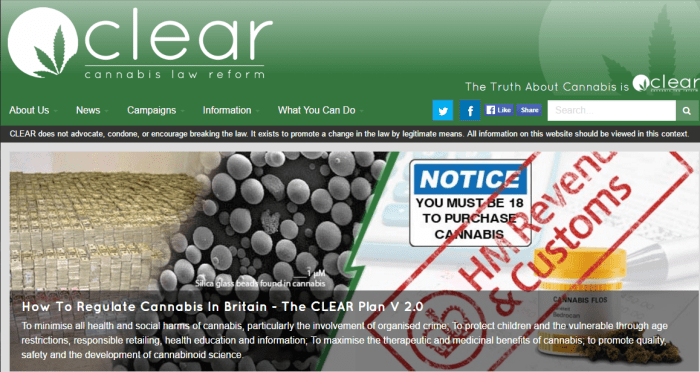
In five years, CLEAR has transformed the UK cannabis campaign from a ragtag group of protestors into a coherent, science and evidence-based strategy. New groups pursuing similar, responsible advocacy have emerged such as the United Patients Alliance (UPA) and most recently End Our Pain (#EndOurPain). In the last three years, in government and Parliament, there has been more liaison between the campaign, ministers and senior politicians than in the last 50 years. The Liberal Democrats have formally adopted policies which are almost identical to those enshrined in CLEAR’s aims and objectives.
Fundamental to CLEAR’s work has been the publication of evidence and the development of plans based on consultation with consumers, patients, doctors, scientists, academics and other experts.
These three publications form the basis for all our work. Please download them, read them, share them and use them as widely as you can. Together they defeat all the arguments for the continuing ban on cannabis.
The most authoritative, independent, expert research on the UK cannabis market by the Independent Drug Monitoring Unit, commissioned by CLEAR in 2011.
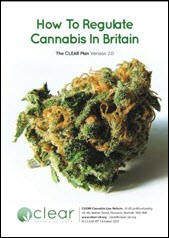 How To Regulate Cannabis In Britain
This is the second version of a plan for the regulation of the cannabis supply chain in Britain. This version was published on 18th October 2013
 Medicinal Cannabis: The Evidence
The most up-to-date, comprehensive analysis of the evidence on the safety and efficacy of cannabis as medicine. Focuses on Alzheimer’s disease, cancer, chronic pain, Crohn’s disease and multiple sclerosis. Published April 2015.
Cancel All Foreign Aid, Get Out Of The EU And Look After My People!

Port Talbot Steelworks
If it wasn’t for the miners and steelworkers of South Wales, the UK would now be a province of the Third Reich. As it is, the disastrous incompetence of the last Labour government, topped off by out-of-touch toffs has brought us to the point where if we stay in the EU, we will be just a subsidiary of Frau Merkel’s Greater Germany.
Call them Keystone Cops, Bullingdon Club Blaggers or Carry on No 10, the loons that sit round the cabinet table in Downing Street have failed this country and should be sent packing back to their country seats. They have no idea what Britain really is and even less how to lead us into an uncertain future.
The ramifications of South Wales steel pervade our economy and our society. It has made Britain great while Blair, Brown, Cameron and the self-serving political elite have diminished us in every way: financially, socially and morally. We are a shadow of our former selves. We must wrest back control from these idiots. They are an exact parallel with overpaid Premier League footballers: utterly selfish, egotistical to the ultimate, irresponsible of everything that does not benefit them directly and despised except of the power they hold. Footballers have their brains in their feet. Our political leaders have their brains in their wallets, pension funds and the sinecures they will acquire when they leave office.
My grandfather was a South Wales steelworker. It was career progress after he first went down the mines at age 14. In 1938, my father was malnourished with rickets because he didn’t have enough food to eat. It was only that year with the build-up to war that grandad had regular shifts and the family could be properly fed. Later my father won a scholarship to Oxford. In the 80s and 90s he became one of the top commercial lawyers in the City and independently wealthy. He was the archetypal boy from the valleys made good. Such is the way that South Wales steel has built Britain and not just with girders, RSJs and driving piles for foundations. It goes much deeper than that in ways that many of the Eton-educated wasters and ponces can never understand.
We must look after our own first. It is ludicrous that we have thousand using foodbanks, we’re cutting benefits for disabled people and meanwhile we’re giving £12 billion a year away in foreign aid, £300 million to India which spends its own money on a space programme! We also pay £13 billion each year to the EU. We have to stop this madness.
Any independent nation of significance must have its own steel manufacturing capability. We are the fifth biggest economy in the world. Save our steel industry by nationalising it. It’s not socialism, it’s common sense.
Personnel Changes At CLEAR.
Roland Gyallay-Pap has resigned as managing director of CLEAR.
Roland contributed significantly to the development of CLEAR and was a valued colleague. We are saddened by his departure and wish him well for the future.
Douglas Fraser has also left his position in charge of CLEAR’s IT systems and it will be no surprise that this is connected with the current offline status of the CLEAR website. Such behaviour is regrettable but we have already regained control of our domain. If the website itself is destroyed by malicious action we will simply have to make alternative arrangements. Various other CLEAR accounts have also been hacked but we are steadily regaining control and expect everything to be resolved within the next day or so.
CLEAR Website
I regret to inform you that the CLEAR website has been hacked in a malicious attack.
We are taking steps to regain control and further updates will be provided here
LibDems: Correct On Cannabis Policy, Wrong On Scaremongering.
The Liberal Democrats are doing great work on advancing the cause of cannabis law reform. Their policy proposals are sensible and their arguments for change are irrefutable but they are wrong to buy into and sustain the myths and scaremongering that have dominated the cannabis debate for so long.
Cannabis does not cause psychosis. Stronger strains do not present serious health risks. Memory loss is not a significant issue and no issue at all in comparison to the health harms of alcohol or tobacco. Cannabis cannot be described as dangerous unless you also apply that word to hay fever remedies, over-the-counter painkillers and energy drinks. There is not and never has been any scientific evidence to support these myths.
Of course, we must be sensitive to people’s fears and concerns. For more than 50 years the British people have been fed a stream of lies and exaggeration by the tabloid media. The Home Office, right up to today, is engaged in a systematic and deliberate policy to mislead and misinform on cannabis. Shocking though that fact is, this policy transcends successive governments and continues irrespective of ministers’ views. It clearly emanates from dishonest and corrupt officials who are determined to pursue their own agenda, irrespective of truth or concern for the massive harms and cost of cannabis prohibition.
 Norman Lamb, the Liberal Democrat MP and health spokesperson, who is leading the party’s campaign, is a brave, sincere and conscientious politician. One of the few in Westminster that matches up to the high standards of probity and wisdom that we should be able to expect from all MPs. Similarly, Nick Clegg, former leader, and Tim Farron, current leader, have spoken out strongly on the need to reform the law. Now is the time for them also to start telling the truth about cannabis, about how its dangers have been vastly exaggerated, how for adults, in moderation, it can actually be very beneficial and far preferable as a choice of relaxant to alcohol. Indeed, if people substituted cannabis for some of their alcohol consumption, it would be a public health revolution. It would save the NHS billions and transform the health of our society.
The cannabis campaign will not succeed unless we tell the truth. We cannot compromise facts and evidence for the illusory belief that buying into the scare stories will somehow advance the cause. We need to push back at the scaremongering, acknowledge there are risks but that they are extremely small. They really only apply to use by children or to behaviour that is analogous to a ‘white cider drinker’. Consume anything to excess, regularly, without a break, without regard to other aspects of life and it will cause harm but even then, cannabis will cause less harm than any other substance.
As for children, one of the main aims of reform must be to minimise underage use. Even then, the scare story that cannabis is causing significant mental health problems amongst young people is untrue. The Department of Health’s own data shows that in the last five years, there has been an average of just 28 episodes per year of care for ‘cannabis psychosis’ in young people. 28 individual tragedies but an insignificant problem in public health terms.
The misuse of the term ‘skunk’ is also unhelpful. The Channel 4 ‘Drugs Live’ debacle last year was based on reckless, irresponsible overdosing of inexperienced users by a scientist who should know better. All the time calling the cannabis was called ‘skunk’ when it is a matter of fact that it was silver haze as grown by Bedrocan, the Netherlands’ government producer of medicinal cannabis. Skunk is actually the name of one particular cannabis strain and not an especially strong one. Cannabis is available in Britain that is twice, sometimes three times as potent as skunk but the word has been selected and promoted by the tabloid press because of its obvious, sensationalist, negative connotations.
Thank you to the Liberal Democrats for the fantastic work they are doing. All we need now is a little adjustment and focus on truth rather than scare stories.
‘Poppers Are Not Psychoactive’. The Arrogant Madness Of UK Drugs Policy.
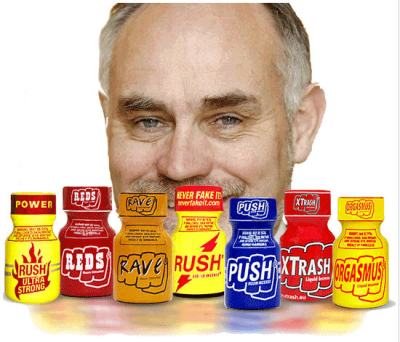
Crispin Blunt MP
If you want something slightly less psychoactive than poppers, I suggest you try a crack pipe.
Seriously, poppers produce an instantaneous high as powerful and intense as anything I have ever known. Cannabis, alcohol, even cocaine are mild and gentle compared to the rush that you get from inhaling the vapour from a bottle of poppers. Maybe crack or crystal meth are stronger. I don’t claim knowledge at that extreme end of drugs experiences.
It’s well established fact that successive UK governments are dishonest and corrupt on drugs policy. You cannot trust anything the Home Office says about drugs. The reality of the policies of both Labour and Tory governments is that they maximise harm and cause enormous damage to our society as well as individuals.
The announcement today that poppers are to be excluded from the Psychoactive Substances Act because they are ‘not psychoactive’ is as ludicrous a statement as ever made by any government anywhere. See minister Karen Bradley’s announcement here.
The Psychoactive Substances Act is universally recognised as the most ridiculous and scientifically-illiterate legislation ever passed by Parliament – universal that is with the exception of the slippery fools that sit in the House of Commons. Most of them have no idea at all of what they are doing on drugs policy and their only concern is to appease the Daily Mail, the Daily Telegraph and the hysteria drummed up by the prohibition lobby. However, when one of their own, Crispin Blunt, MP for Reigate, complains about his drug of choice being banned, in record time the Home Office has obtained fake scientific advice and reversed its decision to ban poppers. Meanwhile, benign, largely beneficial, mild and virtually harmless cannabis remains banned, even for those in desperate need to relieve their pain, suffering and disability.
Don’t misunderstand me, I don’t think poppers should be banned. They are known as a sex aid amongst gay men as they relax the anal sphincter, enabling easier ‘backdoor’ sex. There’s a good argument that this helps to prevent injury and therefore infection but they are also an intense sexual stimulant. I can confirm they are great fun for straight sex too.
I’m very pleased that Crispin Blunt will continue to have access to his drug of choice and I have no argument with him at all. He is an MP who is on the record as supporting cannabis law reform, particularly for medicinal use. It’s the sickening, dishonest and corrupt conduct of Home Office ministers that must be condemned.
I’d like to see the craven fools at the Home Office take a big whack off a bottle of poppers and then say they aren’t psychoactive. Black is white and pigs fly over Marsham Street when it comes to drugs.
CLEAR Withdraws Its Endorsement of UK CBD.
 CLEAR can no longer endorse or recommend UK CBD as a supplier of CBD products.
This decision is made with regret but is unavoidable due to a number of problems which, despite our best efforts, have proved impossible to resolve. Our endorsement was based on UK CBD’s ethical and quality standards but the position has changed and the directors of UK CBD have been unable satisfactorily to address our concerns.
Our main concern is that certain products marketed by UK CBD contain such high levels of the controlled drugs THC and CBN that we consider them to be unlawful.
One particular product, UK CBD 710 Cannabinoid Crystals, is being promoted as containing “over 4mg of THC”. Anyone importing, supplying or in possession of this product risks criminal prosecution.
Potentially this product could destroy the whole CBD market. If a prosecution was brought under the Psychoactive Substances Act 2016, it could result in all CBD products being regarded as psychoactive.
CLEAR strongly supports the developing CBD market as a legal alternative to high-THC products. However, it is vital for the security of consumers that products comply with the law.

 Peter Reynolds