Fast Moving Consumer Goods.
Commercialisation Is The Only Sustainable Route To Legalisation.
Talking Cannabis In Parliament.

Norman Lamb MP, Peter Reynolds
Today, 8th February 2016, Peter Reynolds, president of CLEAR, met with Norman Lamb MP, Liberal Democrat spokesperson for health, for an update on the cannabis campaign.
Independent Panel of Experts on Cannabis Regulation.
The Liberal Democrats have set up an independent panel of experts to establish how a legalised market for cannabis could work in the United Kingdom. Norman Lamb wants the panel to look at evidence from Colorado, Washington State and Uruguay, where cannabis has been legalised and to make recommendations for the party to consider in the spring.
As a contribution to the panel’s work, CLEAR has provided the independent study it commissioned in 2011, ‘Taxing the UK Cannabis Market’ which establishes the most comprehensive database on the reality of cannabis in the UK. In addition, The CLEAR Plan, ‘How To Regulate Cannabis in Britain’, builds on this data to propose detailed regulations for exactly how the market could work and contribute a £6.7 billion net gain to the UK exchequer.
Imminent Launch of New Medicinal Cannabis Campaign.
Within the next few days, CLEAR, along with other cannabis law reform groups, will co-operate in the launch of probably the largest campaign for access to medicinal cannabis ever seen in the UK. The time has come when people who are suffering must be given the opportunity to stop their pain with a safe, non-toxic, proven alternative to expensive and debilitating pharmaceutical products. The intransigence of successive UK governments must be overcome and this time a strategy is in place which will work.
The CLEAR publication ‘Medicinal Cannabis:The Evidence’ has received international acclaim and is the most comprehensive and up to date review of the scientific evidence supporting the use of cannabis.
Further Development of Liberal Democrat Drugs Policy.
In 1971, when the Misuse of Drugs Act came into force there were approximately 3,000 problematic drug users in the UK. Today, 45 years on, that figure has risen to around 350,000. Norman Lamb describes this as “one of the greatest public policy disasters of all time”. Today, in a speech about the prison service, David Cameron talked of the need to tackle the most difficult social problems facing Britain. Drug crime and drug addiction is probably the single biggest factor in our prison problems and the consequences of 45 years of failed drugs policy pervades our society. As the Liberal Democrats consider this difficult issue, tackling reform of cannabis policy is the first step.
Justice Minister Reveals UK Is Trialling Portuguese Approach To Drugs.

In the secretive way that now seems to be standard practice for the UK government, the justice minister, Andrew Selous MP, revealed yesterday, in an answer to a written Parliamentary Question, that he is “currently trialling ‘Liaison and Diversion’ services”.
“These services place health professionals at police stations and courts to assess suspects for a range of health problems, including drug misuse, and make referrals to treatment and support. Information shared with the criminal justice system can be used to inform decisions, supporting diversion into treatment as part of an alternative to charge or to custody where appropriate.
We are also interested in problem-solving courts, such as drug courts, given evidence of success in other jurisdictions. Officials are now working with members of the judiciary to consider how the problem-solving approach might be developed for England and Wales.”
Source: Hansard
This is good news and is to be welcomed. However, why can’t the UK government engage with the electorate on drug law reform? Instead of dismissing all calls for reform out of hand, how about behaving as if the UK really is a democracy? Portugal has made massive improvements in public health through an enlightened and intelligent approach to drugs policy. Let us hope, one day soon the UK will catch up.
CLEAR, The British Medicinal Cannabis Campaign and UK CBD Combine To Offer Media Briefings.
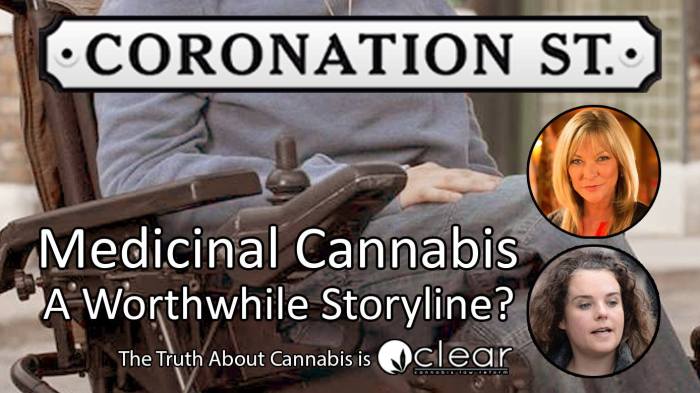
The subject of cannabis as medicine is certain to rise to the top of the UK news agenda in forthcoming weeks as a new Coronation Street storyline unfolds.
The character Izzy Armstrong (Cherylee Houston) who has Ehlers-Danlos Syndrome, will be seen suffering when her prescription medicine fails to alleviate her pain. Erica Holroyd (Claire King) will then suggest that she starts using cannabis as an alternative and ends up supplying Izzy with the drug. The programme will look at all aspects of the debate on medicinal cannabis and examine the legal implications and the far reaching consequences of Izzy’s actions for her family.
Now, three of the UK’s most important organisations in the field are joining forces to provide the media with facts, evidence and personal testimonies about medicinal cannabis.
CLEAR is the largest drugs policy reform group in the UK with nearly 600,000 followers. The British Medicinal Cannabis Campaign (BMCC) is an independent group consisting of 4,500 members, all of whom are UK-based medicinal cannabis users. UK CBD is the leading distributor of legal, cannabinoid nutraceuticals including the world famous Charlotte’s Web and Mary’s brands.
Roland Gyallay-Pap, managing director of CLEAR, commented:
“Not for the first time, but at a crucial time in the worldwide debate, the issue of medicinal cannabis will be addressed in a British soap. We have high hopes that this will stimulate the debate and bring the absurdity of the UK government’s position into sharp focus.”
Throughout Europe, the USA, Canada, Australia, Israel and South America, interest in and the use of medicinal cannabis is growing fast. The UK is now virtually isolated amongst first world countries with the stubborn refusal of government even to consider the evidence. However there is a growing clamour from politicians, scientists and doctors that it must address what is a deeply cruel and evidence-free policy. Hundreds of thousands already use medicinal cannabis and risk a criminal record just for trying to improve their health. In addition they have to deal with a criminal underworld and risk violence, contaminated and low quality product all because government refuses to take responsibility.
There is now an overwhelming body of peer-reviewed, scientific evidence on the safety and efficacy of cannabis as medicine. CLEAR published ‘Medicinal Cannabis: The Evidence’ in April 2015 which has received international acclaim and is now also available in a Spanish language edition. Download here in English or Spanish.
Individual briefings will be available on request to journalists, reporters, media organisations and other interested parties. Briefings will be led by Peter Reynolds, one of the nation’s leading experts on the science, medicine and politics of cannabis, Mark Scott, a representative of BMCC and Nicolas Ellis, founder and managing director of UK CBD.
Please contact CLEAR to arrange a briefing at your premises by appointment. Alternatively, a central London venue can be arranged on request.
My Mother.

My mother, Barbara Reynolds, died peacefully surrounded by her children at about 5.10pm on 29th December 2015.
She was enjoying Christmas but became ill on Boxing Day afternoon and developed pneumonia.
In the last few months she had told us all that she felt her life was complete. She was ready.
Please join us on 15th January 2016 to celebrate her wonderful life.
1.45pm. Chilterns Crematorium, Amersham, HP7 0ND
Top UK Soap ‘Coronation Street’ To Run Medicinal Cannabis Storyline.

Coronation Street Character, Izzy Armstrong
Could This Be A Breakthrough In The UK Campaign For Medicinal Cannabis?
Cannabis used as medicine has appeared before in UK soaps but the news is that this Coronation Street storyline could be less jokey and trivial and actually deal in science and truth. If so it could be a major breakthrough against an intransigent government that flatly refuses even to consider the evidence.
Coronation Street is the world’s longest running soap opera still in production. Each episode reaches an average of between five and eight million viewers. It is deeply enmeshed in the fabric of British working class culture. If it puts a positive spin on medicinal cannabis it could change public opinion quicker than almost anything else.
Most senior politicians know the truth about medicinal cannabis but refuse to act, leaving millions in unnecessary pain and suffering for fear of a media backlash. But the media is changing too. Aside from a few individual dinosaur journalists and the bigots who edit the Daily Mail and Daily Telegraph, the rest of the media is pretty much onside.
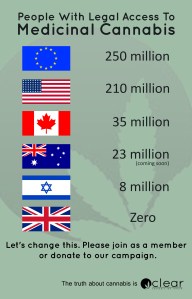 The UK government’s position is nothing short of ridiculous, particularly given developments throughout the rest of the world. Look to Australia for the latest progressive, evidence-based change in policy, where very soon 23 million people will gain legal access to medicinal cannabis.
A positive Coronation Street storyline will give the cowards in the Department of Health and the refuseniks in the Home Office a way out. It is inevitable that reform will come. This could mean it is sooner rather than later.
Expanding Heathrow Is Reckless And Ridiculous.

I find it inconceivable that any sane human being can even consider expansion at Heathrow. The idea of increasing the traffic over what is already a hellhole, already unfit for human habitation, is madness.
The sickening amount of money pumped into the campaign to expand Heathrow raises very unusual feelings in me. It repels me and turns me against business. If this is the result of the profit motive then it is sickening, disgusting and demeans everyone involved.
I think those who advocate expanding Heathrow have slipped into a form of mental illness where common sense is overwhelmed by greed. But I think they’re wrong. It cannot be a wise decision on any basis. The cost is far, far too great.
I’m with Boris and a brand, spanking new mega airport in the Thames Estuary. It is an investment that will enrich our country, that will create so many jobs over so many decades that it can only be a winner. It is the only rational decision.
King’s College Confirms Institute of Psychiatry Misled Media On Cannabis Brain Study.
The Institute of Psychiatry at King’s College London issued a press release on 27th November claiming that its latest study shows cannabis causes damage to the corpus callosum. This was widely reported across the world and many publications extended what was already an inaccurate claim into saying that this “damage” was a cause of psychosis.
As I have already reported and as confirmed by the NHS, the study showed nothing of the sort. Then, last week, by accident really, I discovered that quietly and with just a small footnote the headline had been changed!
Original: “Study shows white matter damage caused by ‘skunk-like’ cannabis”
Edit: “Study shows white matter damage may be caused by ‘skunk-like’ cannabis”
Professor Shitij Kapur, Executive Dean of the Institute of Psychiatry hadn’t responded to two emails from me, so this time I wrote to the Principal of King’s College, Professor Ed Byrne. He has now confirmed that the press release has been changed but makes the extraordinary and false claim that “By and large the press coverage was a true reflection of the science.”
Professor Ed Byrne
Dear Mr. Reynolds
Thank you for your email regarding the recent article from King’s.
I have discussed it with Professor Kapur and the authors and we believe it appropriate to change the headline to ‘may be caused by’, which has already been done.
The body of the press release is a fair representation of the paper so needs no amendment. By and large the press coverage was a true reflection of the science in the paper so we do not believe the press release requires further amendments.
King’s is committed to a balanced reporting of science and its work and hence we have changed the headline and acknowledged the change.
Thank you again for your diligence.
Professor Edward Byrne AC
President & Principal
Too late! The sensationalist, scaremongering deceit and exaggeration has already spread like wildfire across the world. Dozens of publications have repeated the falsehood and yet again the Institute of Psychiatry is responsible for misleading millions of people. It has form for such conduct, regularly, repeatedly and deliberately confusing correlation with causation and vastly exaggerating the results of its work. This is deceit and fraud at the highest level and if it took place in another context, financial services for instance, it would merit police investigation.
I have written again to Professor Byrne asking him to do the right and honourable thing.
Dear Professor Byrne,
Thank you for your email. I am grateful that you have had the courtesy and honour to reply, unlike Professor Kapur.
I am disturbed though by how lightly you take this very serious matter. It is absolutely false to say “By and large the press coverage was a true reflection of the science”.
As someone who has observed the Institute’s work for many years, I am now convinced that it is routinely in the business of exaggerating the results of its work, deliberately misleading the media and through it, the public at large. I can only conclude that this dishonesty is connected with raising funding for its work.
This is not a situation that can be allowed to persist. Every year Professor Sir Robin Murray publishes a paper on cannabis and psychosis which is always presented to the media as showing a causal link when the science itself shows nothing of the sort. I have met with Sir Robin on several occasions and spoken alongside him at conferences. In person he is reasonable and accurate but the way his work is presented to the media is dishonest and false, exactly as this latest episode.
This is a matter of huge importance because it is largely the hysteria drummed up by such falsified science that stands in the way of legal access to medicinal cannabis in the UK. Hundreds of thousands of people suffer needlessly in Britain when throughout the rest of Europe, Israel, Canada and the USA, more enlightened policies enable access to the medicine that people need. I hold the conduct of organisations such as the Institute of Psychiatry directly responsble for the pain and suffering caused.
It is disgraceful that Dr Paola Dazzan should enter into the political arena of cannabis policy with blatantly false claims that her study shows a causal link or that the differences observed amount to “damage”. These are nothing less than lies.
This might be the result of a renegade press office which doesn’t understand the science but we have put up with it for decades and I appeal to you to take proportionate steps to stop it. To start with, on this latest incident, you should issue a further press release explaining the errors in the first. You can’t just change the headline surreptitiously, hope no one will notice and expect the dishonesty to be overlooked. The damage has already been done. You must act to make amends.
This is a matter of professional ethics and integrity and I rely on you to take the appropriate steps.
Kind regards,
Peter Reynolds
This Is The Future Of Cannabis. For Medicine, Nutrition And Pleasure.
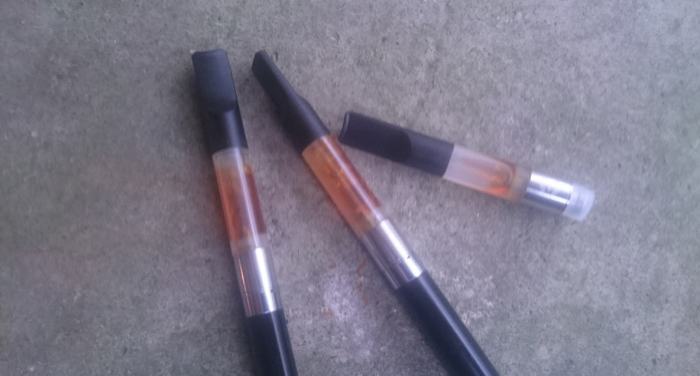
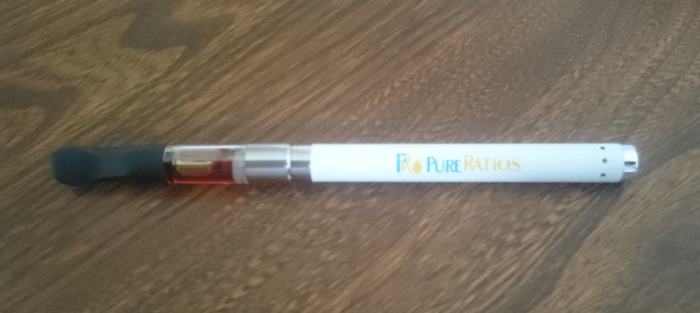
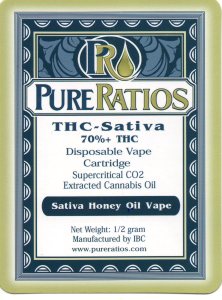
One of these vape pens contains Blue Dream sativa cannabis oil, 91% THC, the other is Hindu Kush indica cannabis oil, 85% THC and the spare cartridge has the dregs of some New York City Diesel sativa, 85% THC. You can’t tell which is which to look at them but each has a distinctive flavour and effect. They’re not completely odour free but almost.
This is the future of cannabis as a consumer product. It is cleaner, neater, handier, healthier and better for you than raw herbal cannabis. Most importantly, for medicinal applications, it homogenises all the compounds into an oil of consistent quality and content meaning that dosage and effect at last becomes predictable and reliable.
High CBD Oil For Medical Use
I have been investigating this theory for some time but my recent trip to Colorado enabled me to conduct some practical experiments and more thoroughly understand how this idea can work. I am now convinced that this is the way forward for the cannabis industry. Once we achieve legalisation in the UK, which is inevitable, probably in about five years, these pens are how cannabis will become available as a consumer product on the high street. They are also how medicinal cannabis will be dispensed. Your doctor’s prescription will be fulfilled by a cartridge with the appropriate blend of cannabinoids which you screw onto your battery and use immediately. Batteries will also be supplied on prescription, in the same way that syringes or blood glucose meters are for diabetics.
In Colorado dispensaries these pens are already available in a choice of strains and blends. Currently, the popular products contain 250 mg of THC in a blend of cannabis oil and propylene glycol (PG), just as e-cigs contain a nicotine oil and PG.
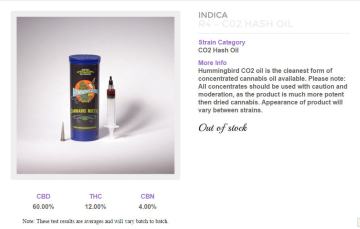
Alternatively, you can buy the oil of your choice and fill the cartridges yourself. This is undoubtedly the way to do it and a wide choice of oils is available, made by CO2 and solvent extraction processes. The Farm, my favourite dispensary in Boulder, is already supplying cannabinoid blends such as a 60% CBD, 12% THC, 4% CBN product which is clearly for medicinal use. I have no doubt that soon we will see a Charlotte’s Web product and Sativex-like blends with equal ratios of THC:CBD. Other, more sophisticated blends of other cannabinoids and probably terpenes will soon follow.
However, I am certain that some propylene glycol is a good thing. The oil vapes much better when diluted and PG is nothing to worry about, it is in many health, cosmetic and food products. It has many uses. It’s a solvent, humectant (keeps things moist), preservative and it helps absorption of some products. It is non-toxic.
There is further development work to be done. I believe there is a ‘sweet spot’ for the correct amount of PG, probably around 20%. I also think the battery and cartridges can be improved, particularly for medical use. Once this is achieved, a product like this with perhaps a 60:40 THC:CBD ratio should form the basis of an application to the Medicines and Health products Regulatory Agency (MHRA) for a marketing authorisation. It will knock Sativex into a cocked hat. In fact, if GW Pharma aren’t investigating this already then they are failing in their duty to shareholders. I shall certainly be doing all I can to research and facilitate the funding to bring such a product to market.
Yes, this is the future of cannabis. Imagine the packaging, marketing and merchandising opportunities for the recreational market. Understand the overwhelming benefits of this as medicine against the raw, herbal product. Yes, I know some will object and the tired old hippy luddites will say it’s a sell out and many more Big Pharma conspiracy theories will emerge but this is the future. Remember you heard it here first.

 Peter Reynolds