Posts Tagged ‘cannabis’
Talking Cannabis In Parliament.
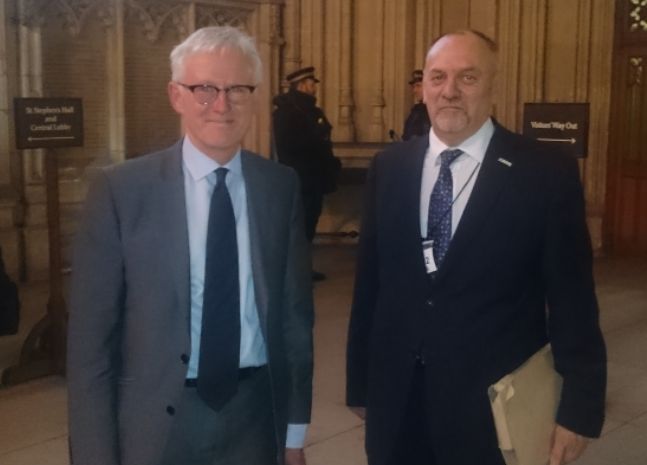
Norman Lamb MP, Peter Reynolds
Today, 8th February 2016, Peter Reynolds, president of CLEAR, met with Norman Lamb MP, Liberal Democrat spokesperson for health, for an update on the cannabis campaign.
Independent Panel of Experts on Cannabis Regulation.
The Liberal Democrats have set up an independent panel of experts to establish how a legalised market for cannabis could work in the United Kingdom. Norman Lamb wants the panel to look at evidence from Colorado, Washington State and Uruguay, where cannabis has been legalised and to make recommendations for the party to consider in the spring.
As a contribution to the panel’s work, CLEAR has provided the independent study it commissioned in 2011, ‘Taxing the UK Cannabis Market’ which establishes the most comprehensive database on the reality of cannabis in the UK. In addition, The CLEAR Plan, ‘How To Regulate Cannabis in Britain’, builds on this data to propose detailed regulations for exactly how the market could work and contribute a £6.7 billion net gain to the UK exchequer.
Imminent Launch of New Medicinal Cannabis Campaign.
Within the next few days, CLEAR, along with other cannabis law reform groups, will co-operate in the launch of probably the largest campaign for access to medicinal cannabis ever seen in the UK. The time has come when people who are suffering must be given the opportunity to stop their pain with a safe, non-toxic, proven alternative to expensive and debilitating pharmaceutical products. The intransigence of successive UK governments must be overcome and this time a strategy is in place which will work.
The CLEAR publication ‘Medicinal Cannabis:The Evidence’ has received international acclaim and is the most comprehensive and up to date review of the scientific evidence supporting the use of cannabis.
Further Development of Liberal Democrat Drugs Policy.
In 1971, when the Misuse of Drugs Act came into force there were approximately 3,000 problematic drug users in the UK. Today, 45 years on, that figure has risen to around 350,000. Norman Lamb describes this as “one of the greatest public policy disasters of all time”. Today, in a speech about the prison service, David Cameron talked of the need to tackle the most difficult social problems facing Britain. Drug crime and drug addiction is probably the single biggest factor in our prison problems and the consequences of 45 years of failed drugs policy pervades our society. As the Liberal Democrats consider this difficult issue, tackling reform of cannabis policy is the first step.
CLEAR, The British Medicinal Cannabis Campaign and UK CBD Combine To Offer Media Briefings.
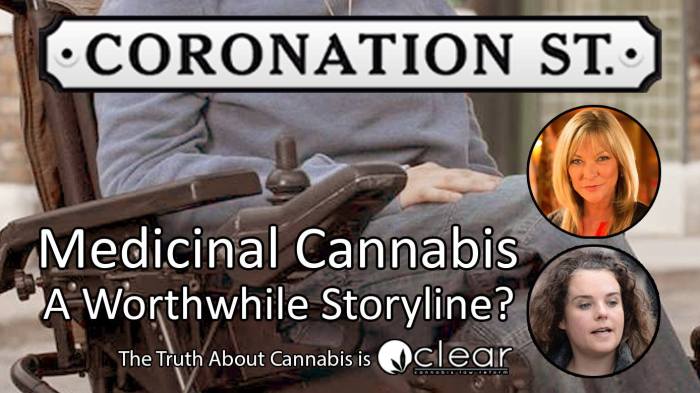
The subject of cannabis as medicine is certain to rise to the top of the UK news agenda in forthcoming weeks as a new Coronation Street storyline unfolds.
The character Izzy Armstrong (Cherylee Houston) who has Ehlers-Danlos Syndrome, will be seen suffering when her prescription medicine fails to alleviate her pain. Erica Holroyd (Claire King) will then suggest that she starts using cannabis as an alternative and ends up supplying Izzy with the drug. The programme will look at all aspects of the debate on medicinal cannabis and examine the legal implications and the far reaching consequences of Izzy’s actions for her family.
Now, three of the UK’s most important organisations in the field are joining forces to provide the media with facts, evidence and personal testimonies about medicinal cannabis.
CLEAR is the largest drugs policy reform group in the UK with nearly 600,000 followers. The British Medicinal Cannabis Campaign (BMCC) is an independent group consisting of 4,500 members, all of whom are UK-based medicinal cannabis users. UK CBD is the leading distributor of legal, cannabinoid nutraceuticals including the world famous Charlotte’s Web and Mary’s brands.
Roland Gyallay-Pap, managing director of CLEAR, commented:
“Not for the first time, but at a crucial time in the worldwide debate, the issue of medicinal cannabis will be addressed in a British soap. We have high hopes that this will stimulate the debate and bring the absurdity of the UK government’s position into sharp focus.”
Throughout Europe, the USA, Canada, Australia, Israel and South America, interest in and the use of medicinal cannabis is growing fast. The UK is now virtually isolated amongst first world countries with the stubborn refusal of government even to consider the evidence. However there is a growing clamour from politicians, scientists and doctors that it must address what is a deeply cruel and evidence-free policy. Hundreds of thousands already use medicinal cannabis and risk a criminal record just for trying to improve their health. In addition they have to deal with a criminal underworld and risk violence, contaminated and low quality product all because government refuses to take responsibility.
There is now an overwhelming body of peer-reviewed, scientific evidence on the safety and efficacy of cannabis as medicine. CLEAR published ‘Medicinal Cannabis: The Evidence’ in April 2015 which has received international acclaim and is now also available in a Spanish language edition. Download here in English or Spanish.
Individual briefings will be available on request to journalists, reporters, media organisations and other interested parties. Briefings will be led by Peter Reynolds, one of the nation’s leading experts on the science, medicine and politics of cannabis, Mark Scott, a representative of BMCC and Nicolas Ellis, founder and managing director of UK CBD.
Please contact CLEAR to arrange a briefing at your premises by appointment. Alternatively, a central London venue can be arranged on request.
Top UK Soap ‘Coronation Street’ To Run Medicinal Cannabis Storyline.
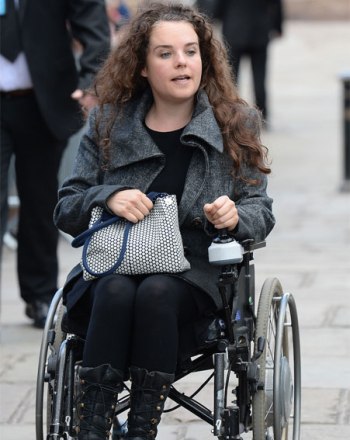
Coronation Street Character, Izzy Armstrong
Could This Be A Breakthrough In The UK Campaign For Medicinal Cannabis?
Cannabis used as medicine has appeared before in UK soaps but the news is that this Coronation Street storyline could be less jokey and trivial and actually deal in science and truth. If so it could be a major breakthrough against an intransigent government that flatly refuses even to consider the evidence.
Coronation Street is the world’s longest running soap opera still in production. Each episode reaches an average of between five and eight million viewers. It is deeply enmeshed in the fabric of British working class culture. If it puts a positive spin on medicinal cannabis it could change public opinion quicker than almost anything else.
Most senior politicians know the truth about medicinal cannabis but refuse to act, leaving millions in unnecessary pain and suffering for fear of a media backlash. But the media is changing too. Aside from a few individual dinosaur journalists and the bigots who edit the Daily Mail and Daily Telegraph, the rest of the media is pretty much onside.
 The UK government’s position is nothing short of ridiculous, particularly given developments throughout the rest of the world. Look to Australia for the latest progressive, evidence-based change in policy, where very soon 23 million people will gain legal access to medicinal cannabis.
A positive Coronation Street storyline will give the cowards in the Department of Health and the refuseniks in the Home Office a way out. It is inevitable that reform will come. This could mean it is sooner rather than later.
King’s College Confirms Institute of Psychiatry Misled Media On Cannabis Brain Study.
The Institute of Psychiatry at King’s College London issued a press release on 27th November claiming that its latest study shows cannabis causes damage to the corpus callosum. This was widely reported across the world and many publications extended what was already an inaccurate claim into saying that this “damage” was a cause of psychosis.
As I have already reported and as confirmed by the NHS, the study showed nothing of the sort. Then, last week, by accident really, I discovered that quietly and with just a small footnote the headline had been changed!
Original: “Study shows white matter damage caused by ‘skunk-like’ cannabis”
Edit: “Study shows white matter damage may be caused by ‘skunk-like’ cannabis”
Professor Shitij Kapur, Executive Dean of the Institute of Psychiatry hadn’t responded to two emails from me, so this time I wrote to the Principal of King’s College, Professor Ed Byrne. He has now confirmed that the press release has been changed but makes the extraordinary and false claim that “By and large the press coverage was a true reflection of the science.”
Professor Ed Byrne
Dear Mr. Reynolds
Thank you for your email regarding the recent article from King’s.
I have discussed it with Professor Kapur and the authors and we believe it appropriate to change the headline to ‘may be caused by’, which has already been done.
The body of the press release is a fair representation of the paper so needs no amendment. By and large the press coverage was a true reflection of the science in the paper so we do not believe the press release requires further amendments.
King’s is committed to a balanced reporting of science and its work and hence we have changed the headline and acknowledged the change.
Thank you again for your diligence.
Professor Edward Byrne AC
President & Principal
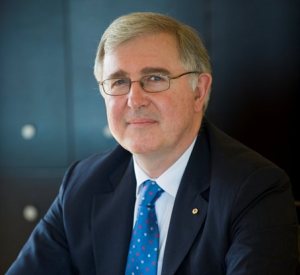
Too late! The sensationalist, scaremongering deceit and exaggeration has already spread like wildfire across the world. Dozens of publications have repeated the falsehood and yet again the Institute of Psychiatry is responsible for misleading millions of people. It has form for such conduct, regularly, repeatedly and deliberately confusing correlation with causation and vastly exaggerating the results of its work. This is deceit and fraud at the highest level and if it took place in another context, financial services for instance, it would merit police investigation.
I have written again to Professor Byrne asking him to do the right and honourable thing.
Dear Professor Byrne,
Thank you for your email. I am grateful that you have had the courtesy and honour to reply, unlike Professor Kapur.
I am disturbed though by how lightly you take this very serious matter. It is absolutely false to say “By and large the press coverage was a true reflection of the science”.
As someone who has observed the Institute’s work for many years, I am now convinced that it is routinely in the business of exaggerating the results of its work, deliberately misleading the media and through it, the public at large. I can only conclude that this dishonesty is connected with raising funding for its work.
This is not a situation that can be allowed to persist. Every year Professor Sir Robin Murray publishes a paper on cannabis and psychosis which is always presented to the media as showing a causal link when the science itself shows nothing of the sort. I have met with Sir Robin on several occasions and spoken alongside him at conferences. In person he is reasonable and accurate but the way his work is presented to the media is dishonest and false, exactly as this latest episode.
This is a matter of huge importance because it is largely the hysteria drummed up by such falsified science that stands in the way of legal access to medicinal cannabis in the UK. Hundreds of thousands of people suffer needlessly in Britain when throughout the rest of Europe, Israel, Canada and the USA, more enlightened policies enable access to the medicine that people need. I hold the conduct of organisations such as the Institute of Psychiatry directly responsble for the pain and suffering caused.
It is disgraceful that Dr Paola Dazzan should enter into the political arena of cannabis policy with blatantly false claims that her study shows a causal link or that the differences observed amount to “damage”. These are nothing less than lies.
This might be the result of a renegade press office which doesn’t understand the science but we have put up with it for decades and I appeal to you to take proportionate steps to stop it. To start with, on this latest incident, you should issue a further press release explaining the errors in the first. You can’t just change the headline surreptitiously, hope no one will notice and expect the dishonesty to be overlooked. The damage has already been done. You must act to make amends.
This is a matter of professional ethics and integrity and I rely on you to take the appropriate steps.
Kind regards,
Peter Reynolds
This Is The Future Of Cannabis. For Medicine, Nutrition And Pleasure.
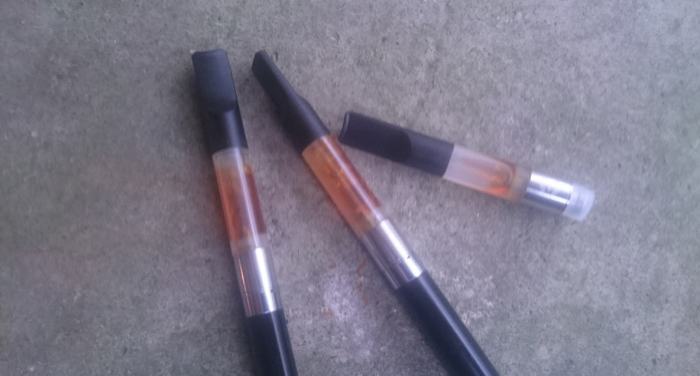
One of these vape pens contains Blue Dream sativa cannabis oil, 91% THC, the other is Hindu Kush indica cannabis oil, 85% THC and the spare cartridge has the dregs of some New York City Diesel sativa, 85% THC. You can’t tell which is which to look at them but each has a distinctive flavour and effect. They’re not completely odour free but almost.
This is the future of cannabis as a consumer product. It is cleaner, neater, handier, healthier and better for you than raw herbal cannabis. Most importantly, for medicinal applications, it homogenises all the compounds into an oil of consistent quality and content meaning that dosage and effect at last becomes predictable and reliable.
High CBD Oil For Medical Use
I have been investigating this theory for some time but my recent trip to Colorado enabled me to conduct some practical experiments and more thoroughly understand how this idea can work. I am now convinced that this is the way forward for the cannabis industry. Once we achieve legalisation in the UK, which is inevitable, probably in about five years, these pens are how cannabis will become available as a consumer product on the high street. They are also how medicinal cannabis will be dispensed. Your doctor’s prescription will be fulfilled by a cartridge with the appropriate blend of cannabinoids which you screw onto your battery and use immediately. Batteries will also be supplied on prescription, in the same way that syringes or blood glucose meters are for diabetics.
In Colorado dispensaries these pens are already available in a choice of strains and blends. Currently, the popular products contain 250 mg of THC in a blend of cannabis oil and propylene glycol (PG), just as e-cigs contain a nicotine oil and PG.
Alternatively, you can buy the oil of your choice and fill the cartridges yourself. This is undoubtedly the way to do it and a wide choice of oils is available, made by CO2 and solvent extraction processes. The Farm, my favourite dispensary in Boulder, is already supplying cannabinoid blends such as a 60% CBD, 12% THC, 4% CBN product which is clearly for medicinal use. I have no doubt that soon we will see a Charlotte’s Web product and Sativex-like blends with equal ratios of THC:CBD. Other, more sophisticated blends of other cannabinoids and probably terpenes will soon follow.
However, I am certain that some propylene glycol is a good thing. The oil vapes much better when diluted and PG is nothing to worry about, it is in many health, cosmetic and food products. It has many uses. It’s a solvent, humectant (keeps things moist), preservative and it helps absorption of some products. It is non-toxic.
There is further development work to be done. I believe there is a ‘sweet spot’ for the correct amount of PG, probably around 20%. I also think the battery and cartridges can be improved, particularly for medical use. Once this is achieved, a product like this with perhaps a 60:40 THC:CBD ratio should form the basis of an application to the Medicines and Health products Regulatory Agency (MHRA) for a marketing authorisation. It will knock Sativex into a cocked hat. In fact, if GW Pharma aren’t investigating this already then they are failing in their duty to shareholders. I shall certainly be doing all I can to research and facilitate the funding to bring such a product to market.
Yes, this is the future of cannabis. Imagine the packaging, marketing and merchandising opportunities for the recreational market. Understand the overwhelming benefits of this as medicine against the raw, herbal product. Yes, I know some will object and the tired old hippy luddites will say it’s a sell out and many more Big Pharma conspiracy theories will emerge but this is the future. Remember you heard it here first.
Blatant Dishonesty From King’s College London. Institute Of Psychiatry Untrustworthy.
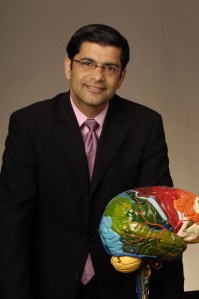
Prof. Shitij Kapur. Explanation Awaited.
On Friday, 27th November 2015, the Institute of Psychiatry, Psychology & Neuroscience (IoPPN) at King’s College London issued a press release titled “Study shows white matter damage caused by ‘skunk-like’ cannabis”. As a result, hundreds of media outlets across the world have published to the effect that cannabis use causes changes in the corpus callosum, the largest white matter structure in the brain, which is responsible for communication between the left and right hemispheres.
In fact, the study showed nothing of the sort. Even one of its authors, Dr Paola Dazzan, is on the record stating “It is possible that these people already have a different brain and they are more likely to use cannabis.”
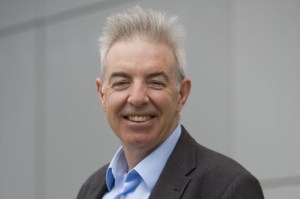
Prof. Sir Robin Murray. Causation Or Just Correlation?
Sadly, this is par for the course by King’s College and I can only assume is a corrupt attempt to sensationalise its work in order to drum up funding. Every time this institution publishes a study on cannabis it confuses causation and correlation.
For instance, Professor Sir Robin Murray’s annual study on cannabis and psychosis only ever shows correlation but when he talks to the press he always puts across the relationship between cannabis use and psychosis as causative.
We simply cannot rely on these so-called eminent scientists to be honest about their work. They are in the gutter and they aren’t looking at the stars, they are looking at their bank balances.
I have now written twice to Professor Shitij Kapur, Executive Dean of the IoPPN asking for an explanation but he hasn’t seen fit even to acknowledge my emails.
For anyone who takes an interest in the science of cannabis and the reasons this immensely valuable plant is banned, this example should give you an insight into the dishonesty, corruption and propaganda that is behind it all.
Anti-Cannabis Cult At Kings College Punts Another Scare Story.
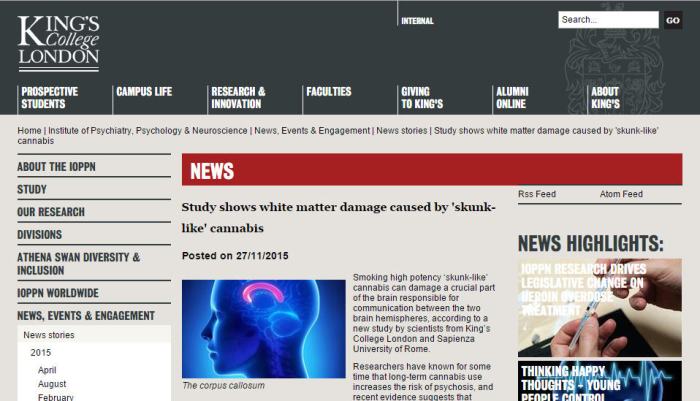
It’s the Institute of Psychiatry at Kings College London, yet again, with another terrifying story about cannabis that is immediately distorted, exaggerated and misrepresented by the scientifically illiterate hacks of Fleet Street.
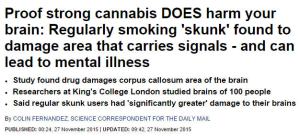
The Daily Mail
This time though King’s College itself has reported the results of its own research inaccurately and published false and misleading claims.
Can King’s College explain why its press release is headlined “Study shows white matter damage caused by ‘skunk-like’ cannabis”, when the researcher Dr Dazzan says “It is possible that these people already have a different brain and they are more likely to use cannabis”? The truth is that the study does not show any causative effect. It is merely correlation yet here we have supposedly eminent scientists and scientific institutions reporting results falsely.
I have written to Professor Shitij Kapur, Executive Dean & Head of Faculty of the Institute asking for an explanation.

The Daily Telegraph
On a regular basis the team at King’s College publishes research about cannabis that suggests it is far more harmful than real world experience demonstrates. Always these studies contain the vital caveat that no causation can be shown for the various ‘differences’ or ‘changes’ that the researchers observe. Always, without fail, the researchers overlook this fundamental weakness in their work when they talk direct to the press. As a result we get ludicrous, inaccurate and wildly irresponsible reporting, particularly in the extremist rags such as the Daily Mail and Daily Telegraph but often extending, as today, even into The Times, supposedly a responsible and authoritative publication.
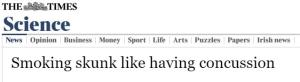
The Times
This latest study was led by Dr Silvia Rigucci of Sapienza University of Rome in conjunction with Dr Paola Dazzan and Dr Tiago Reis Marques from King’s College. Dr Razzan has fallen over herself in an undignified rush to gain media headlines. She is reported as saying: “There is an urgent need to educate health professionals, the public and policy makers about the risks involved with cannabis use.” Of course, in truth, all these people have been systematically misled about cannabis for many years. All that Dr Razaan is doing is contributing to the vast quantity of misinformation already out there by misrepresenting and overstating her own work.
This is a very small study with no proper controls that proves nothing either way about cannabis use. It is exaggerated and misrepresented by both King’s College and the scientists concerned, presumably in an effort to boost funding. This is the state of science on cannabis where vested interests promote misinformation which defies the real world experiences of hundreds of million of cannabis consumers worldwide. The team at King’s College displays all the classic markers of a cult. It pursues a belief in cannabis as the ‘devil’s lettuce’ as a quasi-religion. It dresses up its meaningless observational studies as significant evidence. It reinforces its belief by exaggerating and misrepresenting its work. It considers no alternative explanations and it endlessly repeats itself, its ‘studies’ and its presentation of them as proof of its own conclusions.
No one in their right mind can claim that cannabis is harmless but neither is there any evidence to support claims that it is dangerous. These untruths are promoted by vested interests such as researchers needing more funds, the alcohol industry guarding its monopoly of legal recreational drugs or newspapers seeking sensational stories.
It’s difficult to get hold of a copy of the actual study without paying for it. My advice is read the reports, understand the facts rather than the deliberate misinterpretations and expect more of the same. Remember that unless such evidence is compared with evidence in respect of other substances it is meaningless. All in all there is no evidence to suggest cannabis is any more harmful than coffee.
Another Pack Of Lies On Cannabis From The UK Government.

Yet another cannabis petition amongst hundreds of similar pleas was filed earlier this autumn. This one though is more tightly focused on removing cannabis from schedule 1, which defines it as having no medicinal value. The petition is also commendably concise but characterises itself as a ‘demand‘ that cannabis be rescheduled, an unfortunate choice of words.
 Nevertheless, congratulations are due in that it has exceeded the threshold of 10,000 signatures which means the government must respond. That response is now in and it is predictably dishonest, dismissive and authoritarian in its tone. The Home Office has responsibility for drugs policy so it has drafted the response but it surely must have consulted with the Department of Health.
In fact, I was told only this week by a senior minister that “… the search into the medicinal use of cannabis is something that falls within the jurisdiction of the Department of Health.” That may be a subtle shift in policy from which we can draw some hope. But I fear that the response to this petition offers no hope at all. It is stubborn, obstinate, inaccurate and in denial of evidence and experience.
To be clear, the Home Office has been systematically lying and misleading the British people about cannabis for at least 50 years. The Department of Health is timid on the issue, leaves the public statements to the Home Office heavies and seems more interested in generating fee income for the Medicines and Healthcare products Regulatory Agency (MHRA), than in actually treating patients effectively.
I analyse the response paragraph by paragraph.
“Herbal cannabis is listed in Schedule 1 as a drug with no recognised medicinal uses outside research. A substantial body of scientific evidence shows it is harmful and can damage human health.”
By far the majority of scientists and doctors now recognise that cannabis has real and significant medicinal uses. Of course it is possible that cannabis can cause harm, as can any substance. However, there is no scientific evidence that shows cannabis as being any more harmful than over-the-counter medicines or many common foods. Professor Les Iversen, chair of the Advisory Council on the Misuse of Drugs, is on the record saying: “cannabis is a safer drug than aspirin and can be used long term without serious side effects”.
“The Government will not encourage the use of a Schedule 1 controlled drug based on anecdotal evidence. It is important that a medicine is very thoroughly trialled to ensure it meets rigorous standards before being licensed and placed on the market so that doctors and patients are sure of its efficacy and safety. “
It is not the government’s role to encourage the use of any drug as medicine, that is the role of a doctor. Only by removing cannabis from schedule 1 can that decision be placed in doctors’ hands. There is a vast quantity of peer-reviewed, published scientific evidence on the medicinal use of cannabis including human clinical trials. It is false to suggest that only anecdotal evidence is available. See ‘Medicinal Cannabis: The Evidence’. Thousands of doctors and millions of patients are sure of the efficacy and safety of cannabis based on existing research, trials and experience. Many commonly prescribed medicines have nowhere near as much evidence behind them as cannabis.
“Cannabis in its raw form (herbal cannabis) is not recognised as having any medicinal purposes in the UK. There is already a clear regime in place to enable medicines (including those containing controlled drugs) to be developed and subsequently prescribed and supplied to patients via healthcare professionals. This regime is administered by the Medicines and Healthcare products Regulatory Agency (MHRA), which issues Marketing Authorisations for drugs that have been tried and tested for their safety and efficacy as medicines in the UK.”
The lack of recognition for the medicinal purposes of cannabis is a grave error with no evidence that supports it. Cannabis is a traditional medicine which recorded history shows has been used safely and effectively for at least 5,000 years. The only thing that stands in the way of cannabis being prescribed by doctors is its schedule 1 status. The MHRA is a diversion and is irrelevant. It exists to trial and regulate new medicines and requires a £100,000 application fee before very costly clinical trials take place. This is an unnecessary obstacle to a traditional medicine which contains more than 400 compounds. The MHRA process is designed for potentially dangerous, single molecule drugs and is not applicable to cannabis.
“It is up to organisations to apply for Marketing Authorisation for products that they believe have potential medicinal purposes so that these can be subject to the same stringent regime and requirements that all medicines in the UK are subjected to.”
Many substances and drugs which have medicinal purposes are regulated either as Traditional Herbal Products or food supplements. It is the schedule 1 status of cannabis which prevents it being regulated and controlled in this way which is far more appropriate given its very low potential for harm and the very wide range of conditions for which it can be useful.
“Since 2010 UK patients can use the cannabis-based medicine ‘Sativex’ for the treatment of spasticity due to multiple sclerosis. ‘Sativex’ can also be prescribed for other conditions at the prescribing doctor’s risk. ‘Sativex’ was rigorously tested for its safety and efficacy before receiving approval, and is distinguished from cannabis in its raw form. It is a spray which is standardised in composition, formulation and dose and developed to provide medicinal benefits without a psychoactive effect. Due to its low psychoactive profile ‘Sativex’ was rescheduled from Schedule 1 and placed in Schedule 4 Part 1 to enable its availability for use in healthcare in the UK.”
Sativex is a massively expensive form of cannabis oil which is not prescribed because of its cost. It is at least 10 times the price of Bedrocan medicinal cannabis as regulated by the Netherlands government which could be immediately made available in the UK. It is a deliberate falsehood to claim that Sativex does not have a psychoactive effect. The statutory document ‘Summary of Product Characteristics’ describes “euphoric mood” as a “common” side effect. The scheduling of Sativex in schedule 4 is a deception requiring 75 words falsely to distinguish it from other forms of cannabis whereas every other drug in every other schedule requires just one word.
“The MHRA is open to considering marketing approval applications for other medicinal cannabis products should a product be developed. As happened in the case of ‘Sativex’, the Home Office will also consider issuing a licence to enable trials of new medicines to take place under the appropriate ethical approvals. “
Cannabis, which contains 400 + compounds is not suitable for MHRA regulation which is designed for single molecule drugs which are potentially dangerous. There is no significant danger from the use of cannabis when prescribed by a doctor. This is already well established in scientific evidence and the referral to the MHRA is a diversion and an excuse for failing simply to put the decision in doctors’ hands.
“In view of the potential harms associated with the use of cannabis in its raw form and the availability of avenues for medicinal development, the Government does not consider it appropriate to make changes to the control status of raw or herbal cannabis. “
The government has offered no evidence of the potential harms to which it gives such weight. No “development” of cannabis is required. It is a traditional medicine consisting of the dried flowers of the cannabis plant.
“The Government’s view is that the Misuse of Drugs Act 1971 and regulations made under the Act continue to facilitate the development of medicines which are made from Schedule 1 controlled drugs. The legislation is aimed at protecting the public from the potential harms of drugs and is not an impediment to research into these drugs or development of medicines.”
The government’s view is intransigent and as demonstrated by this response is ignorant of the available evidence. This response reinforces the government’s clear intention not to consider the evidence and simply to deny it. The evidence shows that the potential harms of cannabis as medicine are trivial and inconsequential. If its schedule 1 status was not an impediment to research, there would already be a great deal more research into cannabis as medicine.
“In 2013 the Home Office undertook a scoping exercise targeted at a cross-section of the scientific community, including the main research bodies, in response to concerns from a limited number of research professionals that Schedule 1 status was generally impeding research into new drugs.
Our analysis of the responses confirmed a high level of interest, both generally and at institution level, in Schedule 1 research. However, the responses did not support the view that Schedule 1 controlled drug status impedes research in this area. While the responses confirmed Home Office licensing costs and requirements form part of a number of issues which influence decisions to undertake research in this area, ethics approval was identified as the key consideration, while the next most important consideration was the availability of funding.”
The Home Office is entirely untrustworthy and dishonest on anything to do with cannabis. Researchers, scientists, doctors and those already using cannabis as medicine simply do not trust anything it says on the subject based on long experience of its calculated dishonesty and misinformation.
The Duplicity And Deceit Of UK Drugs Policy.
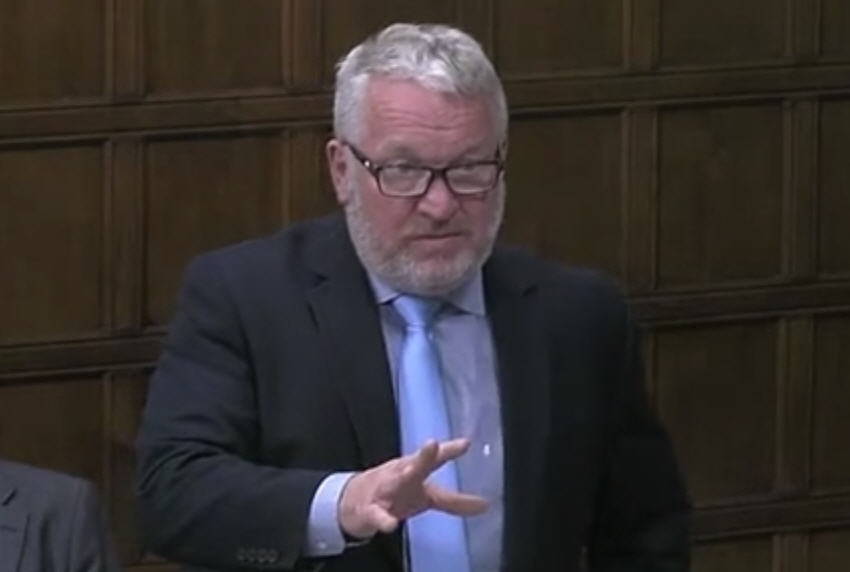
Mike Penning MP
On 12th October, after more than 220,000 people had signed a government e-petition, Mike Penning MP, the drugs minister, responded to the debate. He said:
“I have every sympathy for my friends and members of my family who have had MS and the terrible pain and anguish that they go through because of an incurable disease. So I start from the premise of having sympathy. Let us see what we can do in the 21st century to take people out of that environment…we could look carefully… at the research. We need to look at why the research is not taking place and at the effects of certain parts of the legislation…We have cross-party agreement that we will look at research and see how we can help people. I am committed to that…It is crucial that we do not set ourselves in one position but that instead, we ask what research could help take things forward. That is what I have committed to doing and it is very important.”
Source: Hansard
Then, on 26th October, in response to a written question, he said:
“The government’s position on the medicinal value of cannabis remains unchanged and no discussions are planned.”
Source: Hansard
This is dishonest and a subversion of our democratic process. However, in the UK, despite its historical role as the mother of parliamentary democracy, government ministers are now entirely unaccountable. Even in their individual role as MPs they answer to the electorate only once every five years, a level of accountability which is ridiculous in the 21st century. Between elections they only need consider their party whips or the more senior ministers who hold power over their careers.
In any other context, in business or in personal affairs, reneging on a promise as Mike Penning has done would have serious consequences. In some instances it might even bring him before the criminal courts. But Penning doesn’t give a damn, faces no consequences and he continues with impunity as any robber baron might have in the Middle Ages or any cowboy outlaw in the Wild West.
I have written to Mike Penning asking for an explanation and I have also written to my MP asking him to obtain an official explanation from the government. I ask you to do the same.
If Your MP Isn’t On This List You Need to Have A Word. Next Steps After The Cannabis Debate.
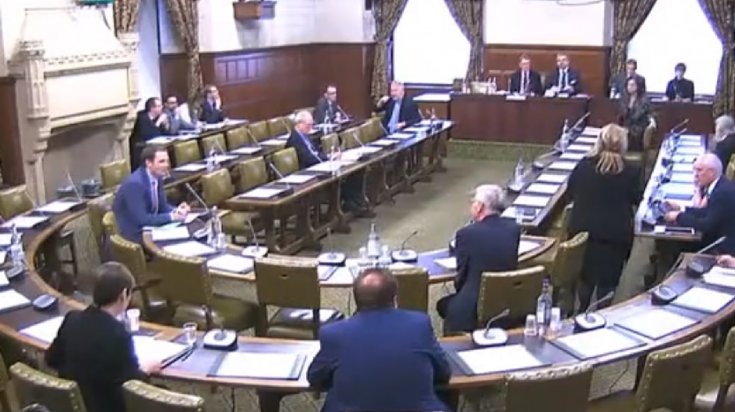
Westminster Hall. 12th October 2015
These Are The MPs Who Did Their Duty And Attended The Debate:
Lyn Brown, Labour, West Ham (Shadow Home Office minister)
Lisa Cameron, Scottish National Party, East Kilbride, Strathaven and Lesmahagow
Nigel Evans, Conservative, Ribble Valley (Chair of the debate)
Paul Flynn, Labour, Newport West
Cheryl Gillan, Conservative, Chesham and Amersham (Chair of the debate)
Sylvia Hermon, Independent, North Down
George Howarth, Labour, Knowsley
Rupa Huq, Labour, Ealing Central and Acton
Norman Lamb, Liberal Democrat, North Norfolk
Peter Lilley, Conservative, Hitchin and Harpenden
Caroline Lucas, Green, Brighton Pavilion
Anne McLaughlin, Scottish National Party, Glasgow North East
Paul Monaghan, Scottish National Party, Caithness, Sutherland and Easter Ross
Mike Penning, Conservative, Hemel Hempstead (Home Office minister)
Dr Dan Poulter, Conservative, Central Suffolk and North Ipswich
Graham Stuart, Conservative, Beverley and Holderness
Andrew Turner, Conservative, Isle of Wight
It’s important to point out that four MPs were there because they had to be. Lyn Brown was there as a shadow Home Office minister. Nigel Evans and Cheryl Gillan were there because they took turns to chair the debate. Mike Penning was there as the Home Office minister with responsibility for drugs policy.
If your MP didn’t attend the debate, particularly if you wrote asking them to, it is your right (I would argue it’s your duty) to complain and ask for an explanation.
There are very few reasonable excuses. If your MP is a government minister then he or she wouldn’t have been able to speak and may well have ministerial duties which would take priority. Other than that, apart from sickness or some other emergency, if your MP failed to represent you then you need to write, ask for an explanation and what will they do instead to advance your views to government.
Excellent work was done in lobbying MPs before the debate. I doubt that so many letters and emails have been sent to MPs on the subject before. Now is not the time to be downhearted, now is the time to keep up the pressure.
You can find out who your MP is by entering your postcode on this website
You can find out your MP’s email address by looking their name up here
You can also Google your MP’s name which will lead you to their personal website and more contact details.
You can write by letter to your MP at: House of Commons, London, SW1A 0AA
Most important is that you must include your full postal address and postcode to show that you are a constituent. Without this your email or letter will be ignored.
Either an email or a letter is fine but you might want to consider doing both!
We are not providing a template letter for reasons already explained. They simply do not work anymore. The activities of mass lobbying groups like 38 Degrees have really stymied individual lobbying efforts because they have swamped MPs with ludicrous quantities of emails. Consequently, to stand any chance of getting any attention your email needs to be clearly an individual, personal message.
Above all, please be polite. Aggression or hostility will get you nowhere. I met several MPs in the run up to the debate who were clearly surprised about how much correspondence they were getting but more than one mentioned that they were unmoved by people getting angry with them by demanding the right to use cannabis.
Asking questions is very important. If you don’t get answers you’re entitled to write again and insist. So these are the points you need to make. Incorporate them into an email or letter in your own words.
Five Point Plan.
- I was disappointed you didn’t attend the cannabis debate (after I wrote asking you to represent my views) Why were you not there?
- Nearly 250,000 people signed the petition to legalise cannabis. That makes it the second largest petition ever and shows it is of huge public concern. As only 17 MPs turned up to the debate what is the point of the petition website? What excuse do MPs have for ignoring this demonstration of democracy?
- A great deal of evidence was presented in the debate about the benefits of legalisation but none from the government about the possible harms of legalisation. Why? What evidence does the government have supporting its position?
- The only evidence the government has offered on the subject is the Advisory Council on the Misuse of Drugs (ACMD) report from 2008. This does not support present policy. It says cannabis should be class C and that the criminal justice measures do not work and public health strategies are needed instead. Why is the government misrepresenting the evidence?
- Please will you write to government ministers on my behalf and get answers to these questions?
Please make sure you do this. We will win this war against cannabis prohibition if we keep up sustained pressure. There is no valid reason to oppose reform and no evidence that supports present policy. We must keep up the lobbying effort. Persistent, polite pressure will work. Please do your bit. If we all work together we will prevail.
If you don’t get a response from your MP then please write again. Don’t be shy about saying you ‘insist’ on a response but do remain polite. If you still don’t get a response then make an appointment to see your MP at their constituency surgery. It may be possible to have a CLEAR representative come with you if you ask in good time. Email: clear@clear-uk.org
Please send any responses received to: mpletters@clear-uk.org


