Posts Tagged ‘alcohol’
Cannabis Embarrassment At The Home Office
 The re-scheduling of Sativex, the cannabis tincture marketed by GW Pharmaceuticals is causing huge embarrassment at the Home Office.
Everybody’s been able to go along with the white lie up to now that Sativex is some sort of highly complex, super scientific, super medicine containing cannabinoids. True enough, GW Pharma has put millions into development and testing in order to jump through the hoops the government has demanded. At the end of the day though, all Sativex consists of is a tincture, an alcohol extract of herbal cannabis. It’s made simply by gently heating a blend of herbal cannabis in ethanol and then adding a little peppermint oil to taste.

An Honourable Man?
The Medicines and Healthcare Products Regulatory Agency (MHRA) has approved Sativex for the treatment of muscle spasticity in MS. I understand that an approval for the treatment of cancer pain is expected shortly. The problem for the Home Office is that Sativex now has to be re-scheduled under the Misuse of Drugs Act 1971. Cannabis is presently in schedule one as having no medicinal value. The Advisory Council on the Misuse of Drugs (ACMD) has recommended this week that Sativex be in schedule four, alongside a variety of minor tranquilisers. However, as the ACMD says, “it will not be appropriate to refer to “Sativex”, which is a proprietary name, in any amendment to the misuse of drugs regulations, and that a suitable description of the relevant component(s) of “Sativex” will have to be scheduled.”
This is going to be tough for James Brokenshire to face up to. GW specifies that Sativex contains approximately equal proportions of THC and CBD but that’s not the whole truth. It also contains as many as 400 other chemical compounds which occur naturally in the plant including at least 85 cannabinoids (nobody is exactly sure how many cannabinoids there are or their effects). You see there’s not really any other accurate way of describing Sativex except to call it cannabis. So how can Mr Brokenshire possibly move it to schedule four? He endlessly repeats the propaganda that “there are no medicinal benefits in cannabis”.
Either Mr Brokenshire has to come clean and accept that his past position was incorrect or he has to promote some further deception.
I trust he will prove to be an honourable man.
How Drugs Work – Cannabis
Well done to the BBC for its programme “How Drugs Work – Cannabis” tonight. It was a well balanced and wide ranging examination of the subject. Inevitably it looked at extreme cases and was sensational in parts but I thought it was fair.
I could pick at details. It certainly didn’t provide any comparisons against other drugs. It should have clarified how dramatically more dangerous is alcohol and with many fewer benefits but overall it was a good job, well done.
I am encouraged by this well produced treatment of the subject. We may well be making progress!
Breakthrough In The Drugs Debate!

Bob Ainsworth
Tomorrow, Bob Ainsworth MP, former Home Office drugs minister and Secretary of State for Defence, will call for the legalisation and regulation of drugs. He is to lead a Parliamentary debate in Westminster Hall, at 2.30pm on Thursday 16th December 2010.
Great credit for this must go to the inestimable Transform Drug Policy Foundation, which has led the fight against prohibition. This is an extraordinary breakthrough. The news literally brought tears to my eyes. We have fought so long for such progress.
Mr Ainsworth said;
“I have just been reading the Coalition Government’s new Drugs Strategy. It is described by the Home Secretary as fundamentally different to what has gone before; it is not. To the extent that it is different, it is potentially harmful because it retreats from the principle of harm reduction, which has been one of the main reasons for the reduction in acquisitive crime in recent years.
However, prohibition has failed to protect us. Leaving the drugs market in the hands of criminals causes huge and unnecessary harms to individuals, communities and entire countries, with the poor the hardest hit. We spend billions of pounds without preventing the wide availability of drugs. It is time to replace our failed war on drugs with a strict system of legal regulation, to make the world a safer, healthier place, especially for our children. We must take the trade away from organised criminals and hand it to the control of doctors and pharmacists.
 As drugs minister in the Home Office I saw how prohibition fails to reduce the harm that drugs cause in the UK, fuelling burglaries, gifting the trade to gangsters and increasing HIV infections. My experience as Defence Secretary, with specific responsibilities in Afghanistan, showed to me that the war on drugs creates the very conditions that perpetuate the illegal trade, while undermining international development and security.
My departure from the front benches gives me the freedom to express my long held view that, whilst it was put in place with the best of intentions, the war on drugs has been nothing short of a disaster.
Politicians and the media need to engage in a genuine and grown up debate about alternatives to prohibition, so that we can build a consensus based on delivering the best outcomes for our children and communities. I call on those on all sides of the debate to support an independent, evidence-based review, exploring all policy options, including: further resourcing the war on drugs, decriminalising the possession of drugs, and legally regulating their production and supply.
One way to do this would be an Impact Assessment of the Misuse of Drugs Act in line with the 2002 Home Affairs Select Committee finding – which included David Cameron – for the government to explore alternatives to prohibition, including legal regulation.
The re-legalisation of alcohol in the US after thirteen years of Prohibition was not surrender. It was a pragmatic move based on the government’s need to retake control of the illegal trade from violent gangsters. After 50 years of global drug prohibition it is time for governments throughout the world to repeat this shift with currently illegal drugs.”
Peter Lilley MP, former Conservative Party Deputy Leader said;
“The current approach to drugs has been an expensive failure, and for the sake of everyone, and the young in particular, it is time for all politicians to stop using the issue as a political football. I have long advocated breaking the link between soft and hard drugs – by legalising cannabis while continuing to prohibit hard drugs. But I support Bob Ainsworth’s sensible call for a proper, evidence based review, comparing the pros and cons of the current prohibitionist approach with all the alternatives, including wider decriminalisation, and legal regulation.”
Tom Brake MP, Co-Chair, Liberal Democrat Backbench Committee on Home Affairs, Justice and Equalities said;
“Liberal Democrats have long called for a science-based approach to our drugs problem. So it is without hesitation that I support Bob Ainsworth’s appeal to end party political point-scoring, and explore sensitively all the options, through an Impact Assessment of the Misuse of Drugs Act.”
Labour’s Paul Flynn MP, Founder Council Member of the British Medicinal Cannabis Register said;
“This could be a turning point in the failing UK ‘war on drugs.’ Bob Ainsworth is the persuasive, respected voice of the many whose views have been silenced by the demands of ministerial office. Every open rational debate concludes that the UK’s harsh drugs prohibition has delivered the worst outcomes in Europe – deaths, drug crime and billions of pounds wasted.”
UK Drug Strategy 2010 – A Plan To Fail
Mother Knows Best
Gone are the days when central Government tells communities and the public what to do.
Rt. Hon. Theresa May, MP, Home Secretary, December 2010

A slim volume of treacle-like and turgid social worker-speak shot through with a few strands of sharp hypocrisy. See here.
A disappointment? Not really, it’s pretty much what I expected – an authoritarian, moralistic smokescreen behind which the government will do what it wants with no regard whatsoever for the views or the welfare of the people. It stinks.
It claims to be radical in that it turns away from reducing the harms caused by drugs and instead aims to force abstinence. In other words, do as we say or suffer the consequences. It is, in fact, a medieval solution to a 21st century problem. It seems that the British government no longer cares about the harm caused by drugs. All it cares about is that you STOP! This is the ultimate exposition of Nancy Reagan’s discredited “Just Say No” campaign because it really is “just” say “no” – no other option exists. This from a government that advocates giving people methadone to “treat” cannabis use. Can you believe it? That isn’t medieval. It’s prehistoric – or perhaps better described as mid 20th century, a sort of Dr Mengele method.
I give Ms May credit for one thing. She mentions alcohol alongside drugs in the first sentence of her foreword. That is progress but from then on there is little of any value. Nothing that you couldn’t have copied from any out of date A level textbook on social work.
The laughable assertion quoted above that the government doesn’t tell us what to do is just absurd. Never has there been a more hard line approach to the drugs issue. See Edwin Stratton’s article in The Guardian here which reveals just how draconian, anti-civil liberties and severe this government is.
In the penultimate paragraph of her foreword, Ms May acknowledges that there were calls during consultation on the strategy for “liberalisation and decriminalisation”. She dismisses these as not “the answer” but fails entirely to consider the enormous harm caused and crime created by existing policies. I will be making Freedom Of Information requests to determine just how much notice was taken of the consultation.
There is a complete failure to understand or consider the harms of prohibition. Britain now stands as one of the most backward and restrictive countries in the world when it comes to drug policy. We now rub shoulders with those countries that execute people for drug possession. There is no civilised country in the world with a more repressive drugs policy than Britain.

Broken Britain
Emphasis is given to the introduction of elected Police and Crime Commissioners. I support this move. Hopefully, these elected officials, being closer to reality and not ensconsed in Whitehall’s ivory towers, will mitigate some of the damage that this strategy could cause. They will have the impossible job of trying to implement these ideas and will surely give Ms May and her protege James “Broken Britain” Brokenshire some lessons in reality and common sense.
The statistics and figures quoted in the strategy are manifest nonsense. Apparently the economic and social costs of Class A drug use are £15.4 billion per annum while the equivalent figure for alcohol is £18 – 25 billion. Supposedly the total illicit drug market in Britain is worth just £4 – 6 billion per annum while the market for alcohol is £30 billion. There are just 320,000 heroin and/or crack cocaine users but tens of million that use alcohol. These figures just don’t add up. Maybe that’s part of the reason this strategy is so badly conceived and directed.
It’s only part of the reason though. The main problem is that the government’s approach is based on prejudice and an arrogant, moralistic, proselytising stance. See David Nutt’s article here on what the government would do if a completely safe alternative to ecstasy was developed. Prohibition is immoral and evil in itself. When will our politicians wake up to what most of the rest of Europe and the USA already knows?
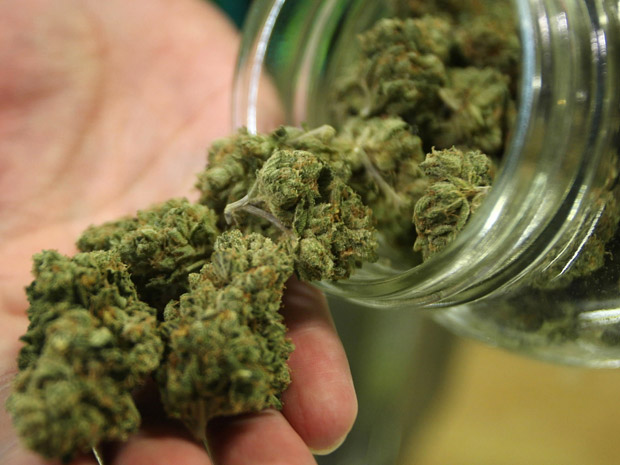
Powerful Medicine. Gentle Pleasure.
Cannabis, the most widely used illegal drug by a factor of at least 10 barely gets a mention except in passing. This, in itself, exposes the inane content of this strategy. The government apparently intends to deal with cannabis in exactly the same way as it deals with heroin and crack. The medicinal use of cannabis, now a burgeoning industry and source of hope to people all over Europe and America isn’t even mentioned. The crass stupidity of this strategy is almost beyond belief.
So the battle lines are drawn. Every other civilised country in the world is coming to terms with the fact that the war on drugs is unwinnable, even lost. Theresa May, like some mad first world war general, is blowing her whistle and urging on millions more to go over the top into certain death, or at least misery and degradation. Her slightly fey, sweet boy, Colonel Jimmy is hiding behind her, determined to gain credit for something but definitely not doing anything worthwhile, “Crikey! Not me. I’m staying safe.”
This could be a deeply depressing day but at least now we know where we stand. David Cameron and Nick Clegg have completely turned around on the progressive and liberal ideas they have advocated in the past. Nothing is a better indicator of the integrity and intelligence of a government than its drug policy. Britain is shamed by this effort which will inevitably cause more harm, cost more money and ruin more lives.
The Truth About Sativex
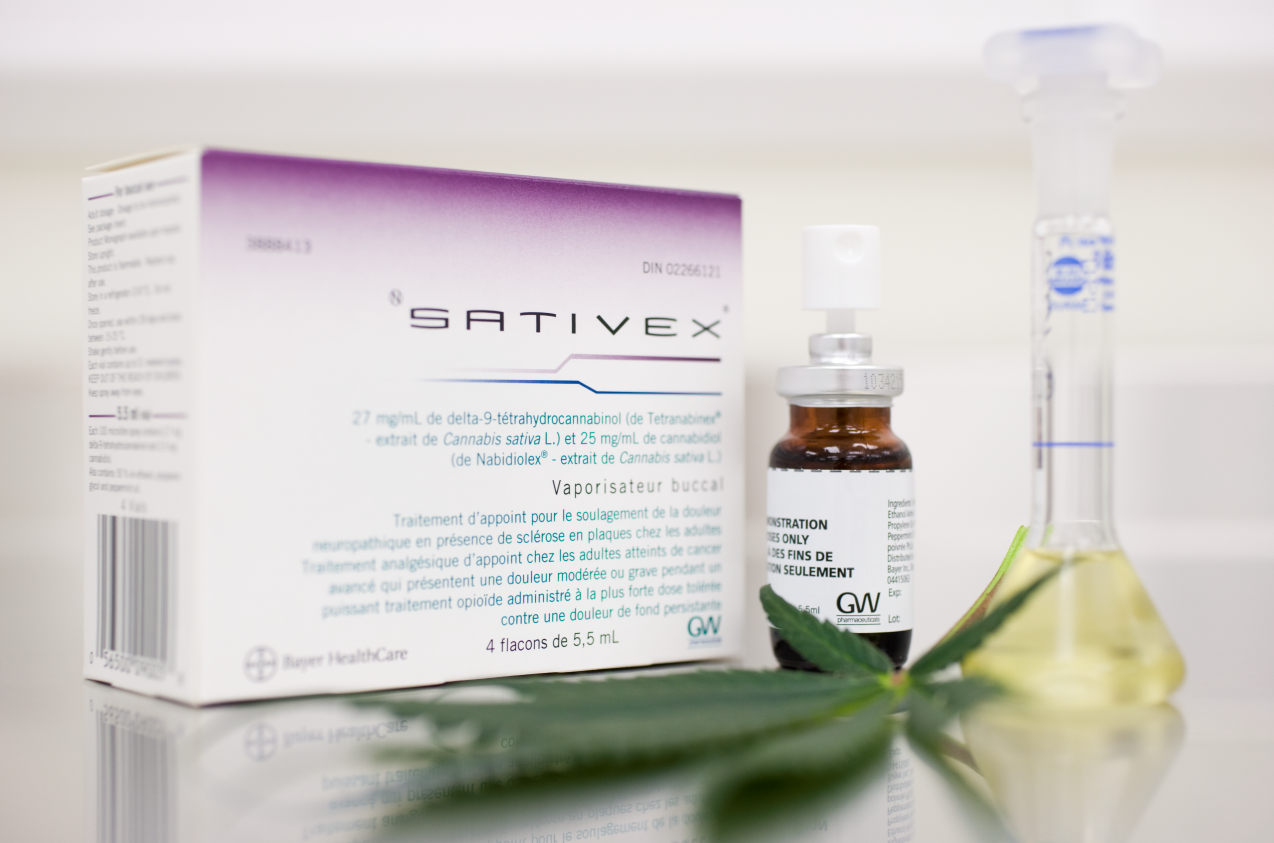 Sativex is super strong, concentrated cannabis. Nothing more, nothing less.
GW Pharmaceuticals would have you believe that it’s a “pharmaceutical” product because according to its research that’s what patients prefer. As the GW spokesman puts it, “It’s a pharmaceutical solution, formulated with the ability to deliver a precise dose and with stringent standards of quality, safety and efficacy”.
 In fact, what GW does is grow high quality cannabis under pretty much the same conditions as most illegal growers. It uses clonal propagation to ensure consistent levels of cannabinoids. Lighting and hydroponic nutrition is computer controlled with automatic ventilation. It really is no different from the most sophisticated and efficent illegal cannabis farms. It’s a recognised and proven technology now also used by Bedrocan in Holland, the Dutch government’s exclusive medicinal cannabis grower and Gropech in California which is building a new 60,000 sq ft facility in Oakland for a crop worth $50 million per year.
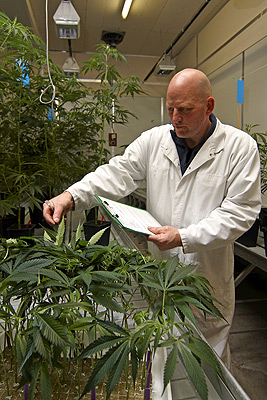
Bedrocan Grow
The difference between these crops from legal and illegal growers is insignificant. It’s similar to buying your tomatoes from the supermarket or the farm shop.
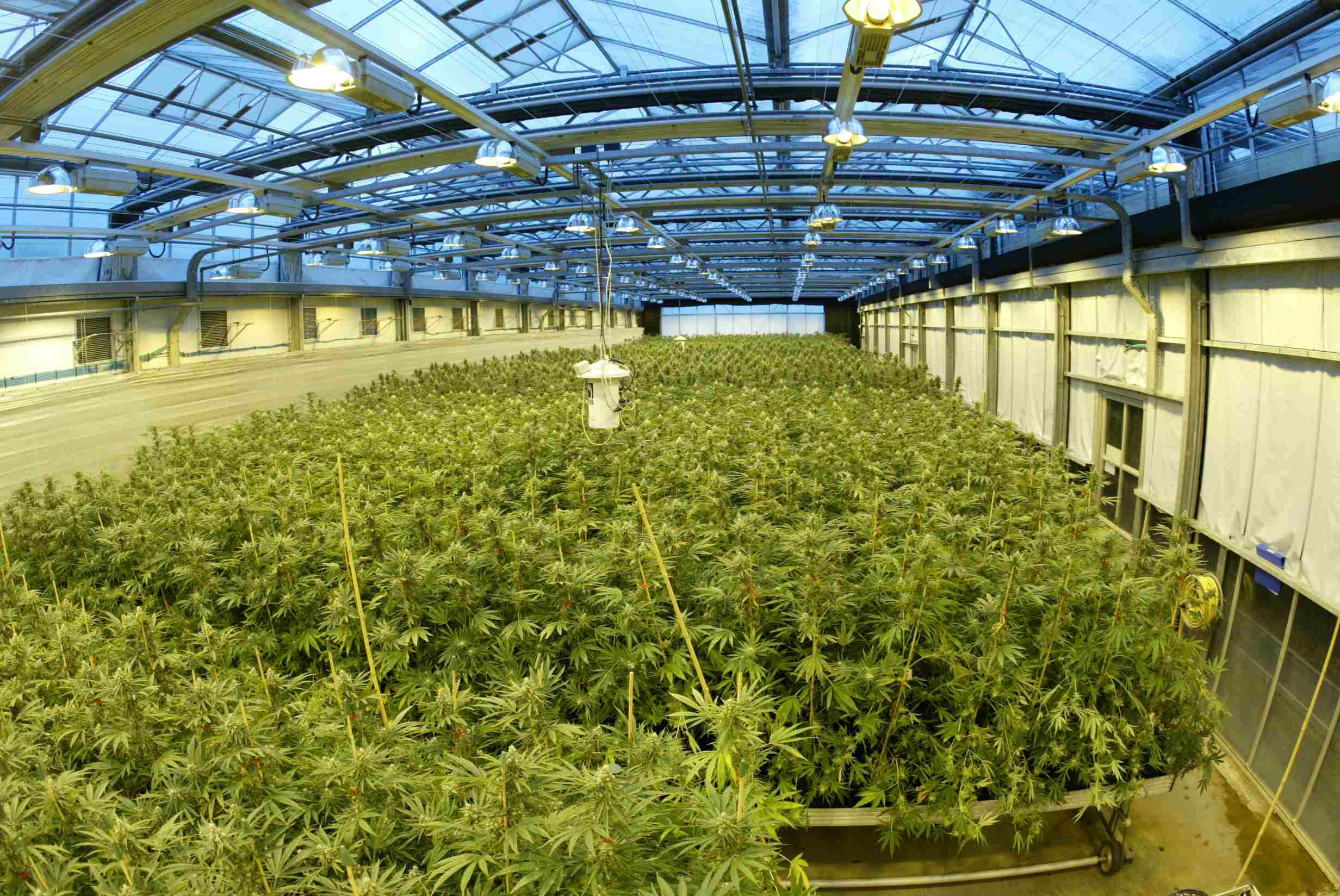
GW Grow
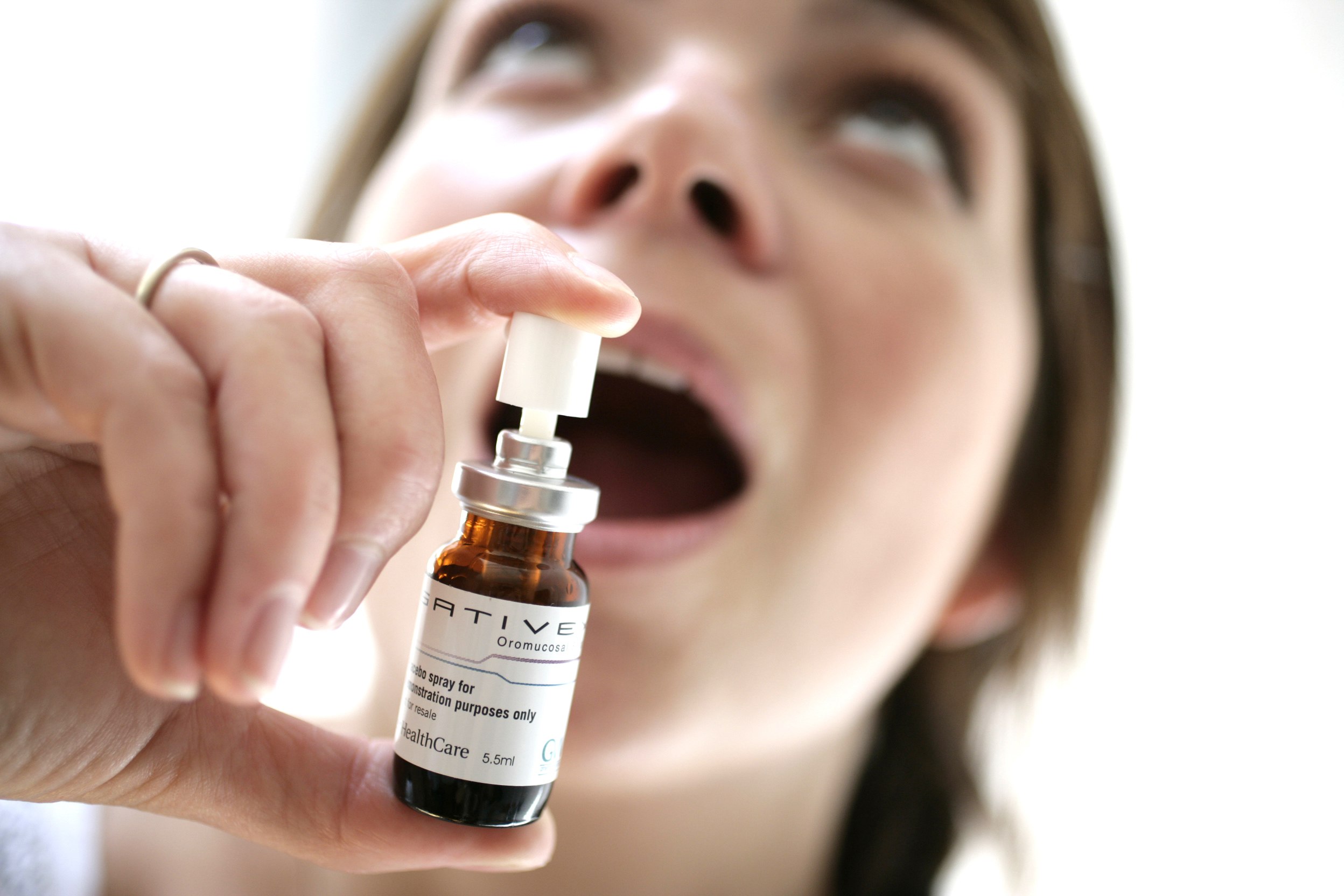
GW takes its high quality cannabis, chops it up and makes a tincture by heating it under pressure with CO2 and then adding ethanol to precipitate an oil. Then, with the addition of a little peppermint oil to mask the taste and some preservative, the filtered liquid is packaged into tiny little aerosol bottles. Each spray delivers 2.7mg of THC and 2.5mg of CBD. What GW doesn’t tell you that it also contains all the other 100+ cannabinoids found in the plant, each of which has its own mechanism of action and effect. It also contains flavonoids, terpines and other compounds. Everything that is found in the plant.
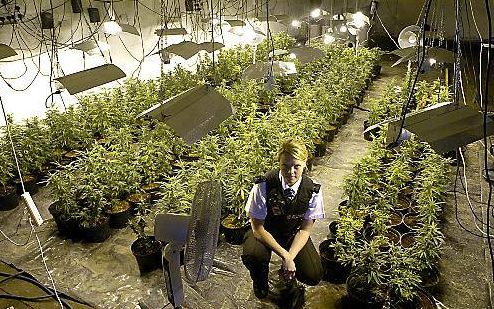
Illegal Grow
I applaud GW Pharmaceuticals for bringing the enormous benefits of cannabinoid therapy into the 21st century. It’s nothing new though. The medicinal value of the plant has been known and widely used for thousands of years. Only in the last century has it been demonised by lies and propaganda. It would be a mistake though to think that Sativex is anything different from the plant itself. It’s just been wrapped up in a marketing and physical package which has enabled stupid and cowardly politicians to accept it.
In fact, Sativex remains just as illegal in Britain as herbal cannabis. Even though it has received MHRA approval for use in the treatment of MS spasticity and may be prescribed by a doctor, it remains a schedule 1 drug under the Misuse Of Drugs Act. The Home Office has indicated that it intends to amend the law but has not yet done so. This means that any pharmacist who dispenses Sativex at present is guilty of exactly the same criminal offence as any street dealer in weed or hash.
The Home Office will, of course, turn a blind eye to this but not to medicinal herbal cannabis even though, in every sense, it is identical to Sativex (except that Sativex also contains alcohol and peppermint oil). The stark idiocy of British law is revealed.
Never before has there been a better example of the how the law is an ass and so are the spineless politicians who support it.
Alan Johnson – An Absence Of Integrity

Shadow
I used to be an admirer. Even as a rabid Tory, in fact, very much as a Tory, I thought the story of postman to Minister of the Crown was Boy’s Own stuff.
He has a sharp intellect and an easy charm with nothing of the snide trade union whinger that he might have been. Then came Professor Nutt and, almost as never before, a politician’s true colours were revealed. Not the gentle pink blush of embarrassment but a black deception and dishonour. It was an astonishing position to take. As David Nutt recalls, “Alan Johnson famously said in the House that he was “big enough, strong enough, bold enough” to sack me for saying cannabis was less harmful than alcohol.” And he did. See here.
Even worse, as a replacement he appointed Professor Les Iversen, author of “Cannabis, Why It Is Safe” and countless other publications extolling the innocuous nature of the plant. He is on the record as saying that “cannabis should be legalised, not just decriminalized”. The complete absurdity of Alan Johnson’s actions were astonishing. He was stating boldly and without apology that whatever the science said he wouldn’t listen to it. Even more than that, he would try to silence the truth.
This is a politician without a shred of integrity. A man of great achievement and intelligence who has shamed himself and destroyed his own career. He is not fit to be in the shadow cabinet. That he has been appointed shadow chancellor is a hollow and sickening joke.
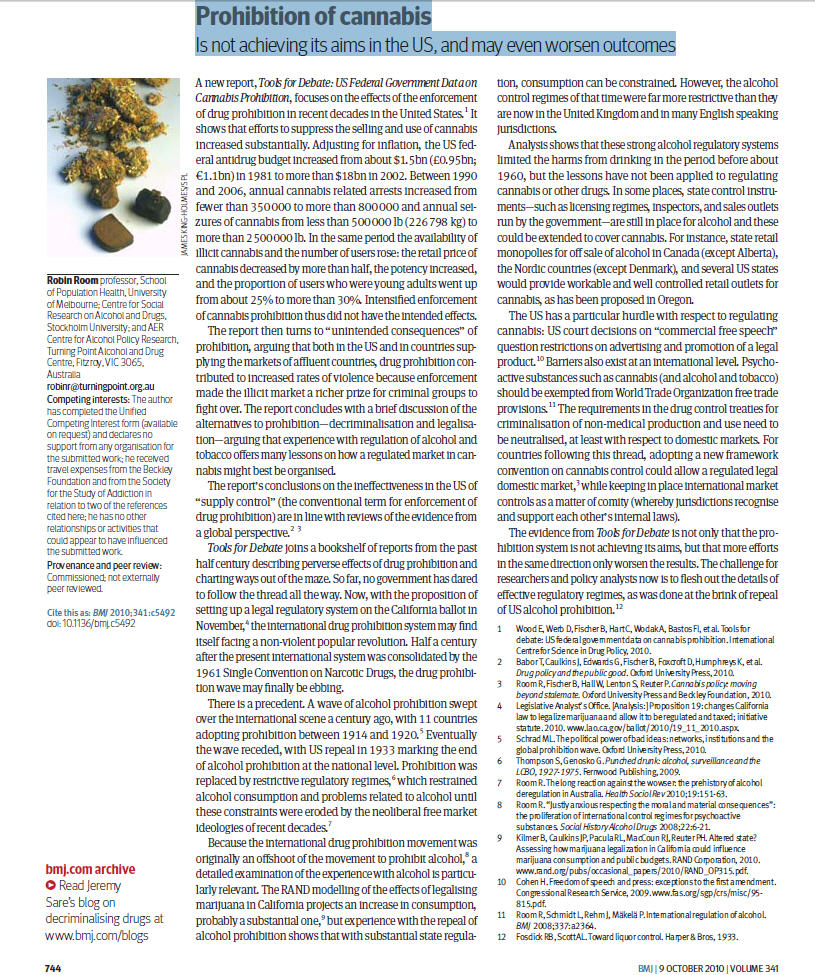
“Cannabis Should Be Sold In Shops Alongside Beer And Cigarettes, Doctors’ Journal Says” – The Daily Telegraph, 11th October 2010
Yes, this is The Daily Telegraph here. Yes, this concerns an article published in the BMJ here.
There are distinct signs of sanity on the horizon. Is it money driving this new reality because we waste £19 billion per annum on the “war on drugs”? Or is it that Proposition 19 in California and the clash between UK and European law over medicinal cannabis is revealing the absurdity of prohibition?
Cannabis should be sold in shops alongside beer and cigarettes, doctors’ journal says
An editorial in the British Medical Journal suggested that the sale of cannabis should be licensed like alcohol because banning it had not worked.
Banning cannabis had increased drug-related violence because enforcement made “the illicit market a richer prize for criminal groups to fight over”.
An 18-fold increase in the anti-drugs budget in the US to $18billion between 1981 and 2002 had failed to stem the market for the drug.
In fact cannabis related drugs arrests in the US increased from 350,000 in 1990 to more than 800,000 a year by 2006, with seizures quintupling to 1.1million kilogrammes.
The editorial, written by Professor Robin Room of Melbourne University, said: “In some places, state controlled instruments – such as licensing regimes, inspectors, and sales outlets run by the Government – are still in place for alcohol and these could be extended to cover cannabis.”
Prof Room suggested that state-run off licences from Canada and some Nordic countries could provide “workable and well controlled retail outlets for cannabis”.
Prof Room suggested the current ban on cannabis could come to alcohol prohibition, which was adopted by 11 countries between 1914 and 1920.
Eventually it was replaced with “restrictive regulatory regimes, which restrained alcohol consumption and problems related to alcohol until these constraints were eroded by the neo-liberal free market ideologies of recent decades”.
The editorial concluded: “The challenge for researchers and policy analysts now is to flesh out the details of effective regulatory regimes, as was done at the brink of repeal of US alcohol prohibition.”
Campaigners criticised the editorial. Mary Brett, a retired biology teacher, said: “The whole truth about the damaging effects of cannabis, especially to our children with their still-developing brains, has never been properly publicised.
“The message received by children were it to be legalised would be, ‘It can’t be too bad or the Government wouldn’t have done this’.
“I know – I taught biology to teenage boys for 30 years. So usage will inevitably go up – it always does when laws are relaxed.
“Why add to the misery caused by our existing two legal drugs, alcohol and tobacco?”
Earlier this year, Fiona Godlee, an editor of the Journal, which is run by the British Medical Association, endorsed an article by Steve Rolles, head of research at Transform, the drugs foundation, which called for an end to the war on drugs and its replacement by a legal system of regulation.
Dr Godlee said: “Rolles calls on us to envisage an alternative to the hopelessly failed war on drugs. He says, and I agree, that we must regulate drug use, not criminalise it.”
Legal Medicinal Cannabis In Britain
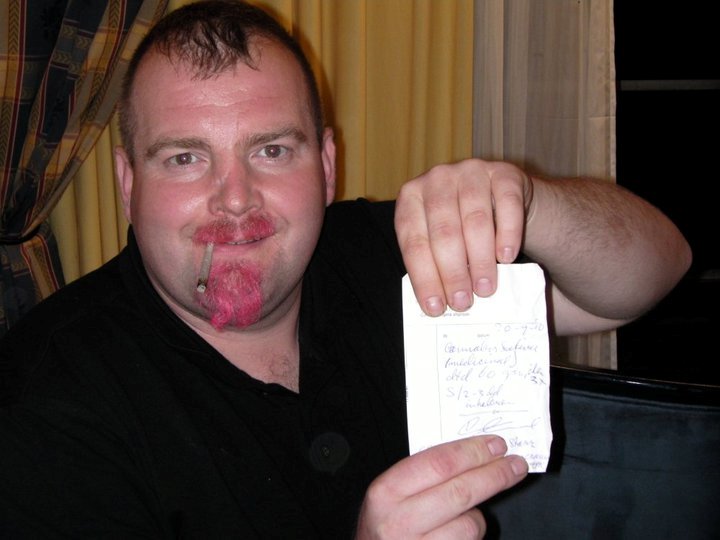
In The Pink
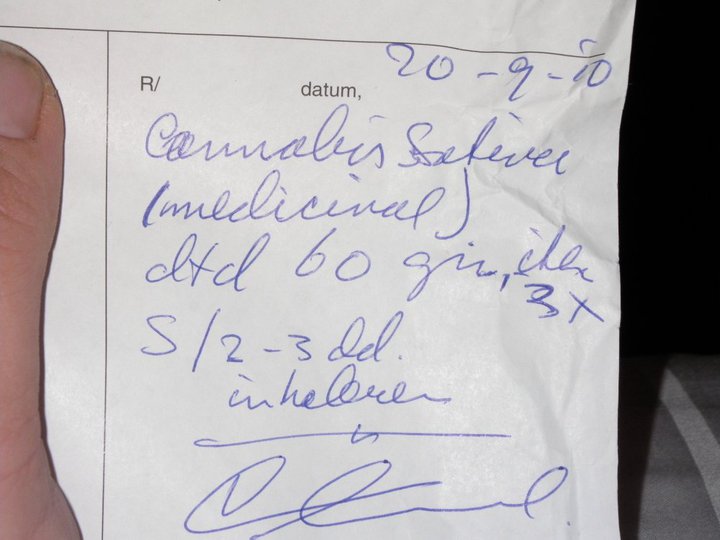
Last week Jim Starr flew into Bristol Airport from Amsterdam carrying 80 grammes of herbal cannabis as prescribed for him by a Dutch doctor. That’s just under three ounces of dried flower heads. He was carrying it in a parcel about the size of a telephone directory.
There was no one at customs, even though Jim went through the red channel and had telephoned ahead to advise the airport that he was bringing the cannabis in. He waited, even looked around for someone, anyone, but there was no one to be seen at all. He wanted to declare what he had with him. He’s never wanted to break the law. He knew that he was risking confiscation of the cannabis, possibly even arrest but the coast wasn’t just clear, it was deserted. The authorities had evidently decided that in their “war on drugs”, this time, discretion was definitely the better part of valour. They were in full scale retreat.
Jim had confirmed to the airport that he had the necessary paperwork to prove it was prescribed medicinal cannabis. His doctor had told him that he was protected under Article 75 of the Schengen Agreement which states “persons may carry the narcotic drugs and psychotropic substances that are necessary for their medical treatment provided that, at any check, they produce a certificate issued or authenticated by a competent authority”
Prescription
Of course, even then, it didn’t stop the journey being a nerve wracking and tense experience. Now, safely at home in Dorchester with his family, Jim understands from the Home Office that he is entitled to bring in the cannabis as prescribed for him by his Dutch doctor. He can bring in up to three month’s supply at a time if he carries it on his person. Otherwise he has to apply for an import licence and have it shipped to a UK pharmacist.
Jim is 36 and is married to Emma, with whom he has two children. Originally from Birmingham, he was a very active man in full time employment until in 1999 he was diagnosed with a degenerative disease of the spine. In 2003 he was involved in a road accident and suffered terrible spinal injuries. His life seemed hopeless. The cocktail of powerful drugs he was prescribed, including morphine, were debilitating in themselves. He couldn’t face a future in which he was turned into a zombie, unable to enjoy any sort of decent life with his wife and children. He admits frankly that he was suicidal.
One day in 2004, Jim was upstairs in bed in so much pain and despair that he could barely move. A friend called round to see him and offered him a joint. Half an hour later Jim made it downstairs for the first time in three weeks. Suddenly he had hope and the possibility of a future with his family.
Life since then has been a constant game of cat and mouse with the police and drug dealers. Apart from risking arrest and even prison, Jim has also been in danger of being robbed or ripped off by dealers. He’s never wanted to break the law. He told his doctor the relief that cannabis provided and as soon as Sativex became available, even before it was officially licensed, his doctor prescribed it for him. Unfortunately, the very next day she rang to say that because of licensing and regulation problems she wouldn’t be able to prescribe it again. In fact, Jim did manage to get another prescription for Sativex but again it was withdrawn, this time because his health authority refused to fund it.
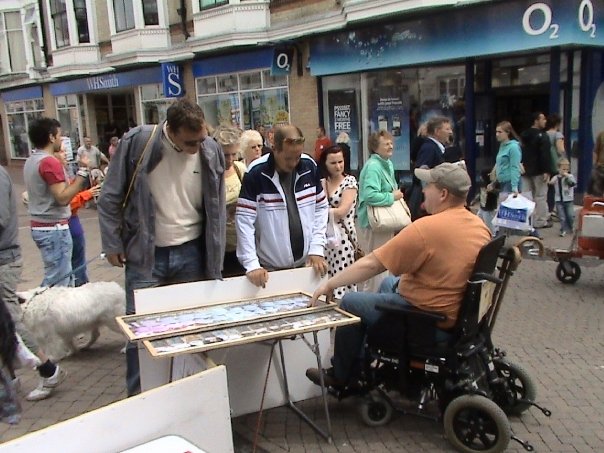
Jim has been an active campaigner for the legalisation of cannabis ever since. He has organised a series of marches, protests and petitions in Dorchester, Weymouth and even Downing Street. Over the last seven years, three MPs, Oliver Letwin, Jim Knight and Richard Drax, have written various letters in support of him. He is a distinctive figure in his wheelchair with his dyed beard which has earned him the nickname “Pinky”. Perhaps he has been a little too high profile for the Dorset police who he accuses of persecuting him. Unable to obtain Sativex or afford the prices and risks of dealers, Jim enlisted the help of a friend to grow his own medicine. Inevitably, in May 2009 the police arrived and Jim was arrested.
Campaigning
In August this year at Dorchester Crown Court Jim was given a two year conditional discharge for growing cannabis. He is now pursuing a complaint against the police alleging brutal treatment during his arrest. Other complications, allegedly at the police’s behest, have led to the DVLA revoking his driving licence although he has never been arrested, charged, convicted or even stopped on suspicion of driving under the influence.
Jim has become an avid recorder of everything. He uses mobile phones, video cameras and audio recorders to retain evidence of every contact with the authorities. He has a video recording of an officer saying to his wife “Look luvvy, whatever he grows up there from now on is up to him. We promise it don’t bother us”. Foolishly, he took the officer at his word. Three weeks after receiving his conditional discharge the police arrived again.
There was no provision for transporting him to the police station in his wheelchair. The officers were warned not to lift him by his arms because of his spinal condition. They wrenched him out of his chair by gripping his shoulders and underpants causing anal bleeding due to an existing condition. He was refused a doctor at the station. There was no provision for disabled people, even for his special toilet needs. He was refused access to any of his prescribed medication or even his specialist anti pressure sore mattresses.
The following day he attended hospital and was diagnosed with torn shoulder muscles. In fact, his spinal column is so delicate that any movement could potentially paralyse him. This is the basis of all his high profile campaigning and must be well known to the police. Jim now faces another charge of cultivating cannabis and a possible prison sentence.

With Mr Nice
The trip to Holland was a last resort, only made possible by the generosity of a friend. The Dutch doctor was horrified at the range of highly toxic prescription medicines given to Jim and prescribed two grammes per day of medicinal herbal cannabis. He told Jim that he shouldn’t be using Sativex as the alcohol in its solution was like pouring petrol on a fire, given his medical conditions.
So at last, Jim seems to have the medicine he needs. He will have to continue to rely on the generosity of friends to pay for it. He is applying for a Home Office licence for the cannabis to be imported to a local pharmacist who can then dispense it to him. He will continue to campaign for the right to grow his own for free. The costs of cultivation at home are minimal compared to the rigmarole of importing from Holland or the massive “Big Pharma” cost of Sativex.
Jim is not the first person to get the medicine they need in this way but he is the first to go public about it. Many tens of thousands may now wish to follow his example. Most European countries and 15 US states already regulate the provision of medicinal cannabis. Surely it is time for the government to consider reform of what looks increasingly like an absurd and cruel law.
Alcohol And Cannabis. Putting Drugs In Perspective.
I am not a fan of embedding YouTube clips unless they’re about films or music. I’ll make an exception for these two though. They make a very important point very powerfully.
The first is a very short US TV commercial with an anti-drugs messsage. The second is a witty, incisive stand-up routine that knocks the pomposity, arrogance and stupidity of our drug laws for six.

 Peter Reynolds