Posts Tagged ‘Weymouth’
Legal Medicinal Cannabis In Britain
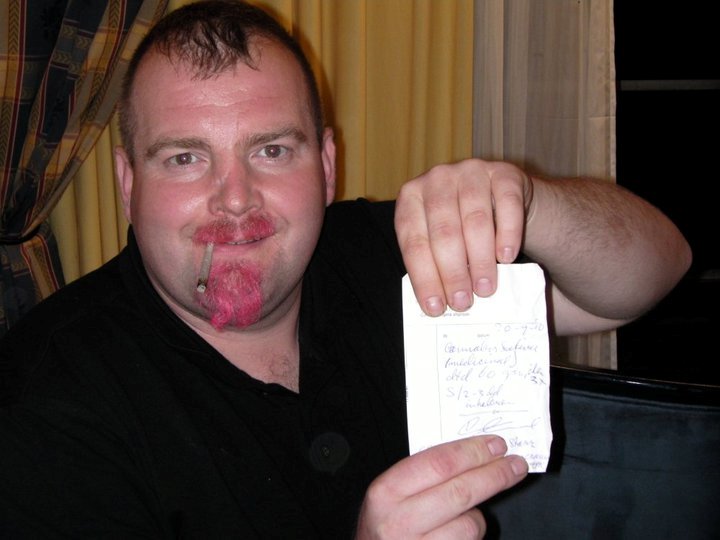
In The Pink
Last week Jim Starr flew into Bristol Airport from Amsterdam carrying 80 grammes of herbal cannabis as prescribed for him by a Dutch doctor. That’s just under three ounces of dried flower heads. He was carrying it in a parcel about the size of a telephone directory.
There was no one at customs, even though Jim went through the red channel and had telephoned ahead to advise the airport that he was bringing the cannabis in. He waited, even looked around for someone, anyone, but there was no one to be seen at all. He wanted to declare what he had with him. He’s never wanted to break the law. He knew that he was risking confiscation of the cannabis, possibly even arrest but the coast wasn’t just clear, it was deserted. The authorities had evidently decided that in their “war on drugs”, this time, discretion was definitely the better part of valour. They were in full scale retreat.
Jim had confirmed to the airport that he had the necessary paperwork to prove it was prescribed medicinal cannabis. His doctor had told him that he was protected under Article 75 of the Schengen Agreement which states “persons may carry the narcotic drugs and psychotropic substances that are necessary for their medical treatment provided that, at any check, they produce a certificate issued or authenticated by a competent authority”
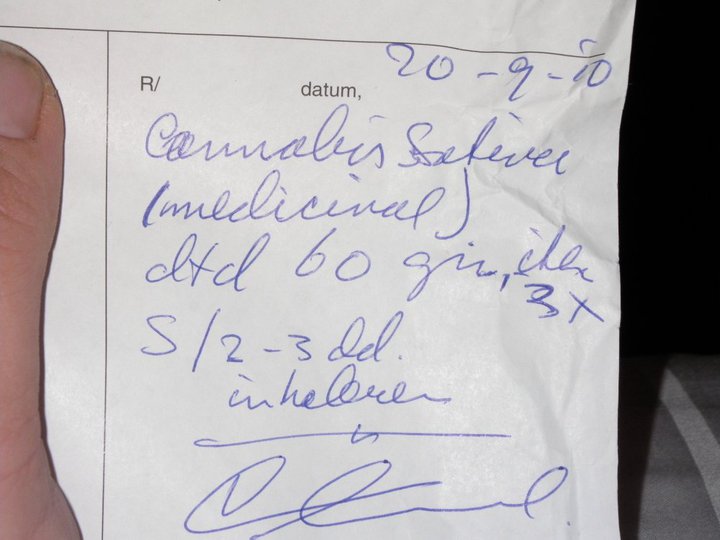
Prescription
Of course, even then, it didn’t stop the journey being a nerve wracking and tense experience. Now, safely at home in Dorchester with his family, Jim understands from the Home Office that he is entitled to bring in the cannabis as prescribed for him by his Dutch doctor. He can bring in up to three month’s supply at a time if he carries it on his person. Otherwise he has to apply for an import licence and have it shipped to a UK pharmacist.
Jim is 36 and is married to Emma, with whom he has two children. Originally from Birmingham, he was a very active man in full time employment until in 1999 he was diagnosed with a degenerative disease of the spine. In 2003 he was involved in a road accident and suffered terrible spinal injuries. His life seemed hopeless. The cocktail of powerful drugs he was prescribed, including morphine, were debilitating in themselves. He couldn’t face a future in which he was turned into a zombie, unable to enjoy any sort of decent life with his wife and children. He admits frankly that he was suicidal.
One day in 2004, Jim was upstairs in bed in so much pain and despair that he could barely move. A friend called round to see him and offered him a joint. Half an hour later Jim made it downstairs for the first time in three weeks. Suddenly he had hope and the possibility of a future with his family.
Life since then has been a constant game of cat and mouse with the police and drug dealers. Apart from risking arrest and even prison, Jim has also been in danger of being robbed or ripped off by dealers. He’s never wanted to break the law. He told his doctor the relief that cannabis provided and as soon as Sativex became available, even before it was officially licensed, his doctor prescribed it for him. Unfortunately, the very next day she rang to say that because of licensing and regulation problems she wouldn’t be able to prescribe it again. In fact, Jim did manage to get another prescription for Sativex but again it was withdrawn, this time because his health authority refused to fund it.
Jim has been an active campaigner for the legalisation of cannabis ever since. He has organised a series of marches, protests and petitions in Dorchester, Weymouth and even Downing Street. Over the last seven years, three MPs, Oliver Letwin, Jim Knight and Richard Drax, have written various letters in support of him. He is a distinctive figure in his wheelchair with his dyed beard which has earned him the nickname “Pinky”. Perhaps he has been a little too high profile for the Dorset police who he accuses of persecuting him. Unable to obtain Sativex or afford the prices and risks of dealers, Jim enlisted the help of a friend to grow his own medicine. Inevitably, in May 2009 the police arrived and Jim was arrested.
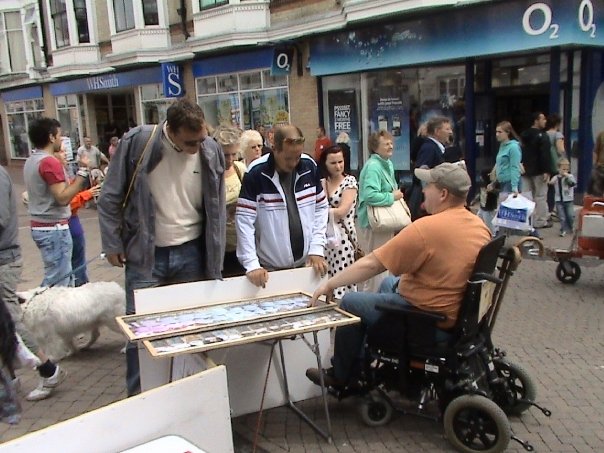
Campaigning
In August this year at Dorchester Crown Court Jim was given a two year conditional discharge for growing cannabis. He is now pursuing a complaint against the police alleging brutal treatment during his arrest. Other complications, allegedly at the police’s behest, have led to the DVLA revoking his driving licence although he has never been arrested, charged, convicted or even stopped on suspicion of driving under the influence.
Jim has become an avid recorder of everything. He uses mobile phones, video cameras and audio recorders to retain evidence of every contact with the authorities. He has a video recording of an officer saying to his wife “Look luvvy, whatever he grows up there from now on is up to him. We promise it don’t bother us”. Foolishly, he took the officer at his word. Three weeks after receiving his conditional discharge the police arrived again.
There was no provision for transporting him to the police station in his wheelchair. The officers were warned not to lift him by his arms because of his spinal condition. They wrenched him out of his chair by gripping his shoulders and underpants causing anal bleeding due to an existing condition. He was refused a doctor at the station. There was no provision for disabled people, even for his special toilet needs. He was refused access to any of his prescribed medication or even his specialist anti pressure sore mattresses.
The following day he attended hospital and was diagnosed with torn shoulder muscles. In fact, his spinal column is so delicate that any movement could potentially paralyse him. This is the basis of all his high profile campaigning and must be well known to the police. Jim now faces another charge of cultivating cannabis and a possible prison sentence.

With Mr Nice
The trip to Holland was a last resort, only made possible by the generosity of a friend. The Dutch doctor was horrified at the range of highly toxic prescription medicines given to Jim and prescribed two grammes per day of medicinal herbal cannabis. He told Jim that he shouldn’t be using Sativex as the alcohol in its solution was like pouring petrol on a fire, given his medical conditions.
So at last, Jim seems to have the medicine he needs. He will have to continue to rely on the generosity of friends to pay for it. He is applying for a Home Office licence for the cannabis to be imported to a local pharmacist who can then dispense it to him. He will continue to campaign for the right to grow his own for free. The costs of cultivation at home are minimal compared to the rigmarole of importing from Holland or the massive “Big Pharma” cost of Sativex.
Jim is not the first person to get the medicine they need in this way but he is the first to go public about it. Many tens of thousands may now wish to follow his example. Most European countries and 15 US states already regulate the provision of medicinal cannabis. Surely it is time for the government to consider reform of what looks increasingly like an absurd and cruel law.
Paradise Valley

Heaven On Earth
It’s that time of the month again!
No, no, no ladies. Happy times! Another walk in Paradise Valley. See here.


The Red Arrows

Portland Harbour 2010
At five o’clock yesterday evening I stood on top of White Horse hill and watched the Red Arrows perform for Weymouth carnival.
From this perfect vantage point I could see them soar a mile high above me then swoop down five or six miles to my left (east), climb again and explode out of formation five or six miles to my right (west).

Portland Harbour 1940
They say the Red Arrows are the best recruiting sergeant that the RAF could possibly have. That is if we have the RAF for very much longer. It looks likely that soon we will have just one integrated service. That makes sense though. In modern times we need an integrated approach using land, sea and air.
Nothing can extinguish or outshine the honour of the RAF or the Army or the Navy, whatever the future holds. As we remember the 70th anniversary of the Battle of Britain, the Red Arrows flew yesterday through the same skies that our young heroes did then in their Spitfires and Hurricanes. Nothing can ever repay our debt to those who enabled Britain to stand alone for more than a year against the Nazis. It is no exaggeration to say that through those dark days they and Britain saved the world. See brilliant BBC story here.
We shall honour them for ever.

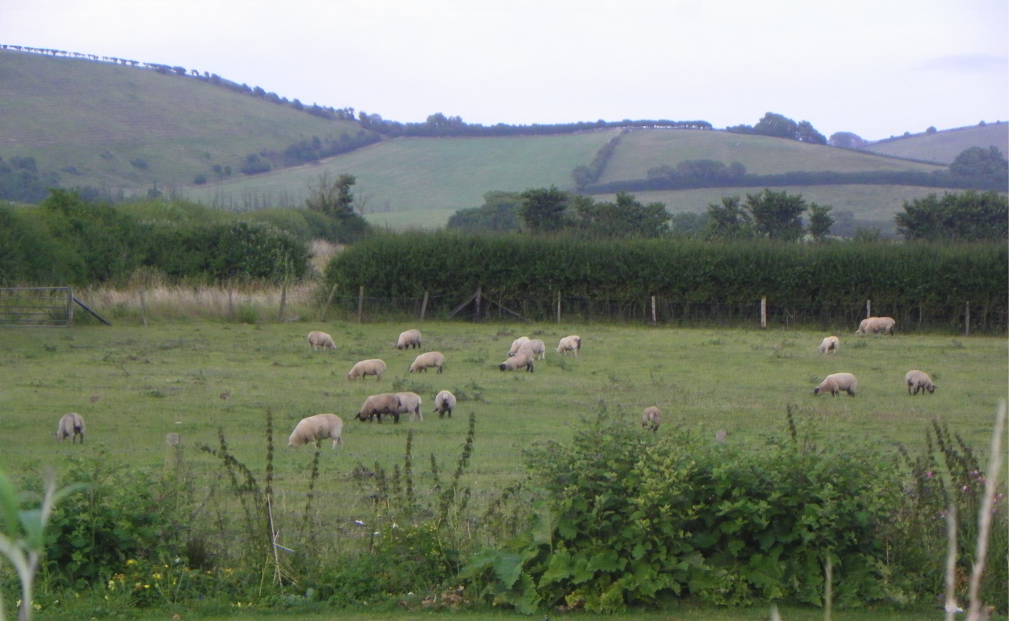
Paradise Valley
The latest instalment in the extraordinary story of the most beautiful place on the planet is available here. Don’t miss it!
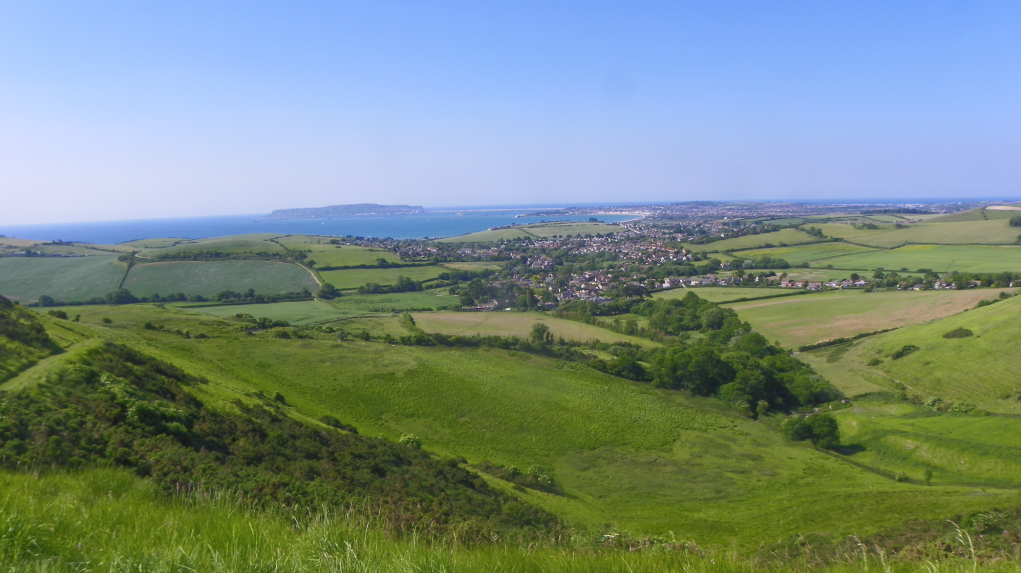
Heaven On Earth
My Letter To The Times
I am honoured to be in august company today with my letter published in “The Times”.
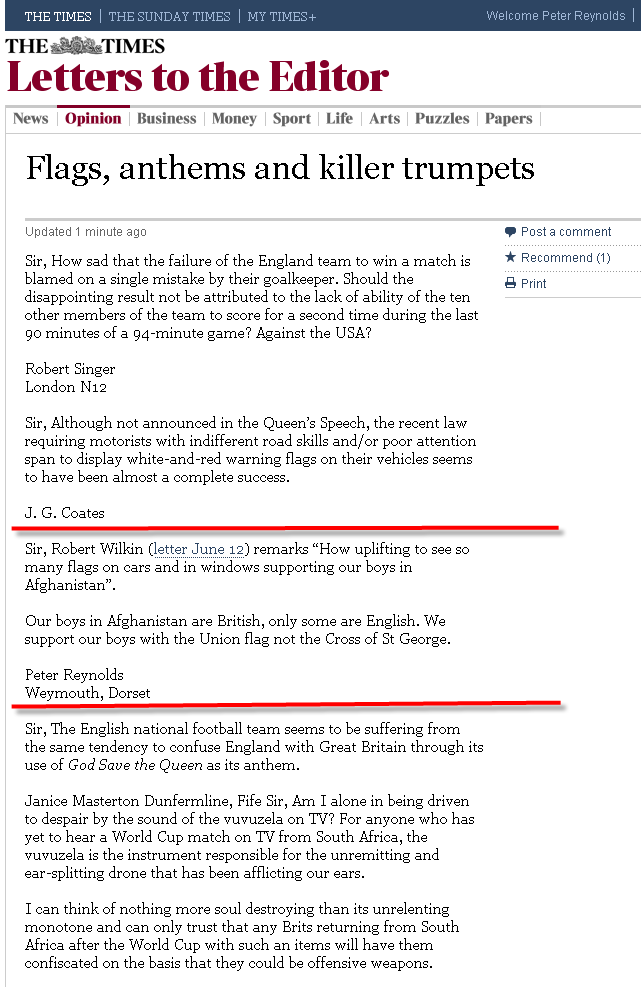
The Times, 15th June 2010
Hundreds Of Miles Away…

Sea Mist
…as the BBC describe us, here in Weymouth, the berk flew in, hijacked Asda, the very source of my daily bread and tried to turn it into Gordon Brown land. Never! We may have an inadequate sycophant in Jim Knight as our present MP and an aristocrat, landowner and James Bond villain, Richard Drax, as our future but we are proud Dorset men, we are, so we are, arrrrghr!
Paradise Valley – Heaven On Earth

Today I started a new blog on Paradise Valley, the beautiful heaven on earth where I am so fortunate to live.
This will be where I write about walking my dogs , Capone and Carla, and all our adventures in deepest Dorset.

 Peter Reynolds
A Fundamental Problem At The BBC
with 3 comments
I am very close to being the BBC’s biggest fan. It is a remarkable and entirely unique institution. Somehow it occupies a place between the state and the people which I can find no comparison for. It would be easy to define it as some sort of socialist idea but it is genuinely independent from the state. I do, however, have some concerns about its accountability. I am very concerned about the way it handles complaints.
No Complaints Accepted Here
I have grown up with the BBC and I trust it. In fact, I think that it’s done a better job of maintaining Britishness and values of integrity, tolerance, fairness and justice than any UK government of any political complexion. That’s why the curmudgeons in all political parties turn against it. I think Jeremy Hunt’s recent attacks and comments were particularly poorly judged. He hasn’t a had a good start in government at all has he?
I made a complaint to the BBC recently and I am very, very unhappy about the way it has been handled. The subject is not relevant here. I shall write about it in future but for now it would distract from my point. I am horrified to discover that the BBC does not handle complaints itself. They are outsourced to Capita in Belfast which describes itself as “the UK’s leading outsourcing company…at the leading edge of redefining and transforming services to the public.” For me that needs a huge pinch of salt, a mountain in fact and even then I’m choking on it.
Handling complaints should be at the very heart of an organisation. It is the essence of your brand. There is no more important management function. Contracting them out is an abdication of responsibility. More than that, it is a complete failure of integrity, a massive mistake. If an organisation is truly committed to meeting its customers’ needs it must be as close to them as possible. This irresponsibility strikes at the very heart of everything I value about the BBC. I am deeply disillusioned.
If this disastrous decision had resulted in a well administered service then that might be some consolation but not a bit of it. It is dreadful. Every bit as bad as any horror story you’ve heard about British Gas, BT or yes, even a bank. This is the British consumer experience at its very worst.
Not What It Used To Be
In sharp contrast to the rest of the BBC’s websites, try making a complaint online. It’s like something from the very early days of the internet with clumsy, badly aligned fields and an archaic feel. I almost expect to hear a modem whistling away in the background. From a complainant’s point of view it’s quite useless. You don’t get any option to save a copy of your complaint or email it to yourself. You don’t even get an acknowledgement once you’ve completed it so you’re left with a completely unsatisfactory feeling of uncertainty. Did they get it or not? Will I get a reply? When?
It gets worse. Complaints are lost. They don’t get answered at all. They certainly don’t get answered within the 10 working days promised. One answer I received was just laughable in its anodyne, crass simplicity. It was nothing more than an patronising acknowledgement of what I was “unhappy about”.
Useless
I could go on even further but I won’t. It does get even worse and it becomes embarrassingly so when Capita start to trot out the oldest excuse of all about “system problems”. It is an excruciatingly bad, defining example of appalling customer service. I’d say it takes the biscuit.
All this is the inevitable result of outsourcing your complaints procedure. That aspect of business that should be one of your most important tools. What’s worse is that Capita are absolutely useless at doing the job.
It is no exaggeration to say that, for me, this rocks the very foundations of everything I believed about the BBC to the very core. It is not the organisation I thought it was. I feel betrayed. I am “disgusted of Tunbridge Wells”. In fact, I am very, very, very disgusted of Weymouth, Dorset.
Written by Peter Reynolds
August 12, 2010 at 2:37 pm
Posted in Business, Consumerism, Politics, technology, television, The Media
Tagged with abdication, accountability, acknowledgement, anodyne, appalling, archaic, attack, bad, bank, BBC, Belfast, believed, betrayed, brand, British, British Gas, Britishness, BT, Business, Capita, choking, clumsy, comment, complainant, complaint, consolation, consumer, contrast, crass, curmudgeon, customer, customer service, decision, defining, disastrous, disgusted of Tunbridge Wells, disillusioned, Dorset, dreadful, email, embarrassing, essence, exaggeration, example, excruciating, excuse, experience, failure, fairness, fan, feeling, foundations, government, horrified, horror story, Independent, institution, integrity, internet, irresponsibility, Jeremy Hunt, justice, laughable, lost, management, mistake, modem, online, outsourced, patronising, pinch of salt, political, political party, poorly judged, remarkable, reply, responsibility, rocks, simplicity, socialist, system problem, the people, the state, tolerance, trust, UK, uncertainty, unhappy, unique, unsatisfactory, useless, values, Weymouth, worse, worst